
Edith Rebecca Saunders
British geneticist and plant anatomist, a pioneer of plant genetics · 1865–1945
- Born
- October 14, 1865
- Died
- June 6, 1945
- Country
- United Kingdom, United Kingdom of Great Britain and Ireland
- Section
- Biology
Biography
Edith Rebecca Saunders was a British geneticist and plant anatomist who played a leading role in the early development of genetics in Britain, in the first decades of the twentieth century. She helped establish the laws of heredity first described by Gregor Mendel as accepted scientific knowledge in Britain, at a time when biology was dominated largely by men. Her work combined experiments on how traits pass between generations with close study of plant structure, which is why she is still cited in the history of plant genetics.
Saunders was born on 14 October 1865 in Brighton, on the south coast of England. She was first educated at Handsworth Ladies' College, and in 1884 she entered Newnham College, Cambridge, a women-only college of the university. There she sat both parts of the Natural Sciences Tripos, the university's examination in the natural sciences, in 1887 and 1888. She then carried on with postgraduate research at the Balfour Biological Laboratory for Women, which prepared students from Newnham and Girton for their examinations. She worked there as a demonstrator between 1888 and 1890, and was its last director from 1890 to 1914, at a time when women had very few chances to hold academic posts. The laboratory also gave university jobs to trained women scientists who would otherwise have struggled to find a place in academia.
She was director of studies at Girton College from 1904 to 1914 and at Newnham College from 1918 to 1925, roles that sat alongside her teaching and research. The Royal Horticultural Society recognised her work with its Banksian Medal in 1906. In 1905 she became one of the first women elected a Fellow of the Linnean Society of London, where she later sat on the council and served as vice-president. In 1920 she presided over the botany section of the British Association for the Advancement of Science, and from 1936 to 1938 she was president of the Genetics Society.
Her early research centred on genetics, and she worked closely with William Bateson from the start of her career. In her breeding experiments with plants, she and Bateson coined terms that are still in use: "allelomorphs", now called alleles, meaning the different versions of a gene; and the words heterozygote and homozygote, which describe whether an individual carries two different or two identical versions of a gene. Together with Bateson and Reginald Punnett she also identified what is now called genetic linkage, the tendency of hereditary factors that lie close together on the same chromosome to be passed on together. The finding became an important foundation for later work on genetic mapping. She also studied how dominant and recessive traits were inherited in plants such as Biscutella laevigata and the garden stock Matthiola incana, which she worked with intensively.
Alongside this, she carried out extensive work on flower anatomy, especially the gynoecium, the set of female reproductive organs in a flower. She published several papers on the subject, including a series titled Illustrations of Carpel Polymorphism in the journal New Phytologist, which appeared between 1928 and 1931. This work linked detailed observation of flower shape with the inheritance of its variations.
During the Second World War she volunteered to help the Allied forces. She died in Cambridge on 6 June 1945, soon after returning to Britain, following injuries from a bicycle accident. Her legacy is twofold: her findings on inheritance in plants, and her role in training generations of women scientists. The geneticist J. B. S. Haldane described her as the "Mother of British Plant Genetics", a title that sums up her importance to the discipline in the United Kingdom.
Main contributions
- 1905Election as one of the first women Fellows of the Linnean Society of London.
- 1906Banksian Medal of the Royal Horticultural Society, for her work in horticulture.
- 1928Illustrations of Carpel Polymorphism, a series of articles in New Phytologist running until 1931 on the anatomy of the flower gynoecium.
Trivia and anecdotes
Mother of British Plant Genetics
The geneticist J. B. S. Haldane gave her the title "Mother of British Plant Genetics".
Their contemporaries
While Edith Rebecca Saunders was alive (1865–1945)…
Alive at the same time
Discovered or invented in those years
- 1869Periodic tableAn arrangement of the chemical elements into rows (periods) and columns (groups), ordered by atomic number, that reveals recurring chemical behaviour and lets scientists predict properties.
- 1876TelephoneA device that carries the human voice over distance by turning sound into electrical signals and back into sound at the other end of the line.
- 1884CarA road vehicle with four wheels and its own engine, mainly built to carry people.
- 1903AirplaneA fixed-wing aircraft, heavier than air, powered by engines or rockets, that stays aloft because its wings generate lift.
- 1925TelevisionA system that sends moving pictures and sound over distance and shows them on a receiver, the television set.
- 1945ComputerA programmable machine that takes in data, processes it by following stored instructions, and produces results, able to switch tasks simply by running different software.
 Thomas Hunt Morgan1866–1945 · Biology
 Hans Spemann1869–1941 · Biology
 Santiago Ramón y Cajal1852–1934 · Biology
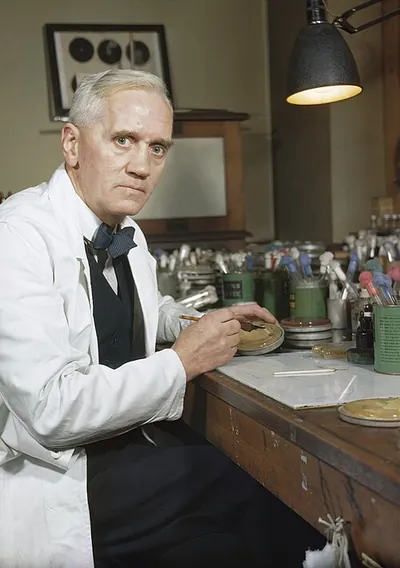 Alexander Fleming1881–1955 · Biology
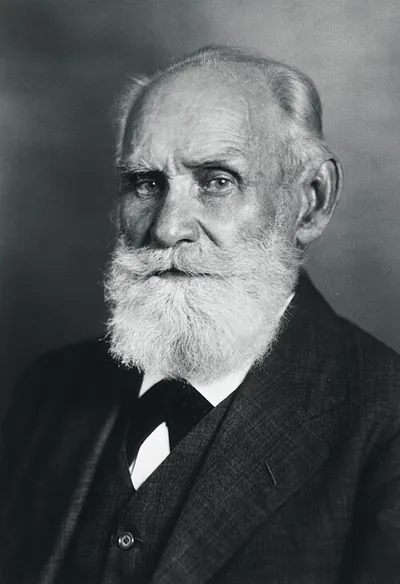 Ivan Pavlov1849–1936 · Biology
 Élie Metchnikoff1845–1916 · Biology
