
Eli Yablonovitch
American physicist and engineer, pioneer of photonic crystals · 1946
- Born
- December 15, 1946
- Country
- United States
- Section
- Physics
Biography
Eli Yablonovitch is an American physicist and engineer, born on 15 December 1946, best known for founding, together with Sajeev John in 1987, the field of photonic crystals. His work has shaped how light is controlled in electronic devices, and it has found practical use in solar cells and lasers, so its reach extends well beyond the laboratory.
Yablonovitch trained in Canada and the United States. He earned a bachelor's degree in physics at McGill University in 1967, then moved to Harvard University, where he took a master's in applied physics in 1969 and a doctorate in 1972. During those years he studied nonlinear optics with carbon dioxide lasers, a field in which the properties of light change as its intensity grows inside a material. After his doctorate he worked at Bell Laboratories, and in 1974 he became a professor of applied physics at Harvard.
In 1979 he joined the Exxon research center to work on photovoltaics, the technology that turns sunlight into electricity. There he derived a theoretical ceiling for light trapping in solar cells, a factor of 4 times the square of the refractive index. Put simply, this is the maximum amount of light a material can hold inside itself to produce current, and the result is now used in almost all solar panels worldwide. He was also the first to notice that a strained quantum-well laser needs a much lower threshold current than an unstrained one. A quantum well is a very thin layer of semiconductor that confines electrons, and the threshold current is the minimum needed for a laser to emit strongly; this improvement is now standard in semiconductor lasers.
In 1984 he joined Bell Communications Research, becoming director of solid-state physics research in 1991. It was there that he carried out his pioneering work on photonic crystals, periodic structures that, much like crystals in ordinary matter, block light of certain frequencies from travelling through them. With his team he built the first three-dimensional structure with a full photonic bandgap, meaning a range of frequencies that cannot pass through it in any direction. The material was named yablonovite. His paper on inhibited spontaneous emission in these crystals is counted among the most cited papers in physics and engineering.
His career continued at UCLA, where he became a professor of electrical engineering and kept developing photonic crystals and photonic bandgap materials. In July 2007 he joined the electrical engineering and computer sciences department at UC Berkeley. His current interests include silicon photonics, telecommunications, optical antennas, new uses of photovoltaics, and the search for a low-voltage replacement for the transistor. He has also explored analog computing as a way to tackle hard problems such as the travelling salesman problem.
Yablonovitch has co-founded several companies linked to his interests. In 2000 he co-founded Ethertronics, a maker of mobile phone antennas. In 2001 he co-founded Luxtera, which builds electro-optical systems using silicon photonics made in CMOS processes, the standard technology behind integrated circuits. In 2002 he founded Luminescent, which supplied mathematical optimization for photolithography masks and was acquired by Synopsys in 2012. In 2008 he founded Alta Devices, which makes thin-film gallium arsenide solar cells and holds efficiency records for single and dual junction cells.
His legacy spans solid-state physics, photonics and solar energy. He has received honours such as the Adolph Lomb Medal, the Harvey Prize, the Isaac Newton Medal from the Institute of Physics and the Oliver E. Buckley Prize, and he is a member of bodies such as the US National Academy of Sciences and, as a foreign member, the Royal Society of London.
Main contributions
- 1979Theoretical limit for light trapping in photovoltaics, a factor of 4 times the refractive index squared, now used in almost all solar panels.
- 1987Founding of the photonic crystal field, with Sajeev John: periodic structures that control how light propagates.
- 1987Yablonovite: the first three-dimensional structure with a full photonic bandgap, blocking light of certain frequencies in every direction.
- 2000Co-founding of Ethertronics, a maker of mobile phone antennas.
- 2001Co-founding of Luxtera, a pioneer of silicon photonics made in CMOS processes.
- 2008Founding of Alta Devices, which makes thin-film gallium arsenide solar cells with efficiency records.
- Strained quantum-well laser with a markedly lower threshold current, now used in most semiconductor lasers.
Teachers and students
Trivia and anecdotes
A material named after him
The three-dimensional structure with a full bandgap bears his name: yablonovite.
Solar records
Alta Devices cells reach 29.1% efficiency in single junction and 31.6% in dual junction, measured at one sun.
Their contemporaries
While Eli Yablonovitch was alive (1946–)…
Alive at the same time
Discovered or invented in those years
- 1947TransistorA semiconductor component that amplifies or switches electrical current between two terminals, depending on a signal applied to a third.
- 1957Artificial satelliteAn artificial satellite is a human-made object placed in orbit around a celestial body, usually Earth, to collect information, relay signals, or carry out a specific task.
- 1969InternetA global network of interconnected computer networks that communicate using the TCP/IP protocol suite.
- 1971EmailA network service that lets users send and receive digital messages through addressed mailboxes, much like postal mail but electronic.
- 1973Mobile phoneA handheld wireless phone that lets people make and receive calls while moving across a cellular network area.
- 1989World Wide WebA system of linked documents and resources, connected by hyperlinks and accessed over the Internet with web browsers.
 Stephen Hawking1942–2018 · Physics
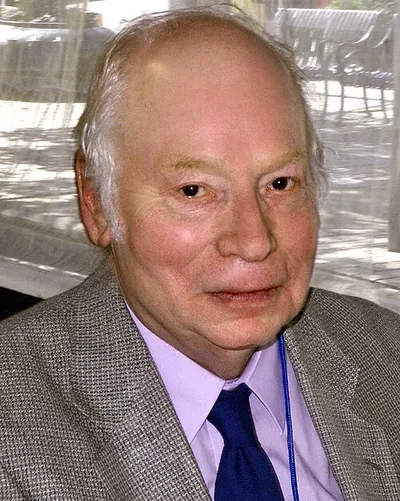 Steven Weinberg1933–2021 · Physics
 Donna Strickland1959 · Physics
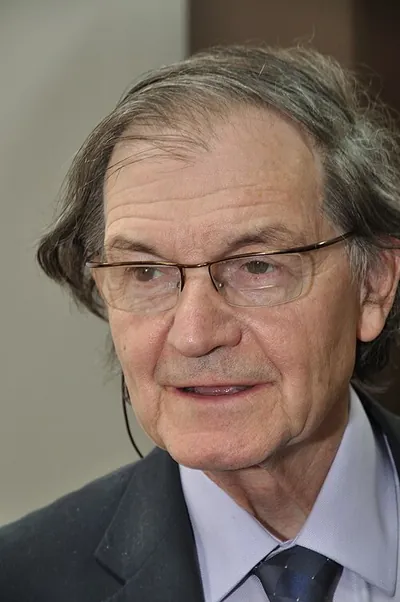 Roger Penrose1931 · Physics
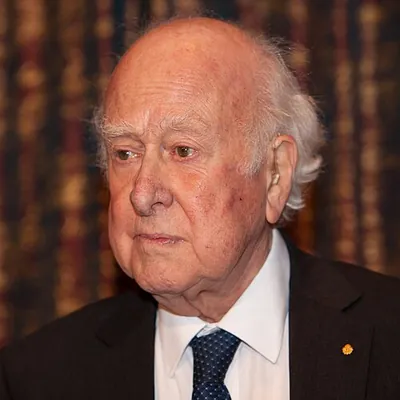 Peter Higgs1929–2024 · Physics
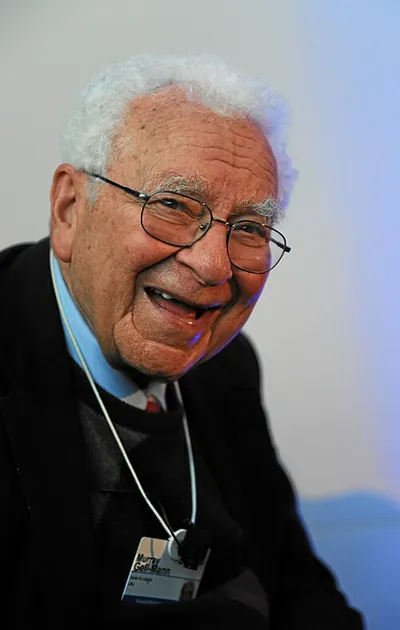 Murray Gell-Mann1929–2019 · Physics
