
Émile Baudot
French telegraph engineer, inventor of the Baudot code and of a system that sent several messages over one line · 1845–1903
- Born
- September 11, 1845
- Died
- March 28, 1903
- Country
- France
- Section
- Technology and communications
Biography
Émile Baudot (Magneux, 1845 - Sceaux, 1903) was a French telegraph engineer who devised a way to send several messages at once over a single line, along with a five-element code that became the basis of teleprinter communication for much of the twentieth century. He worked at a time when electrical telegraphy was spreading across Europe and administrations wanted cheaper ways to use each wire. His importance lies in giving long-distance communication an early digital form, and his name survives in the baud, the unit used to measure transmission speed.
He was born in Magneux, in the Haute-Marne region, the son of the farmer Pierre Émile Baudot, who later became mayor of the village. His formal schooling ended with primary school, and for years he worked on his family's farm. In 1869 he joined the French Post and Telegraph Administration as an apprentice operator. There he learned Morse telegraphy and, during a four-month course, the printing system devised by Hughes, which later inspired his own work. After brief service in the Franco-Prussian War, he returned to civilian duties in Paris in 1872. Alongside his job, he taught himself mechanics and electricity, skills that helped him understand the equipment he operated every day.
Baudot's central idea started from a simple observation. With most printing telegraphs of the period, the line sat idle for most of the time, since it was only in use for the brief moments when a character was sent. To exploit those gaps, he designed a system of time-division multiplexing, in which the line is split into very short turns so that several messages travel interleaved, each receiving its own slot. For this to work, the switches at both ends had to turn in perfect step, and Baudot kept them synchronised with clockwork mechanisms. With this method he could transmit five messages simultaneously, and the French administration adopted the system officially soon afterwards.
His other major contribution was the code. He devised it in 1870 and patented it in 1874. Each character is represented by five pulses of current, which can be positive or negative, giving 32 possible combinations. That was enough for the Roman alphabet, punctuation and a few control signals. Baudot built on existing work: the printing mechanism of Hughes, a distributor invented by Bernard Meyer in 1871, and a five-unit code linked to Carl Friedrich Gauss and Wilhelm Weber. His achievement lay in combining these pieces with his own ideas into a complete system.
The apparatus had three main parts: a keyboard with five piano-style keys, a metal distributor divided into sectors and swept by contacts, and a receiver that printed letters on a paper tape. Each operator had one sector assigned and could only press keys when the distributor reached it. An audible click signalled when the keys were free again. The method demanded a steady rhythm and reached about thirty words per minute. Baudot patented his first printing telegraph on 17 June 1874. The French administration accepted it in 1875, and the first live tests between Paris and Bordeaux took place on 12 November 1877. At the end of that year, the Paris-Rome line began working in duplex mode with his system. In 1878 the apparatus was shown at the Paris Universal Exhibition, where it won the gold medal and brought his work to worldwide attention.
After this success he was promoted to controller in 1880 and to inspector-engineer in 1882. In 1887 he carried out tests on an Atlantic telegraph cable, and in 1890 he linked Paris, Vannes and Lorient over a single wire. In 1894 he installed a triplex system between Paris and Bordeaux, a route that had been running with difficulty on the Hughes apparatus, and that same year he connected the Paris and Milan stock exchanges over one wire using a new retransmitter. In 1897 the system switched to punched tape, prepared offline and read by a mechanical reader, with a sixth row of smaller holes to pull the tape through. His code later became the basis of International Telegraph Alphabet Number One. The French administration gave him little help, and Baudot often paid for his research himself. In 1880 he even sold the gold medal he had received in 1878.
The system spread first through France and then abroad. Italy introduced it for domestic service in 1887, the Netherlands in 1895, Switzerland in 1896, Austria and Brazil in 1897, and Germany in 1900. The British Post Office used it from 1897 and 1898, and it was later adopted in Russia, Spain, Belgium, Argentina and Romania.
Baudot also faced a legal dispute. In 1874 the telegraph operator Louis Victor Mimault patented a system using five separate lines. After his own patent was rejected, Mimault modified his design and filed again, but without success. When Baudot's prototype was patented a few weeks earlier, Mimault claimed priority and sued him in 1877. The Paris civil tribunal ruled in Mimault's favour on the priority of the code and held that Baudot's patents were improvements on his. However, the judgment was eventually set aside, and Mimault was ordered to pay the costs. Badly affected by the outcome, Mimault fired at two students of the École Polytechnique, charges that were later dropped, and then, after a commission led by Jules Raynaud rejected his demands, he shot and killed Raynaud. He was sentenced to ten years of forced labour and twenty years of exile.
In his private life, Baudot married Marie Josephine Adelaide Langrognet on 15 January 1890, but she died three months later. From the start of his telegraph career he suffered physical discomfort that kept him away from work, once for as long as a month, and this condition stayed with him until he died at Sceaux, near Paris, on 28 March 1903, at the age of 57.
His legacy takes two forms. He received honours such as the Legion of Honour, becoming an officer in 1898. His name also entered technical language. In 1926 an international advisory committee meeting in Berlin adopted the baud, derived from his surname, as the unit for the number of symbols transmitted per second. In 1949 the French Post Office issued a stamp in his honour that gave the wrong year of birth. His code and his idea of sharing a single line among several messages remain part of digital data transmission.
Main contributions
- 1870Baudot code: five current pulses per character, giving 32 possible combinations for letters, signs and control orders.
- 1874Printing telegraph: a machine with a five-key keyboard and a sector distributor that printed messages on paper tape, patented on 17 June.
- 1874Time-division multiplexing: sharing one line in very short turns so several messages could travel at once.
- 1877First online tests between Paris and Bordeaux on 12 November, which led to a duplex service with Rome.
- 1897Punched-tape version, prepared offline and read by a mechanical reader, which replaced the manual keyboard.
Trivia and anecdotes
A stamp with the wrong year
In 1949 the French Post Office issued a stamp with his portrait but gave 1848 as his birth year. It was corrected and reprinted, and the faulty stamps are now much sought after by philatelists.
The medal that was sold
Baudot often paid for his research himself and, in 1880, sold the gold medal he had won at the 1878 Universal Exhibition.
A unit named after him
In 1926, an international committee meeting in Berlin chose the baud, derived from his surname, to measure telegraph transmission speed.
Related discoveries and inventions
- 1870Baudot codeA five-signal telegraph code devised by Émile Baudot, the direct ancestor of ITA2 used by teleprinters for decades.
Their contemporaries
While Émile Baudot was alive (1845–1903)…
Alive at the same time
Discovered or invented in those years
- 1846NeptuneThe eighth and most distant planet of the Solar System, an ice giant found through mathematical prediction before any direct sighting.
- 1859EvolutionThe process by which the heritable traits of living populations change over generations, explaining the diversity of life from common ancestors.
- 1869Periodic tableAn arrangement of the chemical elements into rows (periods) and columns (groups), ordered by atomic number, that reveals recurring chemical behaviour and lets scientists predict properties.
- 1876TelephoneA device that carries the human voice over distance by turning sound into electrical signals and back into sound at the other end of the line.
- 1884CarA road vehicle with four wheels and its own engine, mainly built to carry people.
- 1903AirplaneA fixed-wing aircraft, heavier than air, powered by engines or rockets, that stays aloft because its wings generate lift.
 Thomas Edison1847–1931 · Technology and communications
 Alexander Graham Bell1847–1922 · Technology and communications
 John Ambrose Fleming1849–1945 · Technology and communications
 Karl Ferdinand Braun1850–1918 · Technology and communications
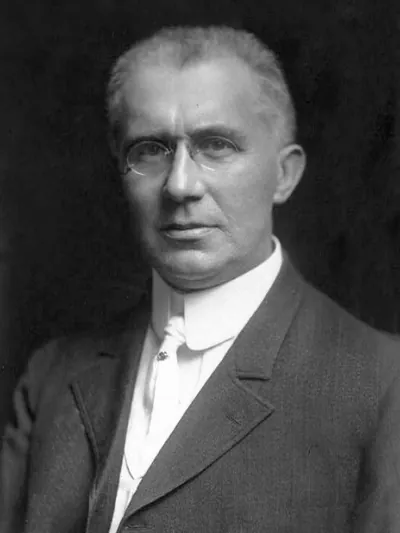 Emile Berliner1851–1929 · Technology and communications
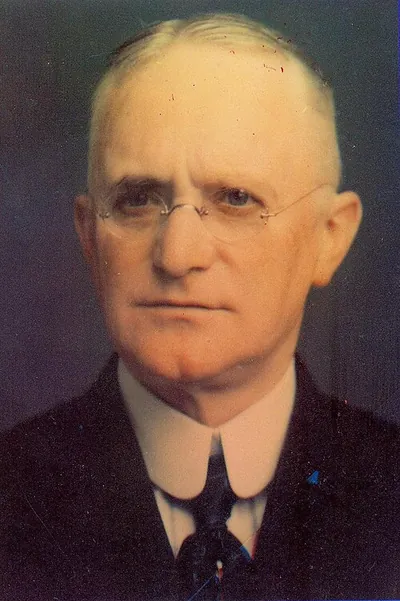 George Eastman1854–1932 · Technology and communications
