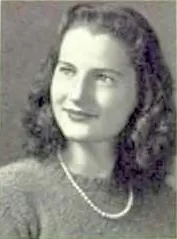
Erna Schneider Hoover
American engineer and inventor, a pioneer of software patents and electronic telephone switching · 1926
- Born
- June 19, 1926
- Country
- United States
- Section
- Computing
Biography
Erna Schneider Hoover (born in Irvington, New Jersey, in 1926) is an American engineer and inventor whose work at Bell Labs helped lay the foundations of computer-controlled telephone switching. She is one of the first women to register software patents, in a field then dominated by men.
She was born on June 19, 1926, and grew up in South Orange, also in New Jersey. Her father was a dentist and her mother a teacher. She had a younger brother who died of polio at the age of five. She loved swimming, sailing and canoeing, and developed an interest in science at an early age. According to one account, reading the biography of Marie Curie convinced her that she could succeed in science despite the prevailing views on gender roles.
She studied philosophy and classical and medieval history at Wellesley College, graduating in 1948 with honors. She was admitted to the honor society Phi Beta Kappa and named a Durant Scholar. In 1951 she earned a PhD in philosophy and the foundations of mathematics at Yale University, at a time when very few women earned doctorates in that subject.
She began her career teaching philosophy and logic at Swarthmore College in 1951, but she could not secure a tenure-track post, a outcome she linked to her gender and marital status. In 1953 she married Charles Wilson Hoover, a physicist at Bell Telephone Laboratories, who strongly supported her work. In 1954 she left teaching and joined Bell Labs in Holmdel as a senior technical associate. She was promoted in 1956, after an internal training program that one source describes as the equivalent of a master's degree in computer science.
At the time, telephone exchanges were moving from electromechanical equipment to electronic and computer-based systems. The trouble was that when thousands of calls arrived within moments, the relays jammed and the whole system could freeze. Hoover drew on her training in symbolic logic and feedback theory, the study of how a system can correct itself using information about its own behaviour. She designed control mechanisms that used data on incoming calls and gave priority to the core tasks of input and output over less urgent ones such as billing. The exchange could then adjust the rate at which it accepted calls in real time. The approach, known as stored program control, combined transistor circuits with programs held in memory.
According to several accounts, the idea came to her while she was recovering in hospital after the birth of her second daughter. Bell Labs lawyers later visited her at home during her maternity leave so she could sign the patent papers. The system was presented in 1965 as the Number One Electronic Switching System, or 1ESS, which the company described as its most ambitious project. It was built in New Jersey by Western Electric, one of the companies that founded Bell Labs.
US patent number 3,623,007, filed in 1967 and granted in 1971, names her together with Barry J. Eckhart, a colleague from a Canadian telephone company. A Canadian patent granted in 1970 covered the same invention. Both are counted among the earliest patents ever to protect software. In the 1970s, Bell Labs asked her to oversee the radar control programs of the Safeguard anti-ballistic missile system.
In 1987 she became the first woman to head a technical department at the company, which worked on artificial intelligence, large databases and software for telephone networks. That same year she retired after more than thirty years at Bell Labs. She then devoted herself to promoting education at every level and to highlighting the shortage of women scientists among university teachers. Her former college, Wellesley, honored her in 1990, and in 2008 she was inducted into the National Inventors Hall of Fame.
Her legacy persists in today's communication networks. The principles of automated switching she developed are still used in telecommunications equipment in the 21st century, and her approach to overload control is part of the foundation of services we use every day.
Main contributions
- 1965Number One Electronic Switching System (1ESS): an electronic telephone exchange run by stored programs, presented by Bell Labs as its most ambitious project.
- 1970Canadian patent No. 843,031: protects the same call-control invention, filed under Western Electric with its inventors named.
- 1971US patent No. 3,623,007: a feedback control monitor for stored-program data processing, one of the earliest software patents.
- 1987First woman to head a technical department at Bell Labs, leading work on artificial intelligence and large databases.
Trivia and anecdotes
A decisive reading
According to one source, a biography of Marie Curie encouraged her to pursue science at a time when many doubted women could excel in it.
Patent papers at home
During her maternity leave, Bell Labs lawyers had to visit her house so she could sign the patent documents.
The hospital idea
Several accounts place the origin of her idea in hospital, while she was recovering after the birth of her second daughter.
Their contemporaries
While Erna Schneider Hoover was alive (1926–)…
Alive at the same time
Discovered or invented in those years
- 1931Big BangA cosmological model describing how the universe expanded from an early state of extreme density and temperature, about 13.8 billion years ago.
- 1932NeutronA subatomic particle with no net electric charge, found in the nucleus of almost every atom alongside protons.
- 1945ComputerA programmable machine that takes in data, processes it by following stored instructions, and produces results, able to switch tasks simply by running different software.
- 1969InternetA global network of interconnected computer networks that communicate using the TCP/IP protocol suite.
- 1973Mobile phoneA handheld wireless phone that lets people make and receive calls while moving across a cellular network area.
- 1989World Wide WebA system of linked documents and resources, connected by hyperlinks and accessed over the Internet with web browsers.
 John McCarthy1927–2011 · Computing
 Douglas Engelbart1925–2013 · Computing
 Marvin Minsky1927–2016 · Computing
 Robert Noyce1927–1990 · Computing
 Seymour Cray1925–1996 · Computing
