
Ernest Solvay
Belgian industrial chemist, philanthropist and politician, inventor of the Solvay process for making soda ash · 1838–1922
- Born
- April 16, 1838
- Died
- May 26, 1922
- Country
- Belgium
- Section
- Chemistry
Biography
Ernest Solvay (Rebecq, Belgium, 1838 – Ixelles, 1922) was a Belgian industrial chemist, philanthropist and politician. He is best known for an industrial method of producing soda ash, the Solvay process, which largely replaced the older Leblanc process and is still used in many plants today. He also funded research institutes and the physics conferences that gathered many of the leading scientists of the early twentieth century.
He was born on 16 April 1838 in Rebecq-Rognon, in the Walloon Brabant province of Belgium. A serious illness of the lungs prevented him from going to university, so he received a basic education in local schools and first worked in his father's salt business. His real industrial training began at the age of 21, when he joined his uncle's chemical factory and devised several methods for purifying gases.
His central problem was soda ash, a compound needed for making glass, soap and many other goods. The Leblanc method then in use was expensive and polluting. Solvay's approach passed ammonia and carbon dioxide through a concentrated brine solution inside a tall tower, producing sodium bicarbonate, which was then heated to yield soda ash. He took out his first patent on soda production in 1861, working alongside his brother Alfred according to some accounts. In 1863 he built his first factory at Couillet and refined the method until he patented it in 1872. By about 1900, roughly 95 per cent of the world's soda output came from this process, and around 70 of its plants are still running.
The wealth from his business let him devote much of his fortune to philanthropy. He founded international research institutes in physiology (1893), sociology (linked to the Free University of Brussels, 1902), physics (1912) and chemistry (1913). In 1911 he launched a series of physics conferences that brought together Albert Einstein, Ernest Rutherford, Max Planck and Marie Curie, and later gatherings included Niels Bohr and Werner Heisenberg. The fifth, held in Brussels in 1927, is generally regarded as the most important. These meetings helped shape the development of quantum mechanics and the modern picture of the atom.
Solvay was also active in social reform. His companies introduced a worker pension from 1899, an eight-hour working day from 1908 and paid holidays from 1913, measures that were unusual for the time. A committed Liberal, he was twice elected to the Belgian Senate and in 1918 was granted the honorary title of Minister of State. He died in Ixelles on 26 May 1922.
His legacy joins industrial chemistry, basic science and social policy. The process bearing his name remained central to the global chemical industry for nearly a century, and the Solvay Conferences are still remembered as a landmark of theoretical physics.
Main contributions
- 1861First patent for soda production, the basis of his process.
- 1872Definitive patent for the Solvay process of making soda ash from ammonia and common salt.
- 1893Founding of the International Institute of Physiology.
- 1911First Solvay Conference in physics, bringing together the leading physicists of the day.
- 1927Fifth Solvay Conference, held in Brussels and considered the most important of the series.
Trivia and anecdotes
Fragile health
Acute pleurisy kept him from university, so he trained largely on his own in the family business.
A name on the map
Solvay, New York, and Rosignano Solvay, Italy, are named after the first plants using the process in those countries.
Their contemporaries
While Ernest Solvay was alive (1838–1922)…
Alive at the same time
Discovered or invented in those years
- 1846NeptuneThe eighth and most distant planet of the Solar System, an ice giant found through mathematical prediction before any direct sighting.
- 1859EvolutionThe process by which the heritable traits of living populations change over generations, explaining the diversity of life from common ancestors.
- 1869Periodic tableAn arrangement of the chemical elements into rows (periods) and columns (groups), ordered by atomic number, that reveals recurring chemical behaviour and lets scientists predict properties.
- 1876TelephoneA device that carries the human voice over distance by turning sound into electrical signals and back into sound at the other end of the line.
- 1884CarA road vehicle with four wheels and its own engine, mainly built to carry people.
- 1903AirplaneA fixed-wing aircraft, heavier than air, powered by engines or rockets, that stays aloft because its wings generate lift.
 James Crafts1839–1917 · Chemistry
 Adolf von Baeyer1835–1917 · Chemistry
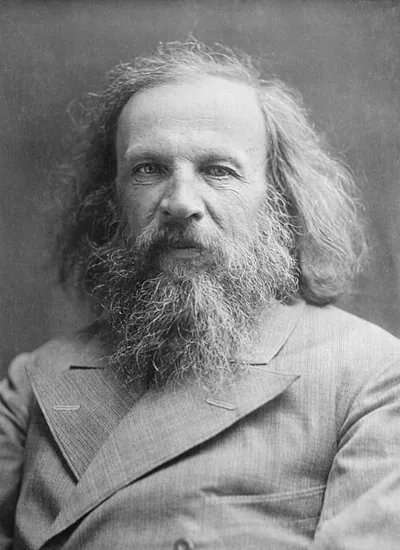 Dmitri Mendeleev1834–1907 · Chemistry
 Alfred Nobel1833–1896 · Chemistry
 August Kekulé1829–1896 · Chemistry
 Stanislao Cannizzaro1826–1910 · Chemistry
