
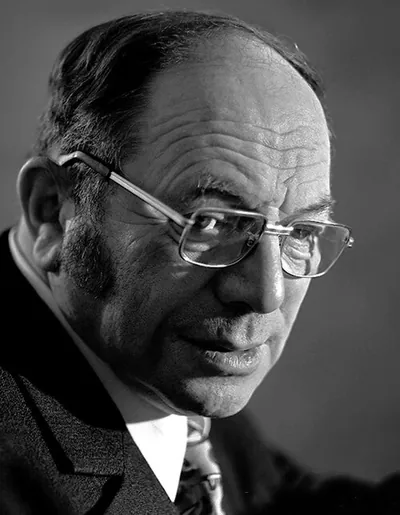
Eugene Dynkin
Soviet and American mathematician, pioneer of Lie group theory and Markov processes · 1924–2014
- Born
- May 11, 1924
- Died
- November 14, 2014
- Country
- United States, Soviet Union
- Section
- Mathematics
Biography
Eugene Borisovich Dynkin (Leningrad, 11 May 1924 – Ithaca, New York, 14 November 2014) was a Soviet and American mathematician who worked in two very different areas: algebra, especially the theory of Lie groups and Lie algebras, which describe continuous symmetries, and probability theory, above all Markov processes, systems in which the future depends only on the present state. His name is attached to the Dynkin diagram, the Dynkin system and Dynkin's lemma, and he is considered one of the founders of the modern theory of Markov processes.
Dynkin was born into a Jewish family. His family lived in Leningrad until 1935, when they were exiled to Kazakhstan. Two years later, when he was 13, his father disappeared into the Gulag, the Soviet system of forced labour camps. At 16, in 1940, he entered Moscow University. Poor eyesight kept him out of military service during the Second World War, and he received his master's degree in 1945 and his doctorate in 1948. His Jewish origin and his father's fate made his career difficult. He was an assistant professor in Moscow, but was not given a chair until 1954, because of his political standing. His doctoral supervisor, Andrey Kolmogorov, made special efforts to help him move up into a teaching post.
As a student he attended Israel Gelfand's seminar on Lie groups. In 1944 Gelfand asked him to prepare a survey of the structure and classification of semisimple Lie groups, based on papers by Hermann Weyl and Bartel Leendert van der Waerden. Dynkin found these papers hard going and, to understand them better, he introduced the idea of a simple root within a root system, a minimal set of vectors from which all the others can be built. He drew the angles between these roots as a diagram, now called a Dynkin diagram, which gave a much cleaner account of the classification of complex semisimple Lie algebras. His first publication, from 1945 and written with N. A. Dmitriev, solved a problem about eigenvalues of stochastic matrices that had been raised in Kolmogorov's seminar on Markov chains. So even his algebraic period, roughly 1944 to 1954, carried a probabilistic thread. His 1952 paper on semisimple subalgebras, with large tables, studied the subalgebras of the exceptional Lie algebras.
In the 1950s his work moved toward probability. The results of his Moscow seminar were gathered into two books, the first of which, "Theory of Markov Processes", appeared in 1959 and laid the foundations of the field. In 1962 he was to give a talk at the International Congress of Mathematicians in Stockholm, but since he was not allowed to travel to the West, Kolmogorov delivered it instead.
In 1968 he was forced to move from Moscow University to the Central Economic Mathematical Institute of the USSR Academy of Sciences, where he worked on economic growth and economic equilibrium. He stayed there until 1976, when he emigrated to the United States. In 1977 he became a professor at Cornell University. He was an atheist. He died in a hospital in Ithaca at the age of 90.
His legacy is twofold. In algebra, the diagram that bears his name remains a basic tool for classifying symmetrical structures, and in probability his work on Markov processes underpins much of the field. He received many honours, including the American Mathematical Society's Leroy P. Steele Prize for Total Mathematical Work in 1993, and membership of the US National Academy of Sciences in 1985.
Main contributions
- 1945First publication, with N. A. Dmitriev: solved a problem on eigenvalues of stochastic matrices, a question tied to Markov chains.
- 1947Paper "Structure of semisimple Lie algebras", covering his work on the classification of these algebras.
- 1947Dynkin diagram: a graphical representation of the angles between simple roots, used to classify complex semisimple Lie algebras.
- 1952Paper "Semisimple subalgebras of semisimple Lie algebras", with extensive tables on subalgebras of the exceptional Lie algebras.
- 1959Book "Theory of Markov Processes", which laid the foundations of the field.
Teachers and students
Studied under:
Taught:
Trivia and anecdotes
A lecture given by someone else
Dynkin was due to give a one-hour talk at the 1962 International Congress of Mathematicians in Stockholm, but as he was not allowed to travel to the West, Kolmogorov delivered it.
An atheist mathematician
Dynkin described himself as an atheist, a detail recorded among the personal facts of his biography.
Their contemporaries
While Eugene Dynkin was alive (1924–2014)…
Alive at the same time
Discovered or invented in those years
- 1925TelevisionA system that sends moving pictures and sound over distance and shows them on a receiver, the television set.
- 1925Quantum mechanicsPhysical theory describing how matter and light behave at atomic and subatomic scales, where energy is exchanged in minimal packets and results are expressed as probabilities.
- 1931Big BangA cosmological model describing how the universe expanded from an early state of extreme density and temperature, about 13.8 billion years ago.
- 1945ComputerA programmable machine that takes in data, processes it by following stored instructions, and produces results, able to switch tasks simply by running different software.
- 1969InternetA global network of interconnected computer networks that communicate using the TCP/IP protocol suite.
- 1989World Wide WebA system of linked documents and resources, connected by hyperlinks and accessed over the Internet with web browsers.
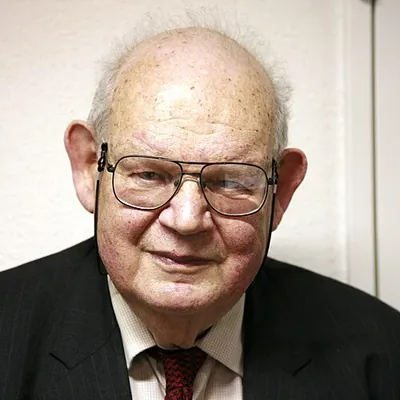 Benoit Mandelbrot1924–2010 · Mathematics
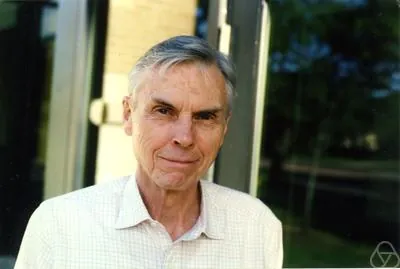 John Tate1925–2019 · Mathematics
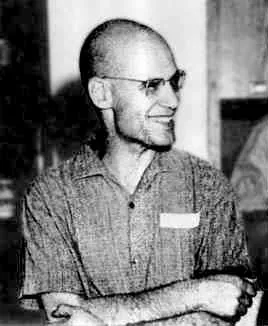 Alexander Grothendieck1928–2014 · Mathematics
 Robert Aumann1930 · Mathematics
 Paul Erdős1913–1996 · Mathematics
 Leonid Kantorovich1912–1986 · Mathematics
