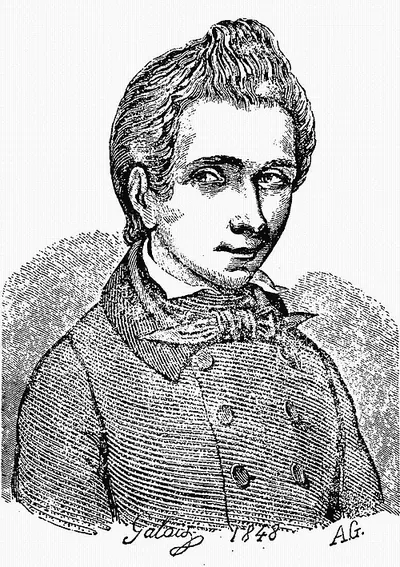
Évariste Galois
French mathematician and republican activist, creator of group theory and Galois theory · 1811–1832
- Born
- October 25, 1811
- Died
- May 31, 1832
- Country
- France
- Section
- Mathematics
Extended biography
Childhood and early years
Évariste Galois was born on 25 October 1811 in Bourg-la-Reine, a village on the outskirts of Paris. His father, Nicolas-Gabriel Galois, ran the local school and belonged to the liberal party, which looked favourably on Napoleon. He later became mayor of the village. His mother, Adélaïde-Marie, came from a family of Parisian lawyers and was a woman of considerable intellect, well able to read Latin and the classical authors.
Until the age of twelve, Évariste was taught mostly at home, largely by his mother, alongside his older sister Nathalie-Théodore. This period gave him a solid grounding in Latin, Greek and the classics. Some accounts describe him as a mathematical child prodigy, but that image is doubtful. It is unlikely that he studied mathematics in any depth at that stage, beyond elementary arithmetic, and there is no record of exceptional mathematical talent elsewhere in his family. His early precocity was above all intellectual and literary.
This distinction matters, because popular retellings of his life often bring his mathematical vocation forward in time. What does seem clear is that the boy was very clever, curious, and had a temperament that did not fit easily into school discipline. Those traits shaped everything that followed.
The Louis-le-Grand years
In 1823, aged twelve, Galois entered the Lycée Louis-le-Grand in Paris, a prestigious school whose former pupils included Robespierre and Victor Hugo. His first years there were broadly ordinary. He won some prizes in Greek and Latin and kept a reasonable record. But a rebellious streak soon appeared. He took part in a clash with the director of the boarding house, which led to several pupils being expelled, though he was not one of them. The episode left him with a lasting distrust of authority. Over time his views became openly anti-clerical and anti-monarchist, positions he kept until his death.
In his third year his rhetoric essay was failed and he had to repeat the year. That setback coincided with his discovery of mathematics, at around fifteen. The official syllabus struck him as undemanding, yet he found in it the intellectual pleasure he missed in other subjects. His teacher Vernier stirred his interest, and Galois quickly absorbed the official textbooks. He soon moved on to more advanced works, studying Legendre's geometry and Lagrange's algebra, and reading original papers by Lagrange on the solving of equations.
Algebra at the time still contained many murky areas and unsolved questions, and Galois increasingly concentrated on them. He began to neglect his other subjects, which earned him the hostility of some teachers of the humanities. Even Vernier advised him to spend more time on other disciplines. Galois, however, was clear about his goal of becoming a mathematician. In the second course, taught by Richard, he found a teacher who recognised his abilities and who supported his application to the École polytechnique.
The problem of equations
To understand what Galois achieved, some background helps. A quadratic equation, of the form x squared plus bx plus c equals zero, can be solved with a formula that combines the four basic operations with square roots. For centuries mathematicians looked for similar formulas for cubic and quartic equations, and they found them, using square roots, cube roots and other roots. Expressions of this kind are called solvable by radicals. The open question was whether a general formula of this type existed for equations of degree five and higher.
Many attempts failed. Paolo Ruffini published an argument in 1799 that such a formula was impossible, but his reasoning had gaps that he could not fully repair. In 1824 Niels Henrik Abel gave a complete proof that no general formula by radicals exists for the quintic. Galois started from that result, but he was not content simply to know that some equations resist this kind of solution. He wanted to understand why, and above all to be able to decide, for a given equation, whether it could be solved by radicals.
To do this, Galois associated each equation with a set of permutations, that is, ways of rearranging its solutions. A permutation is, in simple terms, a change of order: if the solutions are A, B and C, swapping A and B is a permutation. The collection of all rearrangements that preserve the algebraic relations among the solutions forms what is now called the Galois group of the equation. Galois showed that the crucial property is whether this group is solvable, a property of its internal structure. If the group has that structure, the equation can be solved by radicals; if not, it cannot. In this way he turned a question of calculation into a question about the shape of a group.
This approach gave rise to Galois theory, which changed the way equations are studied. What had been a search for formulas became a structural analysis of symmetries.
Groups, finite fields and continued fractions
Galois was not the first to deal with what are now called groups, but he was the first to use the word group in a sense close to today's. For that reason he is regarded as one of the founders of group theory, a central branch of abstract algebra. Put simply, a group is a collection of operations that can be combined and that obey a few basic rules. Galois studied how a group can be split into pieces called cosets, and he called a decomposition a proper decomposition when the left and right cosets coincide. That idea led to what are today called normal subgroups, parts of a group that stand in a special relationship to the whole.
Another fundamental contribution was the notion of a finite field, a set with a finite number of elements in which addition, subtraction, multiplication and division all work. These are now also called Galois fields in his honour, and their modern form is essentially the one he gave. They are standard tools in number theory and computing.
In his final letter Galois also studied linear groups over finite fields. He constructed the general linear group over a prime field and worked out its order, meaning the number of its elements. He also described a group now called the projective special linear group, PSL(2,p), and observed that it is simple, meaning it has no nontrivial normal subgroups, except when p is 2 or 3. These groups formed the second infinite family of finite simple groups known, after the alternating groups. He also noted the exceptional fact that PSL(2,p) is simple and acts on p points only when p is 5, 7 or 11.
In his first paper, published in 1828, Galois worked on continued fractions, a way of writing a number as a nested sequence of divisions. He proved that the continued fraction of certain square roots repeats from the start, and that there is a mirror-image relationship between the fractions of a number and of its conjugate. From these results one can deduce a theorem about square roots of non-square whole numbers that was already known to Lagrange.
Examinations, the Academy and politics
In 1828 Galois sat the entrance examination for the École polytechnique, France's most prestigious school for mathematics, a year earlier than usual. He had not followed the customary preparation and was rejected, partly because he did not justify his oral answers well enough. He then entered the École normale, a less prestigious institution at that time, where he found some sympathetic professors. The following year his first paper appeared in print.
Around the same period he began his most important work on polynomial equations and submitted two papers to the Academy of Sciences. Augustin-Louis Cauchy, one of the leading mathematicians of the day, was asked to referee them. Cauchy did not accept them for publication, for reasons that are still not entirely clear. Accounts suggest he advised merging the two texts into one for the Academy's Grand Prize in mathematics. Galois, who found it hard to accept criticism from examiners, grew increasingly frustrated.
On 28 July 1829 his father took his own life after a bitter political quarrel with the village priest. A few days later Galois made his second and final attempt at the Polytechnique and was rejected again. Accounts differ on the reasons. The most plausible explanation is that the examiners could not follow his logical leaps, and that Galois refused to spell them out, which made matters worse. His father's death may also have affected his behaviour. After this failure he took the baccalaureate examinations and entered the École normale.
In February 1830 he sent his memoir again to the Academy, this time to Joseph Fourier, its permanent secretary, for consideration for the Grand Prize. Fourier died soon afterwards and the manuscript was lost. The prize that year went to Abel, who had died, and to Jacobi. Galois regarded the affair as a sham designed to discredit him. Nevertheless, that same year he published three papers in the Bulletin of Férussac, one of which laid the foundations of what became Galois theory.
Politically, the atmosphere grew explosive. In July 1830 a revolution drove Charles X from the throne and brought Louis Philippe to power, an outcome that disappointed republicans, Galois among them. He took part in demonstrations and republican societies, and after a furious letter against his director he was expelled from the École normale. He then joined the republican artillery unit of the National Guard. In May 1831, at a banquet in honour of officers who had been acquitted, he raised a glass with a dagger above it and proposed a toast to Louis Philippe. Those present read it as a threat and he was arrested. Acquitted after a trial, he was arrested again in July after appearing armed at a protest in the uniform of a disbanded unit, and he was sentenced to six months in prison.
Meanwhile he had submitted his work on equation theory to Poisson. Poisson's report described it as incomprehensible, saying that the argument was neither clear nor developed enough to judge its rigour. The report did, however, end by encouraging the author to publish the whole of his work so that a definite opinion could be formed. Galois received the rejection letter in prison and reacted with anger. He decided to publish privately, through his friend Auguste Chevalier, rather than through the Academy.
Prison, the duel and the final night
Galois was released from prison on 29 April 1832. He kept working on mathematics during his last months, although his days were dominated by politics and by a confused personal situation. Soon afterwards he was caught up in a pistol duel. The exact motives are not known, and this is one of the most debated aspects of his biography.
What is known is that five days before his death he wrote a letter to Chevalier that clearly refers to a love affair that had ended badly. Studies of the surviving documents suggest the woman concerned may have been Stéphanie-Félicie Poterin du Motel, the daughter of the doctor at the boarding house where Galois lodged. Fragments of her letters, copied out by Galois with parts erased, suggest she had confided troubles to him, and he may have provoked the duel on her behalf. Other letters he wrote the night before he died seem to support this idea, though they do not settle it. He wrote that he was the victim of an infamous flirt and her two dupes.
The identity of his opponent is also uncertain. Alexandre Dumas named one of the acquitted artillery officers, but his testimony is the only support for that claim. Other suggestions point to a republican friend, Ernest Duchatelet, who had been imprisoned alongside Galois, but there is no conclusive evidence. It is possible that the identity of the man who shot him has been lost to history.
On the night before the duel Galois stayed awake writing to his republican friends. He also wrote the famous letter to Chevalier summarising his ideas and attached several manuscripts. He was convinced he would die. The image of a Galois who poured all his mathematics onto paper in a single night has been exaggerated. In those papers he sketched work in analysis, annotated copies of his manuscripts and left ideas that needed much more development.
Early on 30 May 1832 he was shot in the abdomen. His opponents and seconds left him, and a passing farmer found him and alerted help. He died the next morning at ten o'clock in the Cochin hospital, probably of peritonitis, after refusing to see a priest. He was twenty. To his younger brother Alfred, who was with him at the end, he said not to cry, because he needed all his courage to die at that age. He was buried on 2 June in a common grave in the Montparnasse cemetery, whose exact location is unknown. A cenotaph in his honour was later erected in his home village.
His funeral ended in disturbances. Some republicans had planned an uprising around the event, but it was postponed and did not take place until 5 June.
Posthumous publication and legacy
After Galois's death his manuscripts remained with friends and relatives and were not widely circulated. Joseph Liouville began studying them in 1842 and publicly recognised their value in 1843. He declared that the young man had solved Abel's problem by other means, means that amounted to a real change in how mathematics was done. It is not known for certain what led Liouville to look at the papers at that moment, nor why about ten years passed between Galois's death and their reading. Some historians suggest that the political climate in France after 1832, and the memory of Galois's republican activity, may have contributed to the delay. The manuscript was finally printed in the Journal de Mathématiques Pures et Appliquées in 1846.
Galois's influence reaches far beyond fifth-degree equations. Galois theory is now the standard method for deciding whether a polynomial equation can be solved by radicals. Group theory and the theory of finite fields are basic tools of modern algebra, and their language appears in cryptography, particle physics and coding theory. Some communication systems also rely on these mathematics. Certain forms of CDMA modulation, used in mobile telephony and in satellite navigation systems such as GPS and GLONASS, draw on mathematical foundations that include Galois theory among their roots.
He is often compared with Niels Henrik Abel. Both died very young, and their work overlapped considerably. Abel proved in 1824 that no general formula by radicals exists for the quintic, while Galois provided a method that explained each individual case. That difference in approach helps explain the lasting influence of Galois on later algebra.
His name is kept alive in several places. In Argentina the Day of the Mathematician is celebrated on 31 May, the date of his death, in his memory. A lunar crater also bears his name, and the finite fields he studied are known today as Galois fields.
His life, marked by rebellion, expulsions, prison and a fatal duel, has fed for generations a romantic image of the misunderstood genius. Historians of science now tend to separate that legend from the documented facts: a very capable young man with a difficult temperament, who lived through a turbulent period and left ideas whose depth took years to be recognised.
Quotes
“Preserve my memory, since fate has not given me life enough for the country to know my name.”
“My heart has revolted against my head.”
“an author never does more damage to his readers than when he hides a difficulty.”
“Don't cry, Alfred! I need all my courage to die at twenty.”
“[This] science is the work of the human mind, which is destined rather to study than to know, to seek the truth rather than to find it.”
Main contributions
- 1829First published paper: he proved a theorem on periodic continued fractions, infinite expansions of numbers in which a block of terms repeats forever.
- 1830Galois theory: a way of linking the solvability of a polynomial equation to the structure of a group of permutations formed by its roots.
- 1830The concept of a finite field, now called a Galois field, a finite set of numbers closed under addition and multiplication.
- 1830Introduction of the word «group» in a mathematical sense close to today's, the basis of group theory.
- 1832Letter to Auguste Chevalier containing studies of linear groups over finite fields, including PSL(2,p), one of the first families of finite simple groups.
- 1846Posthumous publication of his manuscripts in the Journal de Mathématiques Pures et Appliquées, thanks to the work of Joseph Liouville.
Teachers and students
Trivia and anecdotes
Reading Legendre like a novel
He is said to have read Legendre's Éléments de géométrie at fourteen as if it were a novel and mastered them in a single reading. The story comes from biographers and is not documented directly.
A toast with a dagger
At an 1831 banquet he proposed a toast to Louis Philippe with a dagger held above his cup. Republicans took it as a threat, and his lawyer argued that the original words included a condition lost in the cheers.
A duel without a clear explanation
The reasons for the duel that ended his life remain unclear. His letters suggest a love affair, but historians still debate the identity of his opponent.
Their contemporaries
While Évariste Galois was alive (1811–1832)…
Alive at the same time
Discovered or invented in those years
- 1811MoleculeAn electrically neutral group of at least two atoms held together by chemical bonds in a defined arrangement.
- 1817LithiumA soft, silvery, highly reactive metal, the lightest of all metals, used in batteries, alloys and drugs for bipolar disorder.
- 1821ElectricityThe set of physical phenomena linked to the presence and movement of electric charge, and one of the most versatile forms of energy in modern life.
- 1824ThermodynamicsThe branch of physics that studies heat, work and temperature and their relation to energy, entropy and the properties of matter.
- 1825AluminiumA light, silvery metal, very abundant in Earth's crust, with symbol Al and atomic number 13, mainly obtained from bauxite ore.
- 1828Organic chemistryThe branch of chemistry that studies compounds built mainly from carbon, whose establishment as a discipline is often linked to Wöhler's 1828 synthesis of urea.
 Karl Weierstraß1815–1897 · Mathematics
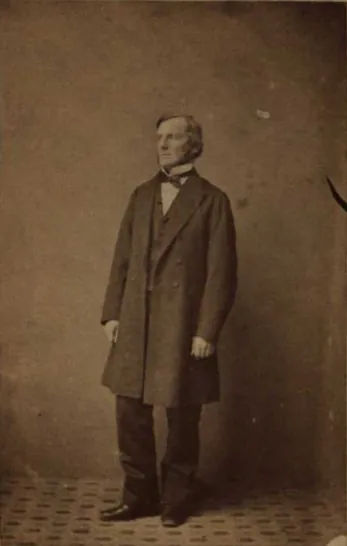 George Boole1815–1864 · Mathematics
 William Rowan Hamilton1805–1865 · Mathematics
 Johann Peter Gustav Lejeune Dirichlet1805–1859 · Mathematics
 Carl Gustav Jacob Jacobi1804–1851 · Mathematics
 Niels Henrik Abel1802–1829 · Mathematics
