
Ewine van Dishoeck
Dutch astronomer and chemist, a pioneer of astrochemistry · 1955
- Born
- June 13, 1955
- Country
- Kingdom of the Netherlands
- Section
- Astronomy and space
Biography
Ewine van Dishoeck (born Leiden, 1955) is a Dutch astronomer and chemist and one of the pioneers of astrochemistry, the study of which molecules exist between the stars and how they form. She is professor of molecular astrophysics at Leiden Observatory and served as president of the International Astronomical Union from 2018 to 2021. Her work matters because it links the chemistry of space to the raw material from which life on Earth eventually emerged.
She was born on 13 June 1955 in Leiden, the daughter of a professor of ear, nose and throat medicine. Her interest in science is usually traced to the age of twelve, when her father spent six months in San Diego, California. There she took her first science class in the local public school system, taught by an African-American woman who, as Van Dishoeck remembers, had to overcome many obstacles to reach her position. Back in the Netherlands, she decided to make chemistry her career.
She studied chemistry at Leiden University, where she discovered that physics also appealed to her. Her interest drifted towards physical chemistry and especially quantum chemistry, which describes how atoms and the bonds between them behave on a very small scale. An unexpected turn followed when the only full professor at Leiden specialising in that field died. Dutch doctoral theses must be supervised by a full professor, so she had to look for another subject. Her boyfriend at the time, Tim de Zeeuw, who was studying astronomy, told her about interstellar molecules and about the leading expert, Alex Dalgarno, at Harvard University.
Working with Dalgarno, she switched to astrochemistry in 1980 and completed her PhD on how molecules are excited and broken apart inside interstellar gas clouds. An interstellar cloud is a region of gas and dust between the stars, and excitation means that a molecule gains energy and can then emit or absorb light. She then returned to Cambridge, Massachusetts, to join Harvard's Society of Fellows as a junior fellow, and in 1984 she was still working there on the interstellar medium.
Her research covers the molecules found in space and how they change, both chemically and physically, while stars and planets form. She studies the light these molecules give off in the infrared and submillimetre ranges, and models how radiation travels through and is altered by gas, a field known as radiative transfer. One of her best-known results answers a basic question: how carbon monoxide, a key carrier of carbon in space, survives the ultraviolet light of nearby stars, which can break it apart. When she compared her models of interstellar clouds with real observations, she found that carbon monoxide is vulnerable only to the wavelengths it can absorb. Together with John Black, she also showed that dust and other molecules shield it from ultraviolet light, so that some of this carbon lasts long enough to take part in the chemistry that comes before life.
Her work has earned many prizes, among them the Gold Medal of the Royal Netherlands Chemical Society (1994), the Spinoza Prize (2000), the Bourke Award of the UK Royal Society of Chemistry (2001), the Kavli Prize in astrophysics (2018) and the Fritz Zwicky Prize (2022). Since 2001 she has been a member of the Royal Netherlands Academy of Arts and Sciences and of the United States National Academy of Sciences. In 2021 Pope Francis appointed her to the Pontifical Academy of Sciences, and the same year she received an ERC Advanced Grant to study the chemistry and physics of the disks around other stars where planets form.
She is married to Tim de Zeeuw, also a professor of astronomy at Leiden, who was Director General of the European Southern Observatory from September 2007 to 2017. Her legacy lies in showing that chemistry is a powerful tool for understanding the cosmos, and in training a generation of researchers in astrochemistry and molecular astrophysics.
Main contributions
- 1980PhD on how molecules are excited and broken apart in interstellar gas clouds, the first step of her shift towards astrochemistry.
- 2021ERC Advanced Grant to study the chemistry of planet-forming disks around stars other than the Sun.
- Models of interstellar clouds showing that carbon monoxide is vulnerable only to the ultraviolet light it can absorb.
- Work with John Black on how dust and other molecules shield carbon monoxide from ultraviolet radiation.
Teachers and students
Trivia and anecdotes
A class in San Diego
Her first science class was in San Diego, during a stay of her father's when she was twelve.
A forced change of course
The death of Leiden's only quantum chemistry professor pushed her into another field, since her thesis needed a full professor as supervisor.
Their contemporaries
While Ewine van Dishoeck was alive (1955–)…
Alive at the same time
Discovered or invented in those years
- 1957Artificial satelliteAn artificial satellite is a human-made object placed in orbit around a celestial body, usually Earth, to collect information, relay signals, or carry out a specific task.
- 1969InternetA global network of interconnected computer networks that communicate using the TCP/IP protocol suite.
- 1971EmailA network service that lets users send and receive digital messages through addressed mailboxes, much like postal mail but electronic.
- 1973Mobile phoneA handheld wireless phone that lets people make and receive calls while moving across a cellular network area.
- 1989World Wide WebA system of linked documents and resources, connected by hyperlinks and accessed over the Internet with web browsers.
- 1990Web browserA program that lets people access the web by fetching a page's files from a server and displaying them on screen as an interactive page.
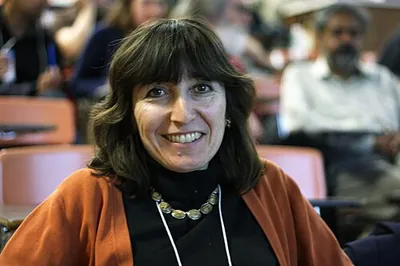 Wendy Freedman1957 · Astronomy and space
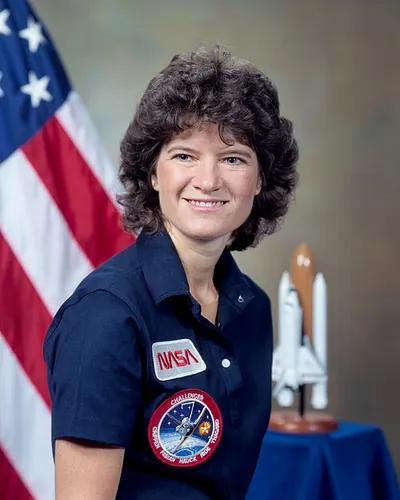 Sally Ride1951–2012 · Astronomy and space
 Saul Perlmutter1959 · Astronomy and space
 Russell A. Hulse1950 · Astronomy and space
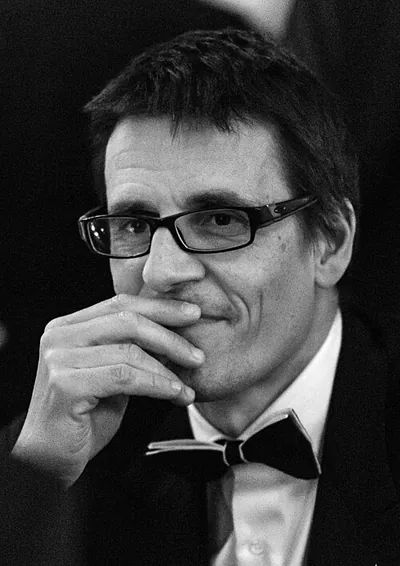 Didier Queloz1966 · Astronomy and space
 Michel Mayor1942 · Astronomy and space