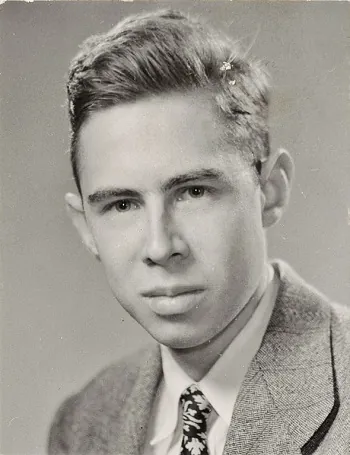
Frank Rosenblatt
American psychologist and pioneer of neural networks, creator of the perceptron · 1928–1971
- Born
- July 11, 1928
- Died
- July 11, 1971
- Country
- United States
- Section
- Computing
Biography
Frank Rosenblatt (New York, 1928-1971) was an American psychologist who spent much of his career on artificial neural networks, systems that learn from examples. His work, carried out in the 1950s and 1960s, places him among the pioneers of artificial intelligence. Some writers call him a father of deep learning, though that label is a later assessment rather than an official title.
He was born in New Rochelle, New York, into a Jewish family. His parents were Dr. Frank Rosenblatt and Katherine. He graduated in 1946 from The Bronx High School of Science, one of the city's most selective science schools, and then entered Cornell University, where he earned his bachelor's degree in 1950 and his doctorate in 1956.
For his thesis he needed to analyze psychometric data from a paid survey of more than 200 Cornell undergraduates, built around 600 items. No existing machine suited the job, so he built his own, the Electronic Profile Analyzing Computer, or EPAC. The calculations amounted to about 2.5 million arithmetic operations and also required an IBM machine. It was said that fifteen minutes of processing took just two seconds.
He then moved to the Cornell Aeronautical Laboratory in Buffalo, where he rose from research psychologist to senior psychologist and head of the cognitive systems section. There he developed the perceptron. A perceptron is a simple model of an artificial neuron. It receives signals, multiplies each by a number called a weight, and decides whether to fire. By combining several units and adjusting their weights after each success or error, the system learns to sort inputs into categories. The idea drew loosely on how brain cells work, though in a heavily simplified form.
His best-known achievement was the Mark I Perceptron, whose hardware was completed in 1960. It is generally regarded as the first machine that could learn new skills by trial and error using a neural network. It could recognize letters and solve fairly complex problems. It is now held by the Smithsonian Institution in Washington. The press of the time, including The New York Times, presented it as a revolution.
Between 1961 and 1967 he helped build Tobermory, a larger machine aimed at speech recognition. It filled an entire room and was a four-layer network with 12,000 weights. By the time it was finished, however, simulations on digital computers had become faster than purpose-built perceptron hardware.
His 1962 book, Principles of Neurodynamics, gathered his results. In it he proved several theorems, including one stating that an elementary perceptron can solve any classification problem when the training data contain no contradictions. He worked with colleagues, especially H. D. Block.
In 1969 Marvin Minsky and Seymour Papert published Perceptrons, which studied restricted versions of the model and showed real limits on certain tasks. The book was often cited as proof that perceptrons were limited in general, a conclusion its results did not support. Enthusiasm for neural networks faded for years, until the 1980s, when the field revived and many researchers returned to Rosenblatt's ideas.
From 1963 he turned to memory, and around 1966 he became absorbed in transferring learned behavior between rats through brain extracts, inspired by James McConnell's work on planarians. In his final years he concluded that the early reports of large effects were far too optimistic. He also had interests in astronomy and liberal politics, and worked on Eugene McCarthy's 1968 presidential campaign.
He died on July 11, 1971, his 43rd birthday, in a boating accident on Chesapeake Bay. His legacy lies in how far his perceptron ideas anticipated central concepts in today's machine learning. The Institute of Electrical and Electronics Engineers (IEEE) honors him each year with the IEEE Frank Rosenblatt Award.
Main contributions
- 1951EPAC: a computer he built to analyze the data for his thesis, used between 1951 and 1953.
- 1957First simulations of perceptrons, run on an IBM 704 computer.
- 1960Mark I Perceptron: a machine that learns new skills by trial and error using a neural network.
- 1961Tobermory: a scaled-up perceptron aimed at speech recognition, built until 1967.
- 1962Principles of Neurodynamics: a book gathering his theories and theorems on perceptrons.
Teachers and students
Trivia and anecdotes
A computer built for a thesis
He built EPAC because no suitable machine existed for analyzing his data. It was said that fifteen minutes of calculation took two seconds.
A whole room
Tobermory filled an entire room, a striking contrast with the small devices that would come decades later.
A tribute in Congress
After his death he was eulogized on the floor of the United States House of Representatives, among others by former senator Eugene McCarthy.
Related discoveries and inventions
- 1958PerceptronA simple mathematical model of an artificial neuron that learns to separate two classes of data by drawing a linear boundary.
- 1986Multilayer perceptronA multilayer neural network of connected neurons that can solve non-linear problems, trained by backpropagating errors.
Their contemporaries
While Frank Rosenblatt was alive (1928–1971)…
Alive at the same time
Discovered or invented in those years
- 1931Big BangA cosmological model describing how the universe expanded from an early state of extreme density and temperature, about 13.8 billion years ago.
- 1932NeutronA subatomic particle with no net electric charge, found in the nucleus of almost every atom alongside protons.
- 1945ComputerA programmable machine that takes in data, processes it by following stored instructions, and produces results, able to switch tasks simply by running different software.
- 1957Artificial satelliteAn artificial satellite is a human-made object placed in orbit around a celestial body, usually Earth, to collect information, relay signals, or carry out a specific task.
- 1969InternetA global network of interconnected computer networks that communicate using the TCP/IP protocol suite.
- 1971EmailA network service that lets users send and receive digital messages through addressed mailboxes, much like postal mail but electronic.
 Peter Naur1928–2016 · Computing
 Juris Hartmanis1928–2022 · Computing
 John McCarthy1927–2011 · Computing
 Marvin Minsky1927–2016 · Computing
 Robert Noyce1927–1990 · Computing
 Edsger W. Dijkstra1930–2002 · Computing
