
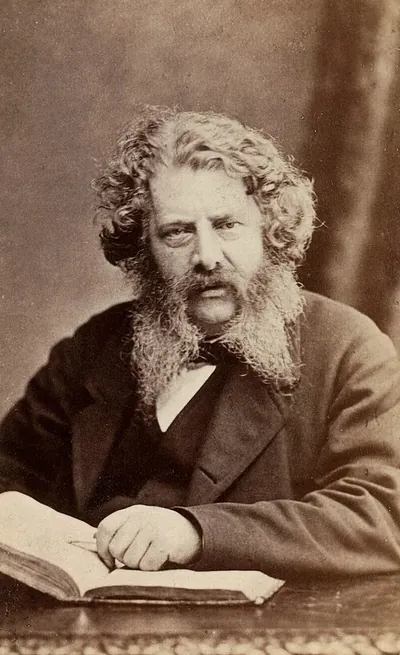
Franz Grashof
German engineer, professor of applied mechanics and namesake of the Grashof number · 1826–1893
- Born
- July 11, 1826
- Died
- October 26, 1893
- Country
- Kingdom of Prussia
- Section
- Engineering and construction
Biography
Franz Grashof (Düsseldorf, 1826 – Karlsruhe, 1893) was a German engineer who spent much of his career teaching mechanics and organising the engineering profession in nineteenth-century Germany. He is remembered today mainly for the Grashof number, a dimensionless quantity used to describe heat transfer by natural convection, and for the Grashof condition, a test applied to the motion of four-bar linkages.
Born on 11 July 1826 in Düsseldorf, he came from a family of teachers: his father, Karl Grashof, taught at an upper secondary school. He attended elementary and lower secondary school in his home city and then the industrial school in Hagen. The rise of steamships and railways drew him towards engineering, and he began work at a locksmith's workshop before continuing his training.
In October 1844 he left school to study metallurgy at the royal vocational institute in Berlin, where he took courses in mathematics, physics and mechanical engineering. From 1847 to 1848 he put his studies on hold to serve in the army as a volunteer. He hoped to become a naval officer, so he signed on as an ordinary sailor on the sailing ship Esmeralda. He sailed around the world until December 1851 and concluded that hands-on work was not his real strength. He then resolved to teach at a technical school and returned to his studies in Berlin in 1852.
In 1854 he completed his degree and became a teacher of mathematics and mechanics at the institute where he had trained. The following year he took charge of the royal measurement office in Berlin. In 1856 he helped found the Association of German Engineers (VDI), serving as its managing director until 1890. From 1863 to 1891 he held the chair of general and theoretical machine science at the Technische Hochschule Karlsruhe.
His research concentrated on applied mechanics and steam flow, and he produced some of the early formulas for that subject. The number that bears his name, however, did not come from research of his own on natural convection; it was attached to him as an honour, and he had not studied that phenomenon in depth. The same is true in part of the Grashof condition, a rule that tells whether a four-bar linkage can turn fully, and which engineers apply often when designing machines.
His contemporaries recognised his work. In 1884 the American Society of Mechanical Engineers made him an honorary member, and in 1896 a memorial was unveiled in Karlsruhe in his honour. He died on 26 October 1893, after a second stroke. After his death the VDI created the Grashof Commemorative Medal, the highest distinction the association awards for merit in engineering.
Main contributions
- 1854Completion of his degree and appointment as teacher of mathematics and mechanics at the Royal Vocational Institute in Berlin.
- 1856Co-founding of the Association of German Engineers (VDI), whose managing director he remained until 1890.
- 1863Chair of general and theoretical machine science at the Technische Hochschule Karlsruhe, held until 1891.
- Early formulas for steam flow, a subject within applied thermodynamics.
- Grashof number, a dimensionless parameter describing natural convection; it bears his name as an honour rather than as a result of his own research.
- Grashof condition, a criterion showing whether a four-bar linkage can make full rotations.
Trivia and anecdotes
A sailor instead of an officer
He wanted to become a naval officer, but he had to sign on as an ordinary sailor on the Esmeralda, and the voyage around the world led him towards teaching.
A number named as an honour
The Grashof number carries his name as an honorific, although he had not researched in depth the natural convection it describes.
Their contemporaries
While Franz Grashof was alive (1826–1893)…
Alive at the same time
Discovered or invented in those years
- 1846NeptuneThe eighth and most distant planet of the Solar System, an ice giant found through mathematical prediction before any direct sighting.
- 1859EvolutionThe process by which the heritable traits of living populations change over generations, explaining the diversity of life from common ancestors.
- 1869Periodic tableAn arrangement of the chemical elements into rows (periods) and columns (groups), ordered by atomic number, that reveals recurring chemical behaviour and lets scientists predict properties.
- 1869Deoxyribonucleic acidA double-stranded molecule that carries the genetic instructions of nearly all living things and many viruses.
- 1876TelephoneA device that carries the human voice over distance by turning sound into electrical signals and back into sound at the other end of the line.
- 1884CarA road vehicle with four wheels and its own engine, mainly built to carry people.
 Gustave Eiffel1832–1923 · Engineering and construction
 William John Macquorn Rankine1820–1872 · Engineering and construction
 William Le Baron Jenney1832–1907 · Engineering and construction
 Ildefons Cerdà1815–1876 · Engineering and construction
 Henry Bessemer1813–1898 · Engineering and construction
 Cyrus McCormick1809–1884 · Engineering and construction
