
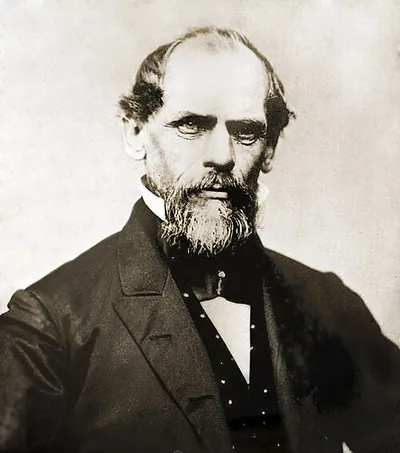
Cyrus McCormick
American inventor and businessman who promoted the horse-drawn mechanical reaper · 1809–1884
- Born
- February 15, 1809
- Died
- May 13, 1884
- Country
- United States
- Section
- Engineering and construction
Biography
Cyrus Hall McCormick (1809–1884) was an American inventor and businessman best known for popularizing the mechanical reaper, a horse-drawn machine that cut grain and eased the harvest. He lived in the second half of the nineteenth century, when the United States was becoming a major agricultural and industrial power. His importance lies in turning an experimental prototype into a product built in quantity.
He was born on February 15, 1809, at Raphine, Virginia, in the Shenandoah Valley, west of the Blue Ridge Mountains. He was the eldest of eight children of the inventor Robert McCormick Jr. and Mary Ann «Polly» Hall. The family, of Irish Presbyterian background, ran a plantation worked partly by enslaved people, and every member was expected to help with farm tasks, especially at harvest time. Cyrus received little formal schooling, but from an early age he favored machines that could lighten the labor. As a teenager he designed and patented devices meant to reduce the burden of farm work, though he struggled to sell them.
His father had spent years on a mechanical reaper without producing a dependable version. Cyrus took up the project with help from Jo Anderson, an enslaved African American man on the family plantation. Machines based on a design by the Scot Patrick Bell, which had never been patented, were already sold in the United States. Bell's machine was pushed by horses, while McCormick's was pulled by them and cut the grain alongside the team. He gave one of his first demonstrations at nearby Steeles Tavern in 1831 and later claimed to have perfected the model within eighteen months. The patent was granted on June 21, 1834, yet at first he sold none, because the machine could not cope with varied conditions.
The next years brought slow refinement. In 1839 he staged more public demonstrations, but local farmers remained unconvinced. He sold one machine in 1840 and none in 1841, then seven in 1842, 29 in 1843 and 50 in 1844, all hand-built in the farm workshop. A financial panic in 1837 had nearly ruined the family after a partner withdrew. In 1845 he received a second patent for improvements. Orders began arriving from the west, where farms were larger and the land flatter, and he contracted mass production at a factory in Brockport, New York. He also licensed other makers, but some copies were poorly built, which damaged the product's reputation.
After his father's death in 1847, he moved with his brother Leander to Chicago. The city had no paved streets, yet it offered good shipping routes across the Great Lakes and rail links to the western markets where his customers were. Another brother, William, joined the business in 1849 to handle its finances. That year the patent office refused to renew his patent, since Obed Hussey had registered a similar machine a few months earlier. McCormick insisted he had invented his own in 1831, but the decision stood. His commercial success rested on a network of salesmen who demonstrated the machines in the field and supplied parts and repairs quickly during the crucial seasons. The spread of railways widened his markets too.
In 1851 he brought a reaper to the Crystal Palace Exhibition in London. His machine harvested a field of green wheat successfully while Hussey's failed, and he won a gold medal. The triumph was short-lived, as he learned he had lost a legal challenge to Hussey's patent. Another rival, John Henry Manny, beat his machine in Paris in 1855, and McCormick sued him for patent infringement. The case drew prominent lawyers on both sides and ended up moving to Cincinnati, where Manny won. Among Manny's lawyers was Edwin Stanton, who objected to Abraham Lincoln joining the defense and dismissively called him «that damned long-armed ape». Lincoln would later appoint Stanton as secretary of war.
McCormick received many honors. The French government made him an officer of the Legion of Honor in 1851, and in 1878 he was elected a corresponding member of the French Academy of Sciences. His legacy lies in the industrialization of farming: his machine reduced the human labor needed in the fields and helped push workers toward the cities. His company, the McCormick Harvesting Machine Company, became part of International Harvester in 1902. It is fair to say he was not the only contributor, since he built on the work of his father, Bell and other designers. His real achievement was to bring the designs together, secure the patents and make the machines at commercial scale. He died on May 13, 1884.
Main contributions
- 1832A patent for a self-sharpening plow, granted two years before his reaper patent.
- 1834Patent for the horse-drawn mechanical reaper, which cut grain alongside the team.
- 1845A second patent covering improvements to the reaper.
- 1851Gold medal at the Crystal Palace Exhibition in London for a reaper that harvested green wheat successfully.
Trivia and anecdotes
An insult that came back
Edwin Stanton, a lawyer on the rival side of McCormick's case, called Lincoln «that damned long-armed ape». Years later, Lincoln appointed him secretary of war.
A town named after him
The town of McCormick in South Carolina took its name after he bought a gold mine there; it was previously known as Dornsville.
Stamps in his honor
In 1940 the United States issued 3-cent postage stamps commemorating Cyrus Hall McCormick.
Their contemporaries
While Cyrus McCormick was alive (1809–1884)…
Alive at the same time
Discovered or invented in those years
- 1846NeptuneThe eighth and most distant planet of the Solar System, an ice giant found through mathematical prediction before any direct sighting.
- 1859EvolutionThe process by which the heritable traits of living populations change over generations, explaining the diversity of life from common ancestors.
- 1869Periodic tableAn arrangement of the chemical elements into rows (periods) and columns (groups), ordered by atomic number, that reveals recurring chemical behaviour and lets scientists predict properties.
- 1869Deoxyribonucleic acidA double-stranded molecule that carries the genetic instructions of nearly all living things and many viruses.
- 1876TelephoneA device that carries the human voice over distance by turning sound into electrical signals and back into sound at the other end of the line.
- 1884CarA road vehicle with four wheels and its own engine, mainly built to carry people.
 Isambard Kingdom Brunel1806–1859 · Engineering and construction
 John Augustus Roebling1806–1869 · Engineering and construction
 Henry Bessemer1813–1898 · Engineering and construction
 Ildefons Cerdà1815–1876 · Engineering and construction
 Joseph Paxton1803–1865 · Engineering and construction
 Henry Darcy1803–1858 · Engineering and construction
