Frits Warmolt Went
Dutch botanist and biologist who discovered auxin's role in plant growth · 1903–1990
- Born
- May 18, 1903
- Died
- May 1, 1990
- Country
- United States, Kingdom of the Netherlands
- Section
- Biology
Biography
Frits Warmolt Went (Utrecht, May 18, 1903 – White Pine County, Nevada, May 1, 1990) was a Dutch botanist and biologist whose 1928 experiments demonstrated the existence of auxin, a hormone that regulates plant growth. His work laid foundations for modern plant physiology and opened the way to the chemistry of plant growth regulators, which later became central to agriculture. He worked at a time when plant life was beginning to be explained through internal chemical signals rather than outward observation alone.
Born in Utrecht, the Netherlands, into a family of botanists, he was the son of the prominent botanist Friedrich August Ferdinand Christian Went. He studied at the University of Utrecht and received his doctorate in 1927 with a dissertation on the effects of auxin, a substance plants use to steer their growth. That same year he took a post as a plant pathologist at the research laboratories of the Royal Botanical Garden in Buitenzorg, in the Dutch East Indies (now Bogor, Indonesia), where he stayed until 1933.
Went's work focused on how plants respond to outside stimuli. His experiments of 1928 showed that a chemical produced at the tip of a shoot controlled cell elongation, which helped explain why a plant bends toward light. To account for this, he and the Soviet scientist Nikolai Cholodny arrived independently at the same conclusions and proposed in 1937 what is now called the Cholodny-Went model. In it, auxin is made in the tip of the coleoptile, the protective sheath around the shoots of grasses such as maize and oats. When light or gravity acts on the plant, the hormone collects on the shaded or lower side, making those cells grow faster and bending the shoot toward the light or upward. It is a broad model, and later research has refined many of its details.
He then moved to the California Institute of Technology (Caltech) in Pasadena, where he first studied plant hormones and gradually turned to how the environment shapes growth. With funds from private donors, he built a series of greenhouses on campus where he could vary light, humidity, temperature and air quality. In 1949 he completed a large complex of climate-controlled rooms, the Earhart Plant Research Laboratory, known as the "phytotron", where he studied how air pollution affects plants. He also helped develop synthetic plant hormones, which became the basis of much of the agricultural chemical industry.
In 1958 he was appointed director of the Missouri Botanical Garden and professor of botany at Washington University in St. Louis. He moved there with his wife, Catharina, and their two children, Hans and Anneka. During his time in Missouri he backed the opening of the Climatron, the world's first geodesic dome greenhouse, but his vision for a renewed garden clashed with that of the board of trustees, and he resigned as director in 1963. After two years as a professor, in 1965 he became director of the Desert Research Institute at the University of Nevada, Reno, where he kept studying desert plants for the rest of his career and occasionally lectured in the biology department.
Went stayed active in many areas of botany until his death in 1990. His legacy combines basic research on plant hormones with the study of the environment and ecology, and his work is still cited in plant physiology and in the study of atmospheric chemistry.
Main contributions
- 1927Doctoral dissertation on the effects of auxin, completed at the University of Utrecht.
- 1928Experiments demonstrating the existence of auxin, a plant hormone that regulates shoot growth.
- 1937Cholodny-Went model, explaining how auxin makes shoots bend toward light or gravity.
- 1949Earhart Plant Research Laboratory, or "phytotron", a complex of climate-controlled rooms for studying plant growth.
- 1956Studies on the control of plant growth, carried out with Paul-Emile Pilet on lentils.
Trivia and anecdotes
Son of a botanist
He was the son of another prominent botanist, Friedrich August Ferdinand Christian Went, which put him in the world of plants from an early age.
A pioneering greenhouse
The Climatron, whose opening he backed in Missouri, was the world's first geodesic dome greenhouse.
Their contemporaries
While Frits Warmolt Went was alive (1903–1990)…
Alive at the same time
Discovered or invented in those years
- 1903AirplaneA fixed-wing aircraft, heavier than air, powered by engines or rockets, that stays aloft because its wings generate lift.
- 1925TelevisionA system that sends moving pictures and sound over distance and shows them on a receiver, the television set.
- 1925Quantum mechanicsPhysical theory describing how matter and light behave at atomic and subatomic scales, where energy is exchanged in minimal packets and results are expressed as probabilities.
- 1931Big BangA cosmological model describing how the universe expanded from an early state of extreme density and temperature, about 13.8 billion years ago.
- 1945ComputerA programmable machine that takes in data, processes it by following stored instructions, and produces results, able to switch tasks simply by running different software.
- 1969InternetA global network of interconnected computer networks that communicate using the TCP/IP protocol suite.
 Konrad Lorenz1903–1989 · Biology
 Ernst Mayr1904–2005 · Biology
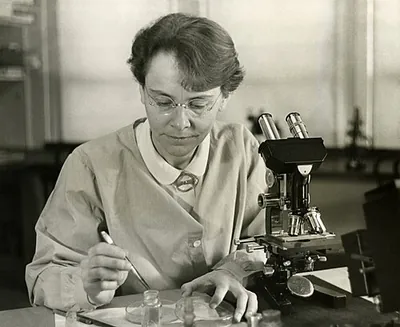 Barbara McClintock1902–1992 · Biology
 Hans Krebs1900–1981 · Biology
 Ernst Chain1906–1979 · Biology
 Gerty Cori1896–1957 · Biology