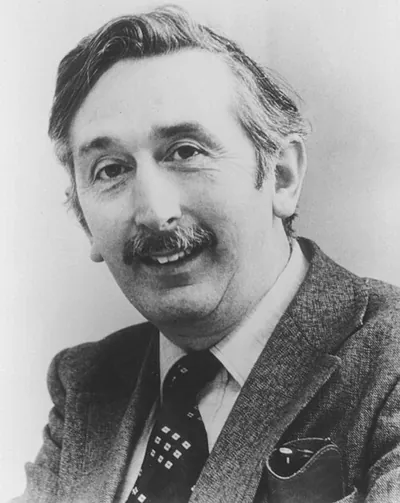
Fritz Leonhardt
German civil engineer specialised in bridges and concrete structures · 1909–1999
- Born
- July 12, 1909
- Died
- December 30, 1999
- Country
- Germany
- Section
- Engineering and construction
Biography
Fritz Leonhardt (Stuttgart, 1909 - Stuttgart, 1999) was one of the most influential civil engineers of the twentieth century in bridge design and large concrete structures. His work ranged from the motorways of Germany in the 1930s to postwar reconstruction and the cable-stayed bridges that are now common in many countries. He matters above all because he combined rigorous calculation with a steady concern for the form and beauty of his structures.
He was born in Stuttgart. The sources do not agree on the exact day: one gives 12 July 1909, another 11 July. He studied at Stuttgart University and also at Purdue University in the United States, which gave him a German training in structural engineering together with early experience abroad.
In 1934 he joined the German Highway Administration, where he worked alongside the architect Paul Bonatz and others. There he took part in several bridges for the motorways, including a viaduct over the Sulzbach valley at Denkendorf. At only 28 he was appointed Chief Engineer for the Cologne-Rodenkirchen Bridge, then the largest suspension bridge in Europe built for a motorway. A suspension bridge is one whose deck hangs from cables strung between towers.
After the war his work focused on prestressed concrete. In this technique steel cables or bars are tensioned inside the member before it carries any load. Concrete copes well with being squeezed but cracks easily when pulled; prestressing presses it from within to offset that weakness. Using this method he built bridges such as the Deutz Bridge, considered the first angled bridge with a box girder, and in 1963 he used for the first time a launching method over the Caroní River in Venezuela. In this approach the bridge is assembled on one bank and pushed out across its piers until it reaches its final position.
His work of the 1950s also included the Cologne-Mülheim Bridge of 1951, the first to use an orthotropic deck, a steel plate stiffened in two directions so that it is lighter and stronger. He had already experimented with such decks in the 1930s. Between 1953 and 1956 the Stuttgart Television Tower went up, the first reinforced concrete television tower in the world, designed with the architect Erwin Heinle. He also developed the Hi-Am anchor for stay cables, made with the Swiss firm B.B.R.V.
He usually worked in teams. He designed much of his output with Gerd Lohmer, Wilhelm Riphahn, Erwin Heinle and Hans Kammerer. In 1954 he founded the consulting firm Leonhardt und Andrä. Not all his proposals were built: a suspension bridge across the Strait of Messina, presented in 1967, remained a project. The sources consulted do not describe any significant personal controversies.
From 1958 to 1974 he taught the design of reinforced and prestressed concrete at Stuttgart University, and from 1967 to 1969 he was its president. He received honorary doctorates from six universities and several prizes, including the Werner von Siemens Ring, the Emil Mörsch Medal, the Freyssinet Medal of the FIP and the Gold Medal of the Institution of Structural Engineers. In 1988 the University of Bath awarded him an honorary doctorate in science.
His legacy lives on in his books, such as Brücken/Bridges (1982), and in the Fritz Leonhardt Prize, created in 1999 for the ninetieth anniversary of his birth to honour outstanding achievement in structural engineering. Its first winner was Michel Virlogeux. Leonhardt showed that an engineer could also be a skilled designer and a dedicated researcher.
Main contributions
- 1938Cologne-Rodenkirchen Bridge: a suspension bridge for a motorway, the largest of its kind in Europe at the time.
- 1948Deutz Bridge: considered the first angled bridge with a box girder in the world.
- 1951Cologne-Mülheim Bridge: the first bridge with an orthotropic deck, a steel plate stiffened in two directions.
- 1956Stuttgart Television Tower: the first reinforced concrete television tower in the world.
- 1963Launching system: the deck is built on one bank and pushed into place, first used on a bridge over the Caroní River in Venezuela.
- 1967Suspension bridge project across the Strait of Messina, which was never built.
- 1982The book Brücken/Bridges, in which he sets out his views on bridge design.
- Hi-Am anchor: a fixing system for stay cables, developed with the Swiss firm B.B.R.V.; the sources do not give a date.
Teachers and students
Trivia and anecdotes
Chief engineer at 28
He was given responsibility for the Cologne-Rodenkirchen Bridge at a remarkably young age, unusual for a project of that scale.
Two birth dates
The sources give both 11 and 12 July 1909 as his birth date, so the exact day is uncertain.
A bridge never built
His 1967 suspension bridge proposal across the Strait of Messina remained on paper and was never built.
Their contemporaries
While Fritz Leonhardt was alive (1909–1999)…
Alive at the same time
Discovered or invented in those years
- 1916Black holeA region of space where gravity is so strong that nothing, not even light, can escape once it crosses a certain boundary.
- 1925TelevisionA system that sends moving pictures and sound over distance and shows them on a receiver, the television set.
- 1925Quantum mechanicsPhysical theory describing how matter and light behave at atomic and subatomic scales, where energy is exchanged in minimal packets and results are expressed as probabilities.
- 1931Big BangA cosmological model describing how the universe expanded from an early state of extreme density and temperature, about 13.8 billion years ago.
- 1945ComputerA programmable machine that takes in data, processes it by following stored instructions, and produces results, able to switch tasks simply by running different software.
- 1969InternetA global network of interconnected computer networks that communicate using the TCP/IP protocol suite.
 Borys Paton1918–2020 · Engineering and construction
 Eduardo Torroja1899–1961 · Engineering and construction
 Godfrey Hounsfield1919–2004 · Engineering and construction
 Buckminster Fuller1895–1983 · Engineering and construction