
Georg Ossian Sars
Norwegian marine and freshwater biologist, pioneer of fisheries research and specialist in crustaceans · 1837–1927
- Born
- April 20, 1837
- Died
- April 9, 1927
- Country
- Norway
- Section
- Biology
Biography
Georg Ossian Sars (1837-1927) was a Norwegian biologist who studied the marine and freshwater life of his country at a time when fisheries science and marine zoology were only beginning to take shape. He is known for his work on fish eggs and larvae and, above all, for classifying Norwegian crustaceans, a group that includes crabs, shrimps and water fleas. His research laid foundations for fisheries science in Norway.
Born on 20 April 1837 in Kinn, on Norway's western coast (now part of Flora), he was the son of Pastor Michael Sars, himself a zoologist, and Maren Sars. His siblings included the historian Ernst Sars and the singer Eva Nansen. The family moved to Manger in Hordaland, where his father served as the local priest. He attended cathedral schools in Bergen and Christiania, and in 1857 entered the university in the capital, now the University of Oslo, to study medicine. Alongside his studies he devoted much of his time to natural history. He collected water fleas, small crustaceans from nearby lakes, and with Wilhelm Lilljeborg identified new species. This work led to his first scientific paper.
Sars had a good memory and a real talent for drawing, and he illustrated some of his father's zoological works. Around 1864 the Norwegian government commissioned him to survey fisheries along the coast. In the Lofoten islands he found that cod eggs were pelagic, meaning they floated in the open water rather than settling on the seabed. In 1865 he demonstrated artificial fertilisation of cod eggs, and in 1872 he studied the herring fishery. He is considered a founding investigator of ichthyoplankton, the drifting eggs and larvae of fish. The state continued to support his work throughout his career.
His main field was crustacean systematics, the description and classification of species. In 1876 to 1878 he worked with Henrik Mohn and made collections aboard the steamship Vøringen, and he also studied material from the Challenger expedition. He described many new species. His most ambitious project was An Account of the Crustacea of Norway, issued in parts between 1895 and 1928, with descriptions and figures of every known Norwegian species. In 1870 he became a university fellow, shortly after his father's death, and in 1874 he was appointed professor of zoology. In 1876 he helped establish the journal Archiv for Mathematik og Naturvidenskab with Sophus Lie and Jakob Worm-Müller. He was made a Knight of the Order of St. Olav in 1892, promoted to Knight-Commander in 1911, and awarded the Linnean Medal in 1910. He never married and died in Oslo on 9 April 1927.
His legacy lives on in the scientific names of many marine invertebrates, in the journal Sarsia, in the Sars International Centre for Marine Molecular Biology, and in the research vessel RV G.O. Sars, the flagship of Norway's research fleet.
Main contributions
- 1864Survey of Norway's coastal fisheries, commissioned by the government, and discovery that cod eggs are pelagic.
- 1865Artificial fertilisation of cod eggs.
- 1867Historie naturelle des Crustacés d'eau douce de Norvège, a work on the freshwater crustaceans of Norway.
- 1895Start of An Account of the Crustacea of Norway, his main work, published in volumes until 1928, covering all Norwegian crustacean species.
- 1896Fauna Norvegiae, a volume devoted to phyllocarids and phyllopods.
- 1925Study of bathypelagic copepods collected during the scientific cruises of Prince Albert I of Monaco.
Trivia and anecdotes
Illustrator for his father
His good memory and drawing skill allowed him to illustrate some of his father's zoological works.
A family of scientists and artists
His father was a zoologist, and his younger sister, the singer Eva Nansen, was a women's skiing pioneer.
Their contemporaries
While Georg Ossian Sars was alive (1837–1927)…
Alive at the same time
Discovered or invented in those years
- 1846NeptuneThe eighth and most distant planet of the Solar System, an ice giant found through mathematical prediction before any direct sighting.
- 1859EvolutionThe process by which the heritable traits of living populations change over generations, explaining the diversity of life from common ancestors.
- 1869Periodic tableAn arrangement of the chemical elements into rows (periods) and columns (groups), ordered by atomic number, that reveals recurring chemical behaviour and lets scientists predict properties.
- 1876TelephoneA device that carries the human voice over distance by turning sound into electrical signals and back into sound at the other end of the line.
- 1884CarA road vehicle with four wheels and its own engine, mainly built to carry people.
- 1925TelevisionA system that sends moving pictures and sound over distance and shows them on a receiver, the television set.
 Robert Koch1843–1910 · Biology
 Camillo Golgi1843–1926 · Biology
 Élie Metchnikoff1845–1916 · Biology
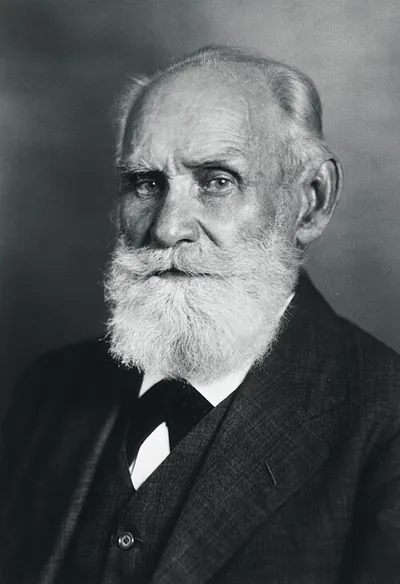 Ivan Pavlov1849–1936 · Biology
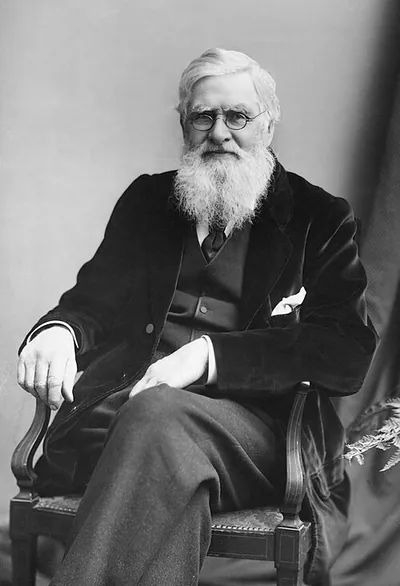 Alfred Russel Wallace1823–1913 · Biology
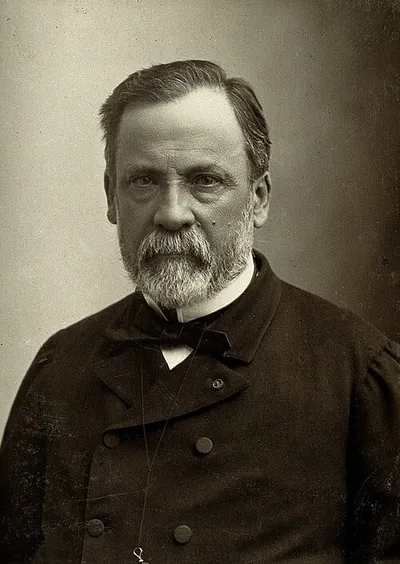 Louis Pasteur1822–1895 · Biology
