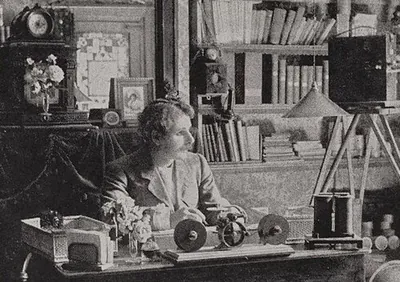
George Albert Smith
English stage hypnotist, psychic investigator, inventor and early film pioneer who developed the first commercially successful colour film process · 1864–1959
- Born
- January 4, 1864
- Died
- May 17, 1959
- Country
- United Kingdom
- Section
- Technology and communications
Biography
George Albert Smith (London, 1864 – Brighton, 1959) was an English stage hypnotist, amateur investigator of psychic phenomena, magic lantern lecturer and inventor. He is remembered chiefly as one of the early film makers grouped by the French historian Georges Sadoul under the name the Brighton School. His short films of the late 1890s and early 1900s helped establish editing techniques and the close-up, and later he developed Kinemacolor, the first colour film process to achieve real commercial success.
Smith was born in Cripplegate, in the City of London, in 1864. His father, Charles Smith, worked as a ticket-writer and artist. After his father died, the family moved to Brighton, where his mother ran a boarding house on Grand Parade. In the early 1880s Smith first attracted attention there, touring the town's theatres as a stage hypnotist. In 1882 he teamed up with Douglas Blackburn for an act at the Brighton Aquarium. It combined muscle reading, in which a blindfolded performer finds objects chosen by the audience by sensing the unconscious movements of a guide, with a claimed form of second sight for locating objects hidden elsewhere in the theatre. Blackburn admitted in 1908, and again in 1911, that the act had been a trick, though Smith always denied it.
Around the same time, the Society for Psychical Research accepted Smith's demonstrations as genuine. Once he had joined the society, he became private secretary to Edmund Gurney from 1883 to 1888. In 1887 Gurney ran a series of "hypnotic experiments" in Brighton with Smith as the hypnotist, and these made Gurney a respected figure to the British public. Much later the researcher Trevor H. Hall examined the affair and concluded that Smith, using his stage skills, had faked the results Gurney relied on in his private papers. Hall suggested this might have contributed to Gurney's death from a narcotic overdose in June 1888, a death that was never fully explained. After Gurney died, his successors F. W. H. Myers and Frank Podmore kept Smith on as private secretary. In 1889 he co-wrote, with Henry Sidgwick and Eleanor Mildred Sidgwick, a paper on thought transference for the society's journal.
In 1892, having left the society, Smith took on the lease of St Ann's Well Gardens in Hove from the estate of the financier and philanthropist Sir Isaac Lyon Goldsmid. He turned the grounds into a popular pleasure garden offering hot-air balloon ascents, parachute jumps, a monkey house, a fortune teller and a hermit who lived in a cave. From 1894 he also staged magic lantern shows in which one picture dissolved into the next. This work proved decisive. By switching from slide to slide to suggest the passing of time, a change of viewpoint or a move to another place, Smith mastered the visual language he would later carry into film, the grammar of editing.
In March 1896 Smith saw the Lumière programme in Leicester Square. Inspired by films by Robert Paul shown in Brighton that summer, he and the local chemist James Williamson bought a prototype camera from the engineer Alfred Darling, who had started making film equipment after repairing apparatus for the Brighton pioneer Esmé Collings. In 1897 Smith converted the garden's old pump house into a workshop for developing and printing film, with Darling's technical help and chemicals from Williamson, and he patented a camera and projector of his own. On 29 March 1897 he added animated pictures to the end of his twice-daily entertainment at the Brighton Aquarium, using it as a showcase for his output.
His early films, such as The Miller and the Sweep and Old Man Drinking a Glass of Beer, both from 1897, were comedies, largely because of his wife, Laura Bayley, who had worked in pantomime. Smith also corresponded with Georges Méliès, the great special effects pioneer, and in The Haunted Castle (1897) and Santa Claus (1898) he used double exposure, a technique he had patented. Charles Urban, who distributed Smith's films through the Warwick Trading Company, became his long-term business partner. In 1899 Urban financed a glass-roofed studio in the Hove gardens. That year Smith shot The Kiss in the Tunnel, a single shot that Cecil Hepworth then built into a train-journey film. In 1900 Smith experimented with reversing the action, dissolves and close-ups, as in Grandma's Reading Glass. The film historian Frank Gray calls the years 1897 to 1900 Smith's "laboratory years". In 1903 Urban took the rights to Smith's films with him when he founded his own company, which marked the end of Smith's most active period as a film maker.
In 1904 Smith moved to Southwick in Sussex, to a house called Laboratory Lodge. With finance from Urban, he worked on the Lee-Turner process, which Urban had acquired after Edward Raymond Turner died in 1903. Smith turned it into Kinemacolor, a two-colour system using red and green that replaced Turner's three-colour approach. Commercial trials began in 1908, and in 1909 the process was publicly shown in Paris and New York, earning Smith a silver medal from the Royal Society of Arts. In 1910 Urban founded the Natural Color Kinemacolor Company, which made more than a hundred short films at its studios in Hove and Nice. Smith felt he had been paid too little for his invention, and Urban suspected him of selling secrets to rivals. In 1914 the company faced a patent lawsuit brought by William Friese-Greene. Smith's patent was revoked in 1915, after which Kinemacolor dropped out of public view.
In the late 1940s British film circles rediscovered Smith, and in 1955 he became a Fellow of the British Film Academy. He died in Brighton on 17 May 1959. Hove Museum keeps a permanent display about him and Williamson. His legacy is twofold. His experiments with editing and the close-up helped lay the foundations of film language, and Kinemacolor showed that colour cinema was technically possible, although patent disputes cut short its success.
Main contributions
- 1897A camera and projector of his own design, which he patented and used for his first films.
- 1897Double exposure used to create special effects, as in The Haunted Castle.
- 1899The Kiss in the Tunnel, later edited into a train scene by Cecil Hepworth, an early example of creative editing.
- 1900Use of the close-up and the dissolve to tell stories, as in Grandma's Reading Glass.
- 1908Kinemacolor, a two-colour (red and green) film process and the first to succeed commercially.
Trivia and anecdotes
A confessed trick
Douglas Blackburn admitted in 1908 and again in 1911 that his act with Smith was a fake, though Smith never accepted this.
The laboratory years
The film historian Frank Gray uses this name for the period from 1897 to 1900, when Smith tested nearly every technique that later defined film editing.
Related discoveries and inventions
- 1908KinemacolorA commercial colour film process that used alternating red and green filters to record and project black-and-white images.
Their contemporaries
While George Albert Smith was alive (1864–1959)…
Alive at the same time
Discovered or invented in those years
- 1869Periodic tableAn arrangement of the chemical elements into rows (periods) and columns (groups), ordered by atomic number, that reveals recurring chemical behaviour and lets scientists predict properties.
- 1876TelephoneA device that carries the human voice over distance by turning sound into electrical signals and back into sound at the other end of the line.
- 1884CarA road vehicle with four wheels and its own engine, mainly built to carry people.
- 1903AirplaneA fixed-wing aircraft, heavier than air, powered by engines or rockets, that stays aloft because its wings generate lift.
- 1925TelevisionA system that sends moving pictures and sound over distance and shows them on a receiver, the television set.
- 1945ComputerA programmable machine that takes in data, processes it by following stored instructions, and produces results, able to switch tasks simply by running different software.
 Louis Lumière1864–1948 · Technology and communications
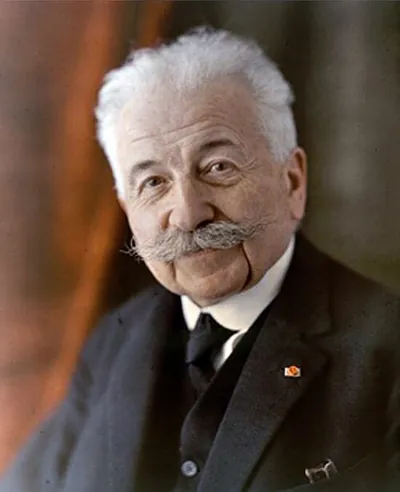 Auguste Lumière1862–1954 · Technology and communications
 Aleksandr Popov1859–1906 · Technology and communications
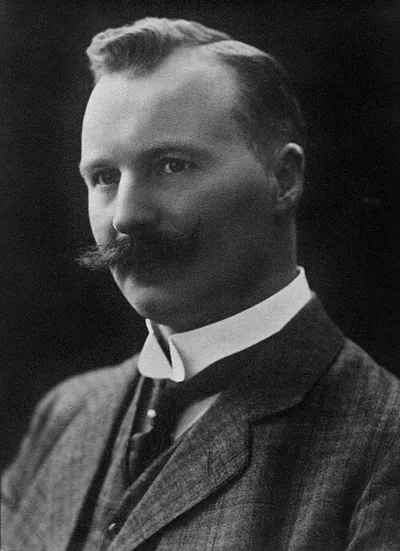 Nils Gustaf Dalén1869–1937 · Technology and communications
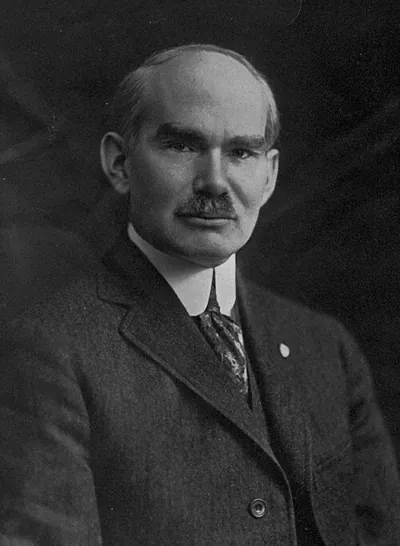 Lee de Forest1873–1961 · Technology and communications
 Guglielmo Marconi1874–1937 · Technology and communications
