
George Bernard Dantzig
American mathematician, physicist and professor, known as the father of linear programming · 1914–2005
- Born
- November 8, 1914
- Died
- May 13, 2005
- Country
- United States
- Section
- Mathematics
Biography
George Bernard Dantzig (Portland, Oregon, 1914 – Stanford, California, 2005) was an American mathematician, physicist and professor whose name is tied to linear programming, a mathematical technique for choosing the best option among many possible ones when a set of conditions must be met. Working mainly in the second half of the twentieth century, he laid the foundations for resource planning in industry, transport and logistics, which is why he is often called the father of the field.
Dantzig was born in Portland and was named after the Irish writer George Bernard Shaw. His father, Tobias Dantzig, was a Russian-born mathematician and linguist who had studied with Henri Poincaré in Paris. There he met Anja Ourisson, a student at the Sorbonne who also became a linguist, and the two married before emigrating to the United States. The family moved from Portland to Baltimore and then to Washington, and young George grew up in a home where mathematics was part of everyday conversation. His father set him demanding problems, especially in projective geometry, which deepened his interest from high school onward.
He studied mathematics and physics at the University of Maryland, graduating in 1936, and earned a master's degree in mathematics at the University of Michigan in 1937. From 1937 to 1939 he worked as a junior statistician at the Bureau of Labor Statistics, then enrolled in the doctoral programme in mathematics at the University of California, Berkeley, where he studied statistics under the Polish mathematician Jerzy Neyman.
His best-known episode happened at Berkeley. At the start of a lecture, Neyman wrote two famous and still unsolved statistical problems on the blackboard. Dantzig arrived late and assumed they were homework, so he copied them down. By his own account they seemed a little harder than usual, yet within days he had complete solutions to both. Six weeks later Neyman, excited, told him that he had solved two of the most celebrated problems in statistics and that one solution was already prepared for publication. Years afterwards, the researcher Abraham Wald reached a conclusion on the second problem and, on learning of Dantzig's earlier work, added him as a co-author. The story spread as an example of the power of positive thinking, and over time details were changed; it also inspired the opening scene of the 1997 film Good Will Hunting. It is best treated as an anecdote with legendary elements rather than a precise record.
When the Second World War broke out, Dantzig left Berkeley temporarily to work as a civilian for the United States Army Air Forces. From 1941 to 1946 he headed the combat analysis branch of the Headquarters Statistical Control, where he had to organise the supply and assignment of hundreds of thousands of items and people. These real logistical problems were the ground on which linear programming took shape. He completed his doctorate in 1946 and, although Berkeley offered him a faculty post, he returned to the Air Force as a mathematical adviser, partly at the urging of his wife and of colleagues at the Pentagon. In 1947 he first presented a linear programming problem and proposed the simplex method to solve it. This procedure moves in an orderly way through the possible solutions of a problem until it reaches the best one, rather than checking them all, and it is still used for tasks such as route design and stock management. His original example was assigning 70 people to 70 jobs in the best possible way; testing every combination would be hopeless, while the method finds the answer almost at once.
In 1952 he joined the RAND Corporation, where he began applying linear programming on computers. In 1960 he returned to Berkeley as a professor of industrial engineering and founded the Operations Research Center. In 1966 he moved to Stanford, where he developed operations research and in 1973 set up the Systems Optimization Laboratory. He stayed there until his retirement in the 1990s. His work also reached decomposition theory, sensitivity analysis, nonlinear programming and optimisation under uncertainty. In 1963 he published Linear Programming and Extensions, which became a standard textbook in the field.
Dantzig received many honours, including the first John von Neumann Theory Prize in 1974 and the National Medal of Science, presented by President Gerald Ford in 1976. He was a member of the National Academy of Sciences and the National Academy of Engineering. In 1982 the Mathematical Programming Society created the George B. Dantzig Prize in his honour, awarded every three years.
He died in 2005 at his home in Stanford, aged 90, of complications from diabetes and cardiovascular disease. His legacy is twofold: a method that is still taught and used, and a way of understanding complex decisions as mathematical problems that can be solved with rigour.
Main contributions
- 1947Simplex method: a procedure that moves in an orderly way through a problem's possible solutions to find the optimal one without checking them all.
- 1947Linear programming formulation: framing planning problems as linear relationships between variables to be optimised.
- 1963Linear Programming and Extensions: a book that became a standard reference text in the field.
- 1974First John von Neumann Theory Prize, for his contributions to mathematical programming.
Teachers and students
Studied under:
Taught:
Trivia and anecdotes
The homework problems
Dantzig thought Neyman's two problems were homework and solved them without knowing they were famous unsolved cases. The anecdote features in the film Good Will Hunting, though its details have changed over time.
Their contemporaries
While George Bernard Dantzig was alive (1914–2005)…
Alive at the same time
Discovered or invented in those years
- 1916Black holeA region of space where gravity is so strong that nothing, not even light, can escape once it crosses a certain boundary.
- 1925TelevisionA system that sends moving pictures and sound over distance and shows them on a receiver, the television set.
- 1925Quantum mechanicsPhysical theory describing how matter and light behave at atomic and subatomic scales, where energy is exchanged in minimal packets and results are expressed as probabilities.
- 1931Big BangA cosmological model describing how the universe expanded from an early state of extreme density and temperature, about 13.8 billion years ago.
- 1945ComputerA programmable machine that takes in data, processes it by following stored instructions, and produces results, able to switch tasks simply by running different software.
- 1969InternetA global network of interconnected computer networks that communicate using the TCP/IP protocol suite.
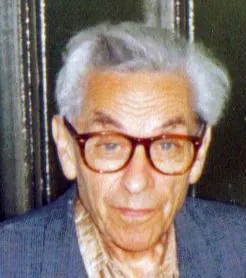 Paul Erdős1913–1996 · Mathematics
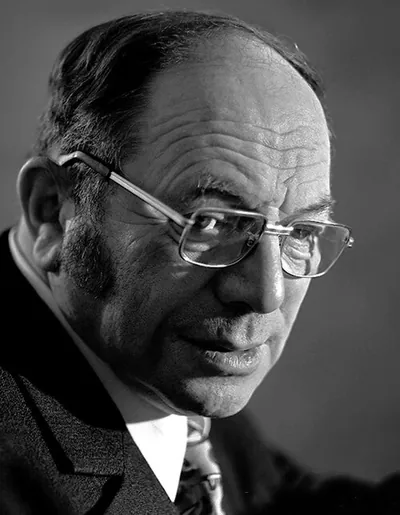 Leonid Kantorovich1912–1986 · Mathematics
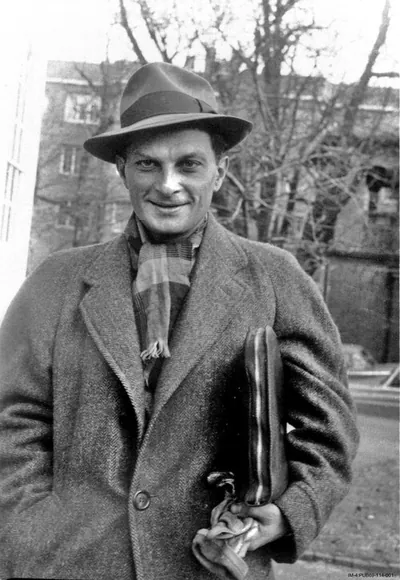 Stanisław Ulam1909–1984 · Mathematics
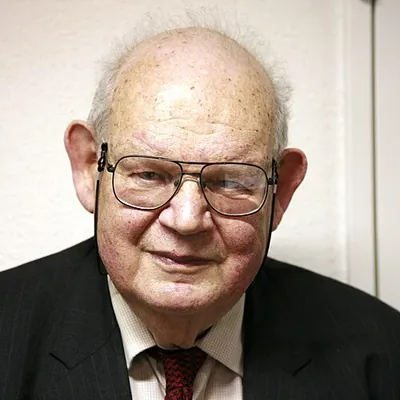 Benoit Mandelbrot1924–2010 · Mathematics
 Andrey Kolmogorov1903–1987 · Mathematics
 John Tate1925–2019 · Mathematics
