
George Wells Beadle
American geneticist who shared the 1958 Nobel Prize in Physiology or Medicine for showing that genes control the chemical reactions inside cells · 1903–1989
- Born
- October 22, 1903
- Died
- June 9, 1989
- Country
- United States
- Section
- Biology
- Awards
- Nobel Prize in Physiology or Medicine
Biography
George Wells Beadle (Wahoo, Nebraska, October 22, 1903 – Pomona, California, June 9, 1989) was an American geneticist who shared the 1958 Nobel Prize in Physiology or Medicine. Working with a bread mold, he helped show that genes direct the making of enzymes, the proteins that speed up chemical reactions inside cells. His work came in the first half of the twentieth century, long before the structure of DNA was known, and it matters because it opened the way to molecular genetics, the study of genes at the level of chemistry.
Beadle grew up on a farm in Nebraska, the son of Chauncey Elmer Beadle and Hattie Albro. He might well have become a farmer himself, but a teacher at his high school steered him toward science and persuaded him to enrol at the College of Agriculture in Lincoln. He graduated from the University of Nebraska in 1926 and spent a year working with Professor F. D. Keim, who was studying hybrid wheat. He earned his master's degree in 1927, and Keim arranged for him to become a teaching assistant at Cornell University. Until 1931 he worked there with R. A. Emerson and L. W. Sharp on maize, studying a problem linked to Mendel's laws of heredity, the rules that describe how traits pass from parents to offspring. He completed his doctorate on this work in 1931.
From 1931 to 1936 he held a fellowship at the California Institute of Technology in Pasadena. There he continued with maize and began working with Theodosius Dobzhansky, S. Emerson and Alfred Sturtevant on crossing-over, the process by which chromosomes swap segments when reproductive cells are formed. They studied it in the fruit fly Drosophila melanogaster, a favourite of geneticists because it breeds quickly and is easy to handle. In 1935 he spent six months in Paris with Boris Ephrussi at the Institut de Biologie physico-chimique. Together they investigated how the eye colour of the fly develops, a question that drew Beadle towards the biochemistry of genes. In 1936 he became an assistant professor of genetics at Harvard University. A year later he moved to Stanford, where he spent nine years, most of them working closely with Edward Lawrie Tatum.
The method that defined his career was simple in outline. Beadle and Tatum exposed the bread mold Neurospora crassa to X-rays, which caused random mutations, or changes, in its genetic material. They then compared the mutant strains with the original. Some of them could not grow on a minimal medium containing only sugar and salts, yet they thrived on a complete medium with many more nutrients. Adding a single substance to the minimal medium, such as an amino acid or a vitamin, was enough to let a mutant grow again. The conclusion was that each mutation blocked just one step in a chemical pathway. They reported their first three such mutants in 1941, and over the following years they built up families of related mutants to work out the order in which several substances were assembled inside the cell.
From these results came the idea known as one gene, one enzyme, which holds that each gene directs the production of a particular enzyme. Later research has refined it, since some proteins depend on several genes and not every gene makes an enzyme, but in its essentials it has stood the test of time. The discovery mattered for two reasons. It showed that genes take part in the chemistry of the cell, which many biologists of the period did not expect, since they thought genes governed only visible traits such as eye colour or the arrangement of bristles on a fly. It also made the question look approachable. Many geneticists had considered gene action too complicated for any simple experiment to settle, and the Beadle and Tatum results changed that view.
In 1946 he returned to the California Institute of Technology as professor of biology and head of its biology division. In January 1961 he was elected chancellor of the University of Chicago, and that autumn he became its president, a post he held until 1968. After retiring he undertook a final study of maize and its wild ancestor, teosinte. He crossed the two in several laboratories and then crossed their offspring with each other. Most of the second-generation plants were intermediate in appearance, but about one in five hundred looked identical to one of the original parents. Using Mendelian arithmetic, he estimated that the differences between the two plants depended on roughly five or six positions on the chromosomes, known as loci. The result was persuasive enough that most scientists now accept teosinte as the wild progenitor of maize.
His work earned many honours. The Nobel Prize came in 1958, shared with Tatum, while the other half went to Joshua Lederberg, who studied sexual reproduction in bacteria. Beadle was president of the American Association for the Advancement of Science in 1955 and of the Genetics Society of America in 1946. He was a member of the National Academy of Sciences, a foreign member of the Royal Society in London, and received honorary doctorates from universities in the United States, Britain and elsewhere. In his private life he married twice. He had a son, David, from his first marriage, and his second wife was the writer Muriel McClure. His favourite pastimes were rock climbing, skiing and gardening, and he is credited with the first ascent of Mount Doonerak in Alaska.
His religious views are not entirely clear from the record. In an interview with The Times he said he saw no conflict between science and religion, and he went as far as to find the biblical account more reasonable than the evolutionary speculation of his day. Other accounts, however, describe him as an atheist. He died on June 9, 1989, aged 85, at a retirement community in Pomona, California, from complications of Alzheimer's disease.
His legacy lives on in biology. The Genetics Society of America awards the George W. Beadle Award in his name, a middle school in Millard, Nebraska, has borne his name since 2001, and the Beadle Center at the University of Nebraska-Lincoln, which houses its biochemistry department, also commemorates him. His work with the bread mold laid one of the foundations of modern biology, because it showed that studying genes also means studying the chemistry of life.
Main contributions
- 1931Doctoral thesis on abnormal chromosome pairing in maize, carried out at Cornell University.
- 1935Study of eye colour development in Drosophila with Boris Ephrussi in Paris, the starting point of his interest in the biochemistry of genes.
- 1941One gene, one enzyme hypothesis: each gene directs the making of a particular enzyme, an idea that came from experiments with Neurospora mutants.
- 1941Auxotrophic mutants of bread mold: strains that grow only when a specific nutrient is added, which revealed which step of a chemical pathway was blocked.
- 1958Nobel Prize in Physiology or Medicine, shared with Edward Tatum for the role of genes in the biochemical reactions of the cell.
- Teosinte and maize study: crosses between the two plants that suggested teosinte is the wild ancestor of maize, separated by about five or six genetic differences.
Trivia and anecdotes
A decisive teacher
Beadle might have become a farmer like his family, until a high school teacher encouraged him to study science.
A mountaineer in Alaska
Besides being a geneticist, he was a climber and skier, and he is credited with the first ascent of Mount Doonerak in Alaska.
Their contemporaries
While George Wells Beadle was alive (1903–1989)…
Alive at the same time
Discovered or invented in those years
- 1903AirplaneA fixed-wing aircraft, heavier than air, powered by engines or rockets, that stays aloft because its wings generate lift.
- 1925TelevisionA system that sends moving pictures and sound over distance and shows them on a receiver, the television set.
- 1925Quantum mechanicsPhysical theory describing how matter and light behave at atomic and subatomic scales, where energy is exchanged in minimal packets and results are expressed as probabilities.
- 1931Big BangA cosmological model describing how the universe expanded from an early state of extreme density and temperature, about 13.8 billion years ago.
- 1945ComputerA programmable machine that takes in data, processes it by following stored instructions, and produces results, able to switch tasks simply by running different software.
- 1969InternetA global network of interconnected computer networks that communicate using the TCP/IP protocol suite.
 Konrad Lorenz1903–1989 · Biology
 Ernst Mayr1904–2005 · Biology
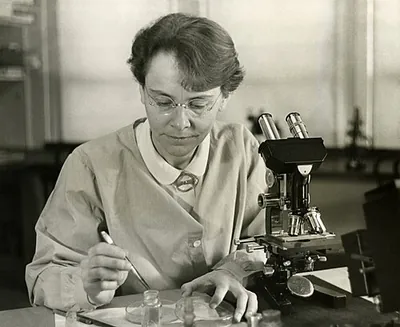 Barbara McClintock1902–1992 · Biology
 Hans Krebs1900–1981 · Biology
 Ernst Chain1906–1979 · Biology
 Gerty Cori1896–1957 · Biology
