
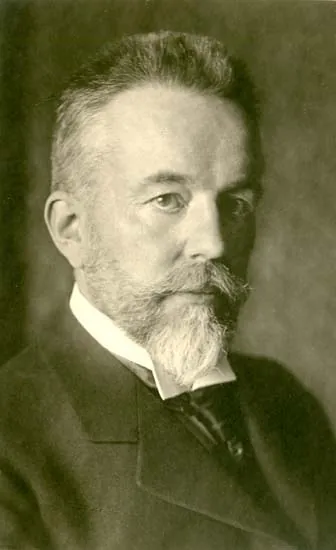
Georges Claude
French engineer, chemist and inventor, pioneer of industrial air liquefaction and neon lighting · 1870–1960
- Born
- September 24, 1870
- Died
- May 23, 1960
- Country
- France
- Section
- Energy
Biography
Georges Claude (Paris, 1870 - Saint-Cloud, 1960) was a French engineer, chemist and inventor whose work spanned the late nineteenth and mid twentieth centuries. His name is linked to three very different fields: the industrial production of oxygen and nitrogen from air, the neon lights that came to brighten city streets and signs, and the first attempts at ocean thermal energy. For this reason he was often called the Edison of France. His record is also controversial, because of his active support for the German occupation during the Second World War.
Claude was born in Paris on 24 September 1870, while the city was under siege by German forces during the Franco-Prussian War. He trained at the School of Industrial Physics and Chemistry of the City of Paris, an institution that prepared engineers for industry. After graduating he held technical posts, first as an electrical inspector at a cable factory and then as laboratory manager at an electrical company. He also founded and edited a magazine, L'Étincelle Électrique (The Electric Spark). Around this time he formed a close friendship with Jacques-Arsène d'Arsonval, a physicist and physician who studied the effects of electric current and became his mentor.
Around 1896 Claude became interested in the danger of bottled acetylene, a gas then used for lighting that is explosive when stored under pressure. He found that acetylene dissolves well in acetone, which allowed it to be stored far more safely, roughly equivalent to keeping it at 25 atmospheres of pressure. This work gave him hands-on experience with gases and led him to a bigger problem: how to separate and liquefy air on a large scale.
In 1902 Claude devised a method for liquefying air, now known as the Claude system. To liquefy a gas is to cool it until it becomes a liquid, which makes it possible to separate its components by their different boiling points. The process produced industrial quantities of liquid nitrogen, oxygen and argon. His approach competed successfully with the system introduced by Carl von Linde in 1895, which was the standard of the time. Together with the businessman Paul Delorme he founded L'Air Liquide, which is today a large multinational company based in Paris.
A by-product of this business led to his next major invention. Neon, a gas obtained when air is separated, was plentiful in his plants. Inspired by Geissler tubes and by Daniel McFarlan Moore's nitrogen-based lamp, Claude developed neon tubes that give off light when an electric current passes through a thin gas. His first large public demonstration of a neon sign took place at the Paris Motor Show in December 1910. He made two main contributions: a method for purifying neon and other inert gases inside a completely sealed glass tube, unlike Moore's tubes, which needed replenishing, and an electrode design that reduced the damage caused by metal being worn away during operation. A United States patent granted in 1915 for these electrodes became the basis of his company's near monopoly in the United States until the early 1930s. A long-repeated story says he introduced neon signs to the country by selling two to a car dealer in 1923, but no conclusive evidence supports it. What is documented is that by 1924 his company had subsidiaries and licensees across the country, and neon spread slowly until it dominated illuminated advertising in the United States for several decades.
Claude was also a pioneer of ocean thermal energy conversion, which uses the temperature difference between warm surface water heated by the sun and cold deep water to drive a turbine. The underlying idea came from d'Arsonval, but Claude was the first to build prototype plants. In 1930 he built one in Matanzas Bay, Cuba, which produced 22 kilowatts through a low-pressure turbine. In 1935 he installed another aboard a 10,000-ton cargo ship moored off the coast of Brazil. Neither produced net power, meaning a surplus after subtracting the electricity the system itself needed, because waves and weather destroyed both. In Cuba, a rectangular excavation cut into the coastal rock still survives and is popularly known as Mr Claude's Pool.
His political life contrasted sharply with his scientific work. Even as a young engineer he was hostile to democratic government. In 1933 he joined the Action Française, a movement that favoured restoring the French monarchy, and he was a close friend of its leader, Charles Maurras. After France's defeat in 1940 and the establishment of the Vichy regime in the south, he openly backed collaboration with Germany, published pamphlets in that spirit and was appointed to the Vichy National Consultative Council in 1941. After the Allied liberation he was taken into custody in December 1944 and removed from the French Academy of Sciences. In 1945 he was convicted of propaganda work supporting collaboration and cleared of helping design the V-1 flying bomb, but he was sentenced to imprisonment. Sources differ on the exact date of his release, placed in 1949 or 1950, when his earlier research on ocean energy was also acknowledged.
Claude's legacy is twofold. His air liquefaction methods remain central to the industrial gas business, and the company he co-founded is still active. His neon lighting transformed urban landscapes and created a form of illumination that, with other gases, is still used today. His ocean energy prototypes failed, but they anticipated a technology that researchers still study. His collaboration with the Vichy regime overshadows his career, and he is remembered in the history of French science with that qualification.
Main contributions
- 1896Safer storage of acetylene dissolved in acetone, which reduces the explosion risk when handling the gas.
- 1902The Claude system for liquefying air on an industrial scale, producing liquid nitrogen, oxygen and argon.
- 1910Neon lamp: sealed tubes of gas that glow when an electric discharge passes through them.
- 1915United States patent for neon tube electrodes that reduced their wear.
- 1930First ocean thermal energy plant, built in Matanzas (Cuba), producing 22 kilowatts.
- 1935Second ocean thermal plant, installed on a cargo ship off the coast of Brazil; waves destroyed it.
Trivia and anecdotes
France's Edison
He was often called the Thomas Edison of France, a nickname that reflects his reputation as a practical inventor.
Mr Claude's Pool
The rectangular excavation in the Matanzas coastal rock still survives and is still popularly known by that name.
Related discoveries and inventions
- 1910Neon lampA glass tube of low-pressure gas that glows when an electric current passes through it, widely used in signs, indicators and decorative lamps.
Their contemporaries
While Georges Claude was alive (1870–1960)…
Alive at the same time
Discovered or invented in those years
- 1876TelephoneA device that carries the human voice over distance by turning sound into electrical signals and back into sound at the other end of the line.
- 1884CarA road vehicle with four wheels and its own engine, mainly built to carry people.
- 1903AirplaneA fixed-wing aircraft, heavier than air, powered by engines or rockets, that stays aloft because its wings generate lift.
- 1925TelevisionA system that sends moving pictures and sound over distance and shows them on a receiver, the television set.
- 1931Big BangA cosmological model describing how the universe expanded from an early state of extreme density and temperature, about 13.8 billion years ago.
- 1945ComputerA programmable machine that takes in data, processes it by following stored instructions, and produces results, able to switch tasks simply by running different software.
 Kálmán Kandó1869–1931 · Energy
 Charles Proteus Steinmetz1865–1923 · Energy
 Viktor Kaplan1876–1934 · Energy
 Aurel Stodola1859–1942 · Energy
 Rudolf Diesel1858–1913 · Energy
 Mihajlo Pupin1858–1935 · Energy
