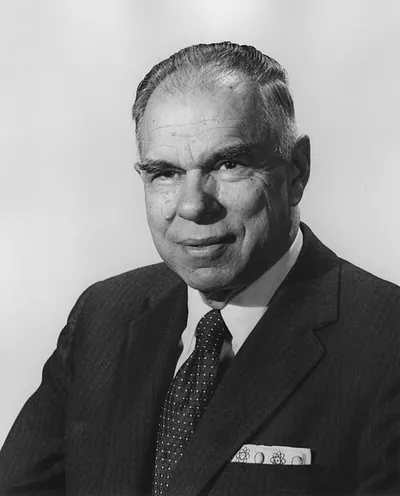
Glenn Theodore Seaborg
American chemist, co-discoverer of ten transuranium elements and 1951 Nobel laureate in Chemistry · 1912–1999
- Born
- April 19, 1912
- Died
- February 25, 1999
- Country
- United States
- Section
- Chemistry
- Awards
- Nobel Prize in Chemistry
Biography
Glenn Theodore Seaborg (Ishpeming, Michigan, 1912 - Lafayette, California, 1999) was an American chemist who spent much of his career studying the heaviest elements in the periodic table. He is remembered for his part in discovering ten elements, for proposing the actinide concept, which set the actinide series where it sits in the modern periodic table, and for sharing the 1951 Nobel Prize in Chemistry with Edwin McMillan. He lived through much of the twentieth century, when nuclear physics moved from the laboratory into war, power generation and medicine, and his work touched all of these areas.
He was born on April 19, 1912, in Ishpeming, in the Upper Peninsula of Michigan, the son of Swedish-American parents, Herman Theodore, known as Ted, and Selma Olivia Erickson. He had one sister, Jeanette, who was two years younger. The family spoke Swedish at home. When he was a boy they moved to Los Angeles County, settling in a neighborhood called Home Gardens, later absorbed into the city of South Gate. At eleven he changed the spelling of his first name from Glen to Glenn. From 1927 he kept a daily journal, a habit he maintained for decades. As a young man he was a keen sports fan and movie lover, and his mother, who thought his literary interests impractical, hoped he would train as a bookkeeper.
Science came to him late. In his final year of high school he was inspired by Dwight Logan Reid, a chemistry and physics teacher at David Starr Jordan High School in Watts. He graduated in 1929 at the top of his class. He paid for his studies by working as a stevedore and as a laboratory assistant at Firestone. He earned his bachelor's degree in chemistry at the University of California, Los Angeles, in the early 1930s. There a German-born professor arranged for him to meet Albert Einstein, an encounter that left a deep impression and strengthened his interest in the physics of atoms.
He received his doctorate in chemistry from the University of California, Berkeley, in 1937. His thesis examined what happened when fast neutrons, particles with no electric charge but high energy, struck lead nuclei. In that work he coined the term nuclear spallation, which describes a heavy nucleus breaking apart after being hit by an energetic particle. His adviser was Gilbert Newton Lewis, with whom he had done wet chemistry, the study of reactions in solutions at the bench, and with whom he published three papers on the theory of acids and bases. As a graduate student he studied the textbook Applied Radiochemistry by Otto Hahn of the Kaiser Wilhelm Institute in Berlin, which pushed him towards nuclear physics. He then worked with the cyclotron at the Lawrence laboratories, a machine that spirals charged particles outward until they reach high speed. His growing expertise drew the attention of Robert Oppenheimer. Where Oppenheimer tended to give long, wide-ranging answers, Seaborg learned to ask short, direct questions, a habit that earned him a reputation for brevity.
He stayed at Berkeley for postdoctoral research, following Frederick Soddy's work on isotopes, which are versions of the same element with different numbers of neutrons. He contributed to the discovery of more than one hundred isotopes. In 1937, working with John Livingood and Fred Fairbrother, he produced iron-59, which proved useful in studying hemoglobin in human blood. In 1938, with Livingood, he produced iodine-131, which is still used to treat thyroid disease. Many years later, the isotope was credited with prolonging his mother's life. These results made him a pioneer of nuclear medicine, the use of radioactive isotopes to diagnose and treat illness.
His academic rise at Berkeley was swift. He became an instructor in 1939, an assistant professor in 1941 and a full professor in 1945. In 1940 the physicist Edwin McMillan led the team that identified element 93, which he named neptunium. That November McMillan left Berkeley to work on radar, an urgent wartime technology. Seaborg and his colleagues had refined McMillan's oxidation-reduction method for separating neptunium, so he asked McMillan to keep working with him on the search for element 94. At first, alpha particles, which are helium nuclei released by some unstable atoms, were blamed on traces of uranium in the samples, but closer analysis ruled this out. In February 1941, Seaborg and his collaborators, among them Arthur Wahl and Joseph Kennedy, isolated element 94. Neptunium turns into it through beta decay, a process in which a neutron becomes a proton. The new element was named plutonium. By March 1941 the team had shown that it could undergo fission, the splitting of a nucleus that releases energy, a finding that became central to both weapons and power.
With the war under way, Seaborg joined the Metallurgical Laboratory of the Manhattan Project at the University of Chicago in April 1942. His task was to pull the tiny amount of plutonium out of large quantities of uranium. Plutonium was first obtained in visible amounts on August 20, 1942, and was weighed in his Chicago laboratory on September 10. He designed the multi-stage chemical process that separated, concentrated and purified it. The method was later developed further at Oak Ridge, Tennessee, and then used on a large scale at the Hanford Engineer Works in Washington State. In Chicago he also developed americium and curium and patented both. Curium never proved commercially viable because of its short half-life, but americium is used in household smoke detectors. Before the first nuclear test, Seaborg signed the Franck Report, a statement by scientists urging President Truman to stage a public demonstration of the bomb. The proposal was not adopted.
After the war he returned to academic life. In 1946 he took charge of nuclear chemistry research at the Lawrence Radiation Laboratory, which operated under the United States Atomic Energy Commission. In 1958 he became chancellor of the University of California, Berkeley, a post he held until 1961. During his term the restrictions on student expression that dated from the McCarthy era were eased, paving the way for later campus activism. He was an enthusiastic supporter of the university's athletic teams, and the columnist Herb Caen pointed out that his surname is an anagram of Go Bears, the cheer used by Berkeley fans. The 1960 Seaborg Report, written for the president's science advisory committee, argued for more federal funding of science. In 1959 he helped found the Berkeley Space Sciences Laboratory.
From 1961 to 1971 he chaired the United States Atomic Energy Commission, having been appointed by President Kennedy. In that role he promoted commercial and peaceful uses of nuclear energy. He also became concerned with the ecological and biological effects of nuclear weapons and commissioned studies on them. He took part in negotiating the Limited Test Ban Treaty, which banned nuclear test explosions in the atmosphere, in outer space and underwater, and he regarded it as one of his greatest achievements. One anecdote says that, although the Soviets strictly limited photography at the signing, he managed to take a close-up of Premier Nikita Khrushchev signing the treaty with a tiny camera. He had a good relationship with President Lyndon Johnson, who pursued the Nuclear Non-Proliferation Treaty, and in 1969 he advised Richard Nixon during a diplomatic crisis over Soviet nuclear testing. During these years he also wrote extensively and developed his theoretical work on transactinide and superactinide elements, heavier ones not yet found.
When his Commission term ended he returned to Berkeley as a university professor and chaired the Lawrence Hall of Science, a science education centre. In 1980, at the Lawrence Berkeley Laboratory, he transmuted several thousand atoms of bismuth-209 into gold, using the Bevalac accelerator to strip protons and neutrons from the bismuth nuclei. The amount was microscopic and the cost enormous, so the result had no commercial value, although it was a notable technical achievement. In 1983, President Ronald Reagan appointed him to the National Commission on Excellence in Education, which produced the report A Nation at Risk, focused on the quality of schooling. In his later years he campaigned for stronger science teaching in California, and Governor Pete Wilson appointed him to lead a committee on the state's science curriculum.
In 1942 he married Helen Griggs, secretary to the physicist Ernest Lawrence. Because they could not find a city hall in Caliente, Nevada, they had to travel to Pioche to be married, riding there in a mail truck. They had seven children, and their son Peter died in 1997. Seaborg was also a devoted hiker, and at the AEC headquarters in Germantown, Maryland, he blazed a trail that became known as the Glenn Seaborg Trail.
Seaborg shared the 1951 Nobel Prize in Chemistry and received the Priestley Medal of the American Chemical Society in 1979, along with roughly fifty honorary doctorates. Element 106, one of the elements he helped discover, was named seaborgium while he was still alive. He wrote many books and hundreds of articles, and his publication record is among the longest in Who's Who. He died on February 25, 1999, in Lafayette, California. His legacy lives on in the periodic table, in the chemistry of heavy elements, and in continuing debates about nuclear energy and science education.
Quotes
“We must understand that science does not intrinsically possess a potential for good or for evil. It is a potential that can be taken advantage of by man to carry out his will.”
“There is a beauty in discovery. There is mathematics in music, a kinship of science and poetry in the description of nature, and exquisite form in a molecule. Attempts to place different disciplines in different camps are revealed as artificial in the face of the unity of knowledge. All literate men are sustained by the philosopher, the historian, the political analyst, the economist, the scientist, the poet, the artisan and the musician.”
“Thus, the serious problem is again the paucity of starting materials.”
Main contributions
- 1937Iron-59, a radioactive isotope of iron useful for studying hemoglobin in human blood.
- 1938Iodine-131, an iodine isotope that is still used to treat thyroid disease.
- 1941Plutonium (element 94), isolated with his collaborators and shown to be fissile, a key finding for nuclear energy and weapons.
- 1942A multi-stage chemical process for separating and purifying plutonium from uranium, the basis of its large-scale production.
- 1951Nobel Prize in Chemistry, shared with Edwin McMillan for their work on the first transuranium elements.
- 1980Transmutation of bismuth into gold at the Lawrence Berkeley Laboratory: a microscopic quantity with no commercial value.
- The actinide concept, which placed the actinide series beneath the lanthanides and gave the periodic table its modern layout.
Teachers and students
Studied under:
Taught:
Trivia and anecdotes
A surname hiding a cheer
The columnist Herb Caen pointed out that Seaborg is an anagram of Go Bears, the cheer used by Berkeley fans.
A wedding without a city hall
Seaborg and Helen Griggs found no city hall in Caliente, Nevada, so they travelled to Pioche in a mail truck; the witnesses were a clerk and a janitor.
An element named in his lifetime
Element 106 was named seaborgium while he was still alive, an honour he said was even greater than the Nobel Prize.
Related discoveries and inventions
- 1941PlutoniumA radioactive metallic element with atomic number 94, symbol Pu, used as nuclear fuel and as a heat source for space probes.
Their contemporaries
While Glenn Theodore Seaborg was alive (1912–1999)…
Alive at the same time
Discovered or invented in those years
- 1916Black holeA region of space where gravity is so strong that nothing, not even light, can escape once it crosses a certain boundary.
- 1925TelevisionA system that sends moving pictures and sound over distance and shows them on a receiver, the television set.
- 1925Quantum mechanicsPhysical theory describing how matter and light behave at atomic and subatomic scales, where energy is exchanged in minimal packets and results are expressed as probabilities.
- 1931Big BangA cosmological model describing how the universe expanded from an early state of extreme density and temperature, about 13.8 billion years ago.
- 1945ComputerA programmable machine that takes in data, processes it by following stored instructions, and produces results, able to switch tasks simply by running different software.
- 1969InternetA global network of interconnected computer networks that communicate using the TCP/IP protocol suite.
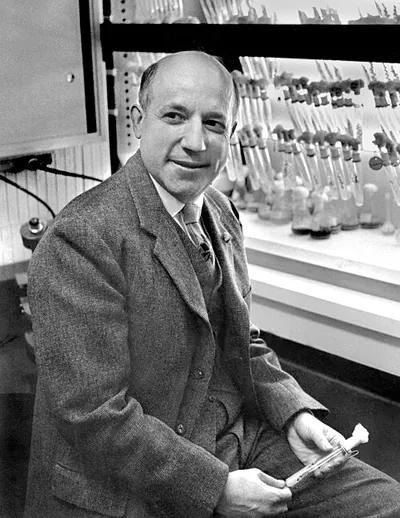 Melvin Calvin1911–1997 · Chemistry
 Dorothy Hodgkin1910–1994 · Chemistry
 Paul Flory1910–1985 · Chemistry
 Willard Libby1908–1980 · Chemistry
 Robert Burns Woodward1917–1979 · Chemistry
 Ilya Prigogine1917–2003 · Chemistry
