
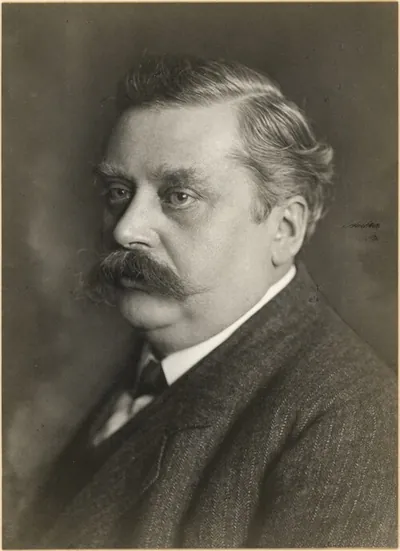
Gustav Heinrich Tammann
Russian-born chemist and physicist of Baltic German origin, pioneer of physical metallurgy and the chemistry of metals · 1861–1938
- Born
- June 9, 1861
- Died
- December 17, 1938
- Country
- Russian Empire, German Reich
- Section
- Chemistry
Biography
Gustav Heinrich Johann Apollon Tammann (Yamburg, now Kingisepp, 1861 - Göttingen, 1938) was a chemist and physicist of Baltic German origin who worked at the turn of the twentieth century, when chemists were beginning to understand the internal structure of materials. His importance lies in treating metals as a serious subject of scientific study, to the point that he is regarded as one of the founders of modern metallurgy.
His parents were Heinrich Tammann, of Estonian peasant origin, and Matilda Schünmann, of German descent. His birth date is given as 28 May, which follows the Julian calendar used in the Russian Empire; in the Gregorian calendar used elsewhere, it corresponds to 9 June. He studied chemistry at the University of Dorpat, now Tartu, where he became a lecturer in 1889 and an associate professor in 1892. There he learned to analyse mixtures and the balances between phases, meaning how substances change with temperature and pressure.
In 1903 he moved to the University of Göttingen to lead the Institute of Inorganic Chemistry, the first of its kind in Germany. In 1908 he became director of the Physico-Chemical Institute, succeeding Friedrich Dolezalek, and held the post until 1929. One of his early results came in 1900, when he identified forms of ice that exist under high pressure, now known as ice II and ice III. This showed that frozen water can take several different crystal structures.
He then focused on the physics and chemistry of metals and their alloys. He studied how crystals form as a liquid cools, how atoms spread through a solid, and how intermetallic compounds, which are combinations of metals in fixed proportions, behave. For his high-temperature experiments he designed a resistance furnace capable of reaching about 3000 degrees, which bears his name. In 1919 he predicted that certain alloys, at low temperatures, shift from a disordered arrangement of atoms to an ordered one, known as the order-disorder transition. X-ray diffraction, a technique that reveals how atoms are arranged in a crystal, confirmed this in 1929. In 1926, working with Otto Heusler, he had also observed an anomaly in the specific heat of a bronze alloy linked to this transition.
Tammann was an active collaborator and teacher. His best-known student was the Japanese physicist and metallurgist Kōtarō Honda. His key works were the Manual of Metallography, published in 1914, and the monograph on the glassy state, published in 1933. He received the Liebig Medal in 1925 and, in 1936, the Eagle Shield of the German Empire, with the dedication "The Doyen of German Metallurgy".
His legacy lives on in the rules on diffusion that bear his name, in the Tammann equation and in thermal analysis, the study of how a material's properties change as it is heated or cooled. The German Society for Materials Science awards the Tammann Medal, and the Göttingen Faculty of Chemistry gives a prize in his name for the best thesis of the year.
Main contributions
- 1900Identification of ice II and ice III, crystalline forms of ice that appear under high pressure.
- 1914Manual of Metallography, a standard reference on the internal structure of metals.
- 1919Prediction of the order-disorder transition in alloys, in which atoms shift from a disordered to an ordered arrangement on cooling.
- 1933The Glassy State, a monograph on amorphous solids such as glass, which lack an ordered crystal structure.
- A resistance furnace, capable of reaching about 3000 degrees, that bears his name.
- Tammann's rules on the diffusion of atoms inside and on the surface of crystals.
- The Tammann equation and the Tait-Tammann equation, which describe the compressibility of liquids and the relation between temperature and viscosity.
Teachers and students
Taught:
Trivia and anecdotes
A birth date in two calendars
His birth is recorded as 28 May because the Russian Empire used the Julian calendar, which corresponds to 9 June in the Gregorian calendar.
A scientist with an astronomer grandson
His grandson, Gustav Andreas Tammann, also became an astronomer.
Their contemporaries
While Gustav Heinrich Tammann was alive (1861–1938)…
Alive at the same time
Discovered or invented in those years
- 1869Periodic tableAn arrangement of the chemical elements into rows (periods) and columns (groups), ordered by atomic number, that reveals recurring chemical behaviour and lets scientists predict properties.
- 1869Deoxyribonucleic acidA double-stranded molecule that carries the genetic instructions of nearly all living things and many viruses.
- 1876TelephoneA device that carries the human voice over distance by turning sound into electrical signals and back into sound at the other end of the line.
- 1884CarA road vehicle with four wheels and its own engine, mainly built to carry people.
- 1903AirplaneA fixed-wing aircraft, heavier than air, powered by engines or rockets, that stays aloft because its wings generate lift.
- 1925TelevisionA system that sends moving pictures and sound over distance and shows them on a receiver, the television set.
 Svante August Arrhenius1859–1927 · Chemistry
 Walther Hermann Nernst1864–1941 · Chemistry
 Alfred Werner1866–1919 · Chemistry
 Marie Curie1867–1934 · Chemistry
 Fritz Haber1868–1934 · Chemistry
 Wilhelm Ostwald1853–1932 · Chemistry
