
Hans Christian Gram
Danish bacteriologist who developed the Gram stain for classifying bacteria · 1853–1938
- Born
- September 13, 1853
- Died
- November 14, 1938
- Country
- Kingdom of Denmark
- Section
- Biology
Biography
Hans Christian Joachim Gram (Copenhagen, 1853 - Copenhagen, 1938) was a Danish bacteriologist whose name lives on in microbiology laboratories through a staining technique that still splits bacteria into two broad groups. He worked at a time when it was becoming accepted that microbes cause disease, and his method gave researchers a simple way to see and sort them under the microscope.
He was born in the Danish capital, the son of Frederik Terkel Julius Gram, a professor of jurisprudence. He studied botany at the University of Copenhagen and worked as an assistant to the zoologist Japetus Steenstrup. Studying plants led him toward pharmacology, the study of how substances act on the body, and toward the use of the microscope, two fields that would shape his career. He later chose medicine and began his medical studies in 1878. Sources differ on when he graduated, giving either 1878 or 1883. His dissertation dealt with the size of human red blood cells, and this interest led him to be among the first to notice that unusually large red cells, known as macrocytes, are characteristic of pernicious anaemia, a serious form of anaemia.
Between 1878 and 1885 he travelled across Europe to train in bacteriology and pharmacology. A key stimulus came in 1882, when Paul Ehrlich published a method for staining the bacterium that causes tuberculosis. Gram began his own experiments with dyes. In Berlin in 1884 he was trying to tell apart two bacteria that cause pneumonia, Klebsiella pneumoniae and the pneumococcus, when he arrived at the procedure that now bears his name.
The method is simple in outline. First a violet dye, gentian violet, is applied. Next the cells are fixed with a solution of iodine in potassium iodide, known as Lugol's iodine, and finally they are rinsed with ethanol. Some bacteria kept the purple colour and others lost it. Gram called the first group Gram-positive and the second Gram-negative. A few years later, Karl Weigert added safranin as a counterstain, so that the bacteria that had dropped the violet turned red. Gram was cautious about his own result. In his first publication he admitted that the method was still very imperfect and hoped that other researchers would improve it.
His work had an international reach and became the foundation of bacterial classification. The distinction remains useful today for choosing the right antibiotic treatment. His academic career advanced alongside it. In 1891 he was appointed professor of pharmacology at the University of Copenhagen, and one source says he moved to a professorship of medicine in 1900. He chaired the Danish Pharmacopoeia commission from 1901 to 1921 and directed the Department of Internal Medicine at Frederiks Hospital until he retired in 1923. He practised medicine throughout his life and, as a teacher, published four volumes of clinical lectures that were widely used in Denmark.
He received honours including membership of the Royal Health Commission (1893), honorary membership of the Swedish Medical Society, an honorary doctorate from the University of Christiania, now the University of Oslo, the Commander's Cross First Class (1912) and the Gold Medal of Merit (1924). He died in Copenhagen in 1938. His legacy is twofold: a technique still used in laboratories around the world, and an example of patient observation before classification. His great-granddaughter, Lone Gram, is also a microbiologist and works at the Technical University of Denmark.
Main contributions
- 1884Gram stain: a colouring method that divides bacteria into Gram-positive, which keep the violet dye, and Gram-negative, which do not.
- Dissertation on the size of human red blood cells, submitted for his medical degree.
- Recognition of macrocytes, unusually large red blood cells, as a feature of pernicious anaemia.
- Four volumes of clinical lectures, widely used as teaching material in Denmark.
Teachers and students
Trivia and anecdotes
A method he called imperfect
In his first publication, Gram admitted that his technique was still very defective and invited other researchers to improve it.
A Google Doodle for his birthday
On 13 September 2019, Google marked the anniversary of his birth, which would have been his 166th, with a Doodle shown in several countries.
Related discoveries and inventions
- 1884Gram stainA laboratory staining method that colours bacteria so they can be seen under a microscope and sorted into gram-positive and gram-negative groups by the structure of their cell walls.
Their contemporaries
While Hans Christian Gram was alive (1853–1938)…
Alive at the same time
Discovered or invented in those years
- 1859EvolutionThe process by which the heritable traits of living populations change over generations, explaining the diversity of life from common ancestors.
- 1869Periodic tableAn arrangement of the chemical elements into rows (periods) and columns (groups), ordered by atomic number, that reveals recurring chemical behaviour and lets scientists predict properties.
- 1876TelephoneA device that carries the human voice over distance by turning sound into electrical signals and back into sound at the other end of the line.
- 1884CarA road vehicle with four wheels and its own engine, mainly built to carry people.
- 1903AirplaneA fixed-wing aircraft, heavier than air, powered by engines or rockets, that stays aloft because its wings generate lift.
- 1925TelevisionA system that sends moving pictures and sound over distance and shows them on a receiver, the television set.
 Santiago Ramón y Cajal1852–1934 · Biology
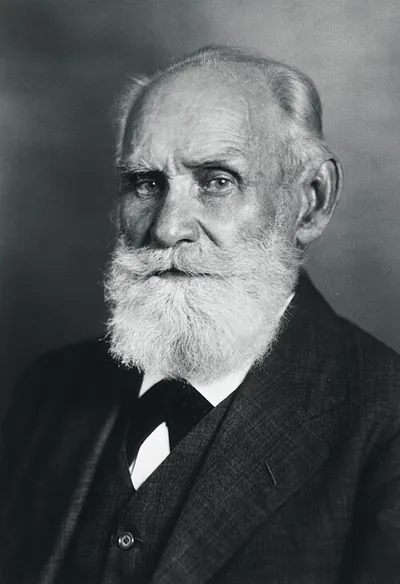 Ivan Pavlov1849–1936 · Biology
 Élie Metchnikoff1845–1916 · Biology
 Robert Koch1843–1910 · Biology
 Camillo Golgi1843–1926 · Biology
 Thomas Hunt Morgan1866–1945 · Biology
