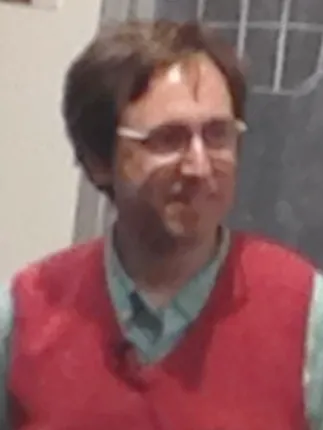
Harald Helfgott
Peruvian mathematician working in number theory, known for proving Goldbach's weak conjecture · 1977
- Born
- November 25, 1977
- Country
- Peru
- Section
- Mathematics
Biography
Harald Helfgott is a Peruvian mathematician born in Lima in 1977 and based in France. He works in number theory, the branch of mathematics that studies whole numbers and the relationships between them. He is best known for his work on Goldbach's weak conjecture, a problem first posed more than two and a half centuries ago and tackled by him in the 2010s.
He was born into a family connected to universities. His mother was a statistician, and his father taught at the National University of San Marcos in Lima and at the State University of New York. Helfgott attended the María Alvarado school for his early primary years and then, on a scholarship, the Alexander von Humboldt school. He lived in Peru until the age of sixteen. As a teenager he received training at the Pontifical Catholic University of Peru to compete in mathematics olympiads. In an interview in 2025 he recalled starting at the age of thirteen, combining that training with self-study.
Between 1994 and 1998 he studied at Brandeis University in the United States, graduating summa cum laude with top honours in mathematics and computer science. He then moved to Princeton University, where he earned his doctorate in 2003 with the thesis Root numbers and the parity problem, supervised by Henryk Iwaniec and Peter Sarnak. The work dealt with certain numbers attached to functions that describe the behaviour of prime numbers, and with the parity problem, a technical obstacle in the field.
After his doctorate he held postdoctoral posts at Yale University from 2003 to 2004 and at the University of Montreal from 2004 to 2006. In 2006 he joined the University of Bristol, where he held several teaching posts until 2011. He has worked at the French National Centre for Scientific Research (CNRS) since 2010, and in 2014 he became a directeur de recherche, the highest research rank in that organisation. In 2015 he took up an Alexander von Humboldt professorship at the University of Göttingen.
His best-known result is the proof of Goldbach's weak conjecture, which states that every odd number greater than five can be written as the sum of three prime numbers. He released two papers presenting the argument in 2013. The mathematical community has broadly accepted it, although the formal publication was still in progress. The strong version of the conjecture, which concerns even numbers, remains unproven.
In 2017 he spotted a subtle error in a proof of a quasipolynomial-time algorithm for the graph isomorphism problem, announced by László Babai in 2015. The problem asks whether two networks of points and lines have the same structure. Babai later repaired his proof.
Among his honours are the Leverhulme Prize in 2008, the Whitehead Prize of the London Mathematical Society, the Adams Prize shared with Tom Sanders in 2011, and an honorary professorship at the National University of San Marcos in 2013, the university where he first became interested in mathematics. In 2016 he received an honorary doctorate from the National University of Córdoba.
His legacy lies in settling the weak case, for odd numbers, of one of the oldest questions in number theory, and in showing that analytic methods still yield results on classical problems.
Main contributions
- 2003Doctoral thesis Root numbers and the parity problem, on numbers attached to functions that describe prime numbers.
- 2013Proof of Goldbach's weak conjecture: every odd number greater than 5 is a sum of three primes.
- 2017Detection of an error in a proof of a fast algorithm for the graph isomorphism problem, later fixed by its author.
Teachers and students
Studied under:
Taught:
Trivia and anecdotes
Early olympiad training
In a 2025 interview he recalled starting olympiad preparation at thirteen, alongside self-directed study.
A family link to San Marcos
His parents were connected to the National University of San Marcos, the same institution that made him an honorary professor in 2013.
Their contemporaries
While Harald Helfgott was alive (1977–)…
Alive at the same time
Discovered or invented in those years
- 1989World Wide WebA system of linked documents and resources, connected by hyperlinks and accessed over the Internet with web browsers.
- 1990Web browserA program that lets people access the web by fetching a page's files from a server and displaying them on screen as an interactive page.
- 1991HTMLThe markup language used to structure web page content so that a browser can display it.
- 1994SmartphoneA mobile phone that combines the functions of a telephone with those of a small pocket computer, featuring a touchscreen, internet access and installable apps.
- 1998International Space StationA permanently crewed research laboratory in low Earth orbit, about 400 kilometres up, built and operated by five space agencies from different countries.
- 2007IPhoneA line of premium smartphones designed and sold by Apple since 2007, built around a touchscreen and the iOS operating system.
 Maryam Mirzakhani1977–2017 · Mathematics
 Andrew Wiles1953 · Mathematics
 Vladimir Arnold1937–2010 · Mathematics
 Robert Aumann1930 · Mathematics
 Alexander Grothendieck1928–2014 · Mathematics
 John Tate1925–2019 · Mathematics
