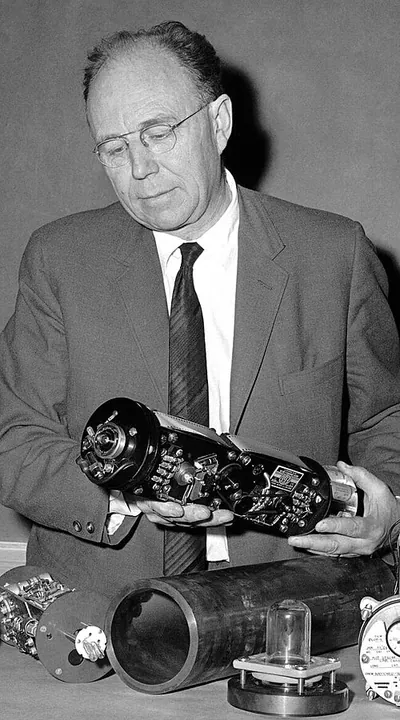
Harold Edgerton
American electrical engineer and photographer, a pioneer of high-speed flash photography and strobe technology · 1903–1990
- Born
- 1903
- Died
- 1990
- Country
- United States
- Section
- Technology and communications
Biography
Harold Eugene Edgerton (Fremont, Nebraska, 1903 – Cambridge, Massachusetts, 1990) was an American electrical engineer and photographer who used light to reveal things the human eye cannot see. For much of his career he worked at the Massachusetts Institute of Technology (MIT), where he turned the stroboscope, an obscure laboratory instrument, into a device that people encountered everywhere. His work linked engineering, art and underwater exploration, and his name is tied to some of the most recognisable photographs of the twentieth century.
He was born on April 6, 1903, in Fremont, Nebraska, the son of a lawyer who was also a journalist, author and public speaker. His father served as assistant attorney general of Nebraska between 1911 and 1915. The family settled in Aurora, Nebraska, and the young Edgerton also spent parts of his childhood in Washington and Lincoln. He took a bachelor's degree in electrical engineering at the University of Nebraska in 1925 and then an SM in the same subject at MIT in 1927. His training was that of a practical engineer, interested in motors and circuits, rather than that of a photographer.
At MIT he worked with the stroboscope, a device that flashes light at regular intervals. Under its light a moving object appears frozen, or its successive positions can be recorded on a single picture. Edgerton used it to study synchronous motors, which turn in step with the alternating current that powers them, and earned his doctorate in 1931 with that research. Around the same time he began to wonder whether such flashes could photograph everyday things. The first experiment, according to accounts of his work, was a stream of water from a faucet. His recognition came early. By 1926 he had developed a flash tube that could produce very intense light for only a millionth of a second, enough to freeze almost any motion. Versions of that tube are still used in camera flashes today, and it can also emit repeated bursts of light at short, regular intervals.
Photographing animals in flight was another path. In 1936 he visited the hummingbird expert May Rogers Webster and, with her help, showed that it was possible to photograph birds whose wings beat about sixty times a second, using an exposure of one hundred-thousandth of a second. A picture of her surrounded by the birds appeared in National Geographic. That same year he began a lifelong association with the photographer Gjon Mili, who used multiple electronic flash units in studio work, and many of their images were published in Life magazine. With these methods Edgerton recorded balloons at different stages of bursting, a bullet at the moment it struck an apple, and the motion of a devil stick. His pictures became a kind of visual science, and in 1940 his short high-speed film Quicker'n a Wink won an Academy Award.
He had been appointed professor of electrical engineering at MIT in 1934, and there he created a hands-on laboratory that students nicknamed Strobe Alley. The writer Pagan Kennedy regards it as a forerunner of the hackerspaces where enthusiasts build and test their own gadgets. That culture of tinkering shaped students such as Martin Klein, who contributed to the development of side-scan sonar, a technique that maps the sea floor on both sides of a vessel to find wrecks.
His commercial partnerships began with Kenneth J. Germeshausen and later included Herbert Grier. The firm was first called Edgerton, Germeshausen and Grier and became EG&G in 1947. EG&G became a principal contractor for the US Atomic Energy Commission and played a major role in filming and recording American nuclear tests through the 1950s and 1960s. For that work Edgerton, Charles Wykoff and colleagues developed the Rapatronic camera, built to capture events lasting only millionths of a second. The company also made the krytron, an electronic switch used to trigger the detonation of hydrogen bombs. This link to nuclear weapons is part of his legacy and remains a subject of debate.
His underwater work was equally wide-ranging. He worked with the explorer Jacques Cousteau, first supplying custom underwater cameras fitted with electronic flash and later developing sonar techniques that helped locate the wreck of the Britannic. He also took part in the discovery of the American Civil War ironclad USS Monitor. During these expeditions he acquired the nickname Papa Flash, a name tied to the stories of the time rather than to a documented ceremony. In 1988 he joined Paul Kronfield in Greece on a sonar search for the lost city of Helike, which some have linked to the legend of Atlantis. Claims about his equipment being used in searches for the Loch Ness Monster circulate, but the sources available do not confirm details of such work.
His family life was settled. In 1928 he married Esther May Garrett, a skilled pianist and singer who had trained as a teacher, and they had three children. His sister Mary Ellen was married to L. Welch Pogue, a pioneering aviation lawyer who chaired the former Civil Aeronautics Board. The technology journalist David Pogue is his great-nephew. Students valued his willingness to teach. He said that the trick to education was to teach people in such a way that they did not realise they were learning until it was too late. His last undergraduate class, a freshman seminar in autumn 1977, was called Bird and Insect Photography. He was elected to the American Academy of Arts and Sciences in 1956, joined the United States National Academy of Sciences in 1964 and the American Philosophical Society in 1972, and received the National Medal of Science in 1973. In 1962 he appeared on the television programme I've Got a Secret, where he fired a bullet into a playing card and photographed the result.
He died suddenly on January 4, 1990, at the MIT Faculty Club, at the age of 86, and was seen on the campus many times after retiring. His legacy is kept in several places. The Edgerton Explorit Center in Aurora, Nebraska, a hands-on science museum that preserves his work and artefacts, was dedicated in 1995. At MIT the Edgerton Center, founded in 1992, offers laboratory resources to students and outreach programmes for schools. The asteroid 11726 Edgerton bears his name. His photographs are held in collections such as the Museum of Modern Art in New York. His images of the bullet, the apple and the hummingbird still show clearly how a technique can reveal what the eye misses, and how that revelation can lead to new discoveries.
Main contributions
- 1926Electronic flash tube: an intense burst of light lasting a millionth of a second, still used in cameras today.
- 1931Study of synchronous motors using the stroboscope, the research behind his MIT doctorate.
- 1936Photographs of hummingbirds whose wings beat about sixty times a second, made with the help of May Rogers Webster.
- 1940Quicker'n a Wink, a high-speed short film that won an Academy Award.
- 1947Founding of EG&G, which brought sonar and high-speed photography to industry and research.
- 1988Sonar search for the lost city of Helike, in Greece, together with Paul Kronfield.
- Rapatronic camera, developed to record American nuclear tests in fractions of a second.
Trivia and anecdotes
Papa Flash
During his expeditions with Cousteau he acquired the nickname Papa Flash, which became closely linked to his name.
Strobe Alley
The laboratory he created at MIT was nicknamed Strobe Alley and is seen as a forerunner of hackerspaces.
A bullet through a playing card
In 1962 he fired a bullet into a playing card on the television show I've Got a Secret and photographed the result.
Their contemporaries
While Harold Edgerton was alive (1903–1990)…
Alive at the same time
Discovered or invented in those years
- 1903AirplaneA fixed-wing aircraft, heavier than air, powered by engines or rockets, that stays aloft because its wings generate lift.
- 1925TelevisionA system that sends moving pictures and sound over distance and shows them on a receiver, the television set.
- 1925Quantum mechanicsPhysical theory describing how matter and light behave at atomic and subatomic scales, where energy is exchanged in minimal packets and results are expressed as probabilities.
- 1931Big BangA cosmological model describing how the universe expanded from an early state of extreme density and temperature, about 13.8 billion years ago.
- 1945ComputerA programmable machine that takes in data, processes it by following stored instructions, and produces results, able to switch tasks simply by running different software.
- 1969InternetA global network of interconnected computer networks that communicate using the TCP/IP protocol suite.
 Rudolf Hell1901–2002 · Technology and communications
 Philo Farnsworth1906–1971 · Technology and communications
 Frederick Terman1900–1982 · Technology and communications
 Kenjirō Takayanagi1899–1990 · Technology and communications
 John Bardeen1908–1991 · Technology and communications
 William Shockley1910–1989 · Technology and communications
