
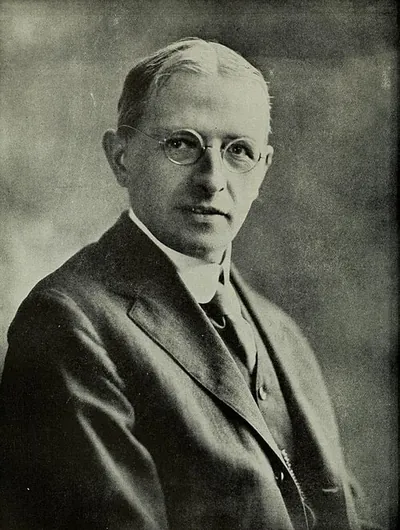
Milutin Milanković
Serbian civil engineer, astronomer and mathematician who developed the orbital cycles theory linking Earth's orbit to ice ages · 1879–1958
- Born
- May 28, 1879
- Died
- December 12, 1958
- Country
- Austria–Hungary, Kingdom of Yugoslavia
- Section
- Astronomy and space
Biography
Milutin Milanković (Dalj, then in Austria-Hungary, now Croatia, 1879 – Belgrade, 1958) was a Serbian civil engineer, mathematician, astronomer and geophysicist. He is best known for calculating how slow changes in Earth's orbit alter the amount of sunlight reaching each latitude and season, a process now called Milankovitch cycles, and for proposing that these changes were enough to drive the recurring ice ages of the Quaternary. His work linked celestial mechanics with the Earth sciences in a rigorous mathematical framework.
He was born into a Serb family of merchants and landowners. His father, a merchant and local politician, died when Milutin was seven, and he was raised by his mother, grandmother and an uncle. Three of his brothers died young of tuberculosis. Because of his fragile health, he was taught at home by his father, private tutors and relatives and family friends, some of whom were notable philosophers, inventors and poets. He finished secondary school in Osijek in 1896 and moved to Vienna to study civil engineering at what is now the Vienna University of Technology, graduating in 1902.
As a student he was strongly influenced by Johann Emanuel Brik, whose mechanics lectures relied heavily on mathematical analysis. Milanković later said that this command of mathematics gave a good mathematician independence in solving problems. After his compulsory military service he borrowed money from an uncle to pay for further study, and in December 1904 he defended a doctoral thesis on pressure curves, useful for designing bridges, domes and abutments. His examiners included Brik and Emanuel Czuber, who became his mentor and close friend.
Between 1905 and 1909 he worked as a practical engineer for a Viennese firm, building dams, bridges, viaducts and aqueducts in reinforced concrete across Austria-Hungary. He took part in ten hydroelectric plants, the most notable in Sebeș, in present-day Romania, where he designed an aqueduct about 1,200 metres long. With Theodor Kreutz he developed a concrete floor system, known as the Milanković-Kreutz system, which was simpler and cheaper than existing ones and included built-in thermal and sound insulation; it was protected by several patents. His theoretical papers on reinforced columns and membranes also built his professional reputation. A 1908 analysis showed that the ideal shape for a reservoir with walls of equal thickness resembles a drop of water.
In 1909 he accepted a post as professor of applied mathematics at the University of Belgrade, covering rational mechanics, celestial mechanics and theoretical physics. This was the turning point of his career. He still took on some construction projects, such as the first reinforced concrete bridges on the Niš–Knjaževac railway, but he chose to focus on basic research. His early papers dealt with celestial mechanics, including the motion in the three-body problem and general integrals of the n-body problem. Around 1912 he turned to climate. Reading Julius von Hann, he concluded that meteorology lacked rigorous mathematics, and he chose ice ages as a central problem. Earlier thinkers such as John Herschel and Louis Agassiz had suggested astronomical causes, and Joseph Adhémar and James Croll had proposed theories that were largely rejected or forgotten. Milanković sought a quantitative calculation of astronomical influence on Earth's climate, using spherical geometry, celestial mechanics and theoretical physics.
In 1912 he published his first paper on the mathematical theory of climate in Belgrade. In June 1913 came a second, on the distribution of solar radiation over Earth's surface, which Wilhelm Wien presented and which appeared in the German journal Annalen der Physik. In 1914 he published a paper on the astronomical theory of ice ages. That same year he married Kristina Topuzović, an amateur opera singer, and the couple set off for a honeymoon in Switzerland. The war changed their plans. As a reserve officer of the Serbian army, he was arrested by Austro-Hungarian authorities, spent some weeks under house arrest, and was then interned in a prisoner-of-war camp at Nezsider, today Neusiedl am See in Austria. Through Czuber's connections he was released and allowed to serve his internment in Budapest, where he worked in the library of the Hungarian Academy of Sciences and at the Central Meteorological Institute. His son Vasilije was born there in 1915.
During the war he applied his methods to the planets. In 1916 he published a study of Mars's climate, whose temperature estimates suggested a harsh environment and cooled the hope of finding liquid water on its surface. He also studied Venus, whose rotation was then unknown, and the Moon, for which he estimated extreme temperatures across its roughly two-week days and nights. Between 1912 and 1917 he wrote seven papers on mathematical climate theory for Earth and other planets, establishing an astronomical theory of climate as a general mathematical theory of insolation. The manuscript summarising this work, Mathematische Grundlagen der kosmischen Strahlungslehre, was sent to Czuber in 1917, but a paper shortage delayed its publication.
His most widely read work appeared in 1920 as Mathematical Theory of Heat Phenomena Produced by Solar Radiation, which brought him considerable reputation. His curve of insolation at Earth's surface was not accepted until 1924, when Wladimir Köppen, the founder of paleoclimatology, and his son-in-law Alfred Wegener included it in their book Climates of the Geological Past. In 1927 he was invited to contribute to two reference handbooks, one on climatology and one on geophysics, and wrote the introduction that appeared in German in 1930 as Mathematische Klimalehre und astronomische Theorie der Klimaschwankungen. It developed the theory of planetary climate with special attention to Earth and was translated into Russian in 1939. He also devised a rule for revising the Julian calendar, still used by many Orthodox churches. It is more accurate than the original Julian calendar, though less so than the Gregorian calendar on which it is based.
Milanković directed the Belgrade Observatory, served on Commission 7 of the International Astronomical Union for celestial mechanics, and was vice-president of the Serbian Academy of Sciences and Arts. His legacy is twofold: a theory connecting Earth's orbital motions to past and future climates, and a demonstration that celestial mechanics and the Earth sciences could be joined in an exact mathematical framework. Orbital cycles alone are now known not to explain the sequence of glacial periods, yet his calculations remain the basis of paleoclimate research. A lunar crater, a Martian crater and the asteroid (1605) Milankovitch commemorate him.
Main contributions
- 1904Doctoral thesis on pressure curves, useful for calculating bridges, domes and abutments.
- 1908Milanković-Kreutz reinforced concrete floor system, simpler and cheaper, patented with Theodor Kreutz.
- 1912First paper on the mathematical theory of climate, calculating the solar radiation received by Earth.
- 1916Study of the climate of Mars, suggesting harsh surface temperatures.
- 1920Mathematical Theory of Heat Phenomena Produced by Solar Radiation, containing his insolation curve for Earth's surface.
- 1930Mathematical Climate Theory and Astronomical Theory of Climate Variations, published in German, developing planetary climate theory.
Teachers and students
Trivia and anecdotes
A water drop as the ideal shape
In 1908 he showed that the ideal shape for a reservoir with walls of equal thickness is that of a drop of water.
From arrest to the library
After his arrest in 1914, his former mentor Czuber's intervention allowed him to serve his confinement in Budapest, where he could work in an academic library.
Their contemporaries
While Milutin Milanković was alive (1879–1958)…
Alive at the same time
Discovered or invented in those years
- 1884CarA road vehicle with four wheels and its own engine, mainly built to carry people.
- 1903AirplaneA fixed-wing aircraft, heavier than air, powered by engines or rockets, that stays aloft because its wings generate lift.
- 1925TelevisionA system that sends moving pictures and sound over distance and shows them on a receiver, the television set.
- 1925Quantum mechanicsPhysical theory describing how matter and light behave at atomic and subatomic scales, where energy is exchanged in minimal packets and results are expressed as probabilities.
- 1931Big BangA cosmological model describing how the universe expanded from an early state of extreme density and temperature, about 13.8 billion years ago.
- 1945ComputerA programmable machine that takes in data, processes it by following stored instructions, and produces results, able to switch tasks simply by running different software.
 Henry Norris Russell1877–1957 · Astronomy and space
 Arthur Eddington1882–1944 · Astronomy and space
 Karl Schwarzschild1873–1916 · Astronomy and space
 Ejnar Hertzsprung1873–1967 · Astronomy and space
 Edwin Hubble1889–1953 · Astronomy and space
 Henrietta Swan Leavitt1868–1921 · Astronomy and space
