Henry Bryant Bigelow
American oceanographer and marine biologist, founding director of the Woods Hole Oceanographic Institution · 1879–1967
- Born
- October 3, 1879
- Died
- December 11, 1967
- Country
- United States
- Section
- Earth sciences
Biography
Henry Bryant Bigelow was an American oceanographer and marine biologist who spent most of his career studying the oceans and the animals that live in them. Born in Boston in 1879 and dying in Concord in 1967, he helped establish oceanography as a recognised scientific field in the United States, and his name remains attached to one of the country's leading marine research institutions.
Bigelow was the grandson of Henry Bryant, an American physician and naturalist, which drew him toward natural history from an early age. After graduating from Harvard in 1901, he began working with the ichthyologist Alexander Agassiz, one of the most respected marine zoologists of the period. He joined Agassiz on several major expeditions, including a voyage aboard the Albatross in 1907, which gave him firsthand experience collecting specimens and data from deep and coastal waters. Fieldwork of this kind shaped the direction of his career.
He started at Harvard's Museum of Comparative Zoology in 1905 and joined the university's faculty in 1906, remaining there for 62 years. From this base he described many species new to science, and 110 of them are still recognised today according to the World Register of Marine Species. His particular expertise lay in coelenterates, a group that includes jellyfish, corals and sea anemones, and in elasmobranchs, the family of sharks and rays. He was regarded as a leading authority on both around the world.
One of his best-known works was Fishes of the Gulf of Maine, written with William C. Schroeder. First published in 1953, it served for decades as a practical guide for fishers and scientists alike studying the fauna of the Gulf of Maine off the northeastern coast of the United States. The Smithsonian Institution Press issued a heavily revised third edition in 2002, a sign that the book remained relevant long after its first appearance.
In 1930 he helped found the Woods Hole Oceanographic Institution in Massachusetts and became its founding director. The institution grew into one of the world's leading centres for marine research. Bigelow was elected a Fellow of the American Academy of Arts and Sciences in 1911, a member of the United States National Academy of Sciences in 1931, and a member of the American Philosophical Society in 1937. In 1948 he received the Daniel Giraud Elliot Medal from the National Academy of Sciences.
His legacy is visible in several ways. Since 1960 the Woods Hole Oceanographic Institution has awarded the Henry Bryant Bigelow Medal in Oceanography to those who make significant inquiries into the phenomena of the sea, and Bigelow was its first recipient. The research vessel NOAAS Henry B. Bigelow, operated by the National Oceanic and Atmospheric Administration, carries his name. Around 26 species and two genera, including Bigelowina and Bigelowiella, also honour him, among them Bigelow's ray, Rajella bigelowi, and the lantern shark Etmopterus bigelowi.
Main contributions
- 1905Start of his work at Harvard's Museum of Comparative Zoology, where he carried out much of his scientific career.
- 1907Took part in an expedition aboard the Albatross with Alexander Agassiz, collecting marine specimens.
- 1930Founded the Woods Hole Oceanographic Institution, becoming its founding director.
- 1953Publication of Fishes of the Gulf of Maine with William C. Schroeder, a guide to the fish of that region that stayed useful for decades.
- 1960Receives the first Henry Bryant Bigelow Medal in Oceanography, an award named after him.
Trivia and anecdotes
A long-serving researcher
He stayed on Harvard's faculty for 62 years, an unusually long tenure.
Species named after him
About 26 species and two genera carry his name, including a lantern shark and a ray.
Their contemporaries
While Henry Bryant Bigelow was alive (1879–1967)…
Alive at the same time
Discovered or invented in those years
- 1884CarA road vehicle with four wheels and its own engine, mainly built to carry people.
- 1903AirplaneA fixed-wing aircraft, heavier than air, powered by engines or rockets, that stays aloft because its wings generate lift.
- 1925TelevisionA system that sends moving pictures and sound over distance and shows them on a receiver, the television set.
- 1925Quantum mechanicsPhysical theory describing how matter and light behave at atomic and subatomic scales, where energy is exchanged in minimal packets and results are expressed as probabilities.
- 1931Big BangA cosmological model describing how the universe expanded from an early state of extreme density and temperature, about 13.8 billion years ago.
- 1945ComputerA programmable machine that takes in data, processes it by following stored instructions, and produces results, able to switch tasks simply by running different software.
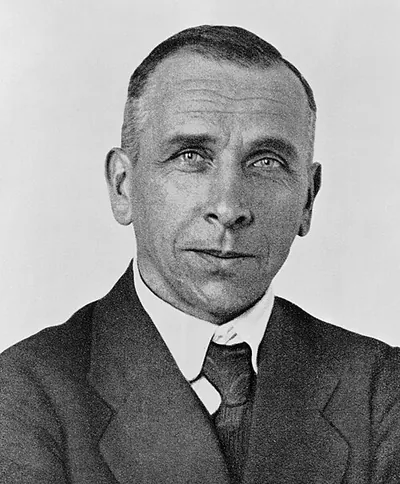 Alfred Wegener1880–1930 · Earth sciences
 Lewis Fry Richardson1881–1953 · Earth sciences
 Lev Berg1876–1950 · Earth sciences
 Inge Lehmann1888–1993 · Earth sciences
 Viktor Goldschmidt1888–1947 · Earth sciences
 Beno Gutenberg1889–1960 · Earth sciences