
Hermann Hankel
German mathematician working on analysis and function theory, best known for the Hankel transform and the Hankel matrix · 1839–1873
- Born
- February 14, 1839
- Died
- March 29, 1873
- Country
- Kingdom of Prussia
- Section
- Mathematics
Biography
Hermann Hankel (1839 - 1873) was a German mathematician who worked on mathematical analysis, the branch that studies functions, limits and infinite processes. He lived in the second half of the nineteenth century, when German mathematics was being reshaped around rigour and new theories. Today he is remembered above all for the Hankel transform and the Hankel matrix, and for his study of complex numbers.
He was born on 14 February 1839 in Halle, then part of the German Confederation. His father, Wilhelm Gottlieb Hankel, was a physicist, and the young Hermann was first educated at the Nicolai Gymnasium in Leipzig. In 1857 he entered Leipzig University, where he attended lectures by Moritz Drobisch, August Ferdinand Möbius and his own father.
In 1860 he moved to the University of Göttingen, where his interest in function theory developed under Bernhard Riemann. After an award-winning article, he went on to Berlin to work with Karl Weierstrass and Leopold Kronecker. Studying under such different teachers helps explain the breadth of his interests. He earned his doctorate at Leipzig in 1862.
A year later he qualified to teach at university level. In 1867 he became an associate professor at Leipzig and, in the same year, received a full professorship at Erlangen-Nuremberg. He spent his last four years at the University of Tübingen. He died of an illness in Schramberg, near Tübingen. The exact date of his death is uncertain: some records give 29 March 1873 and others 29 August 1873. He was married to Marie Hankel.
His 1867 exposition on complex numbers and quaternions is his most memorable work. Complex numbers pair a real part with an imaginary part, and quaternions extend this idea with four components. In that work he tackled an old puzzle: why the product of two negative numbers is positive. According to Fischbein, Hankel proved that the only multiplication that extends the ordinary one on positive numbers, while respecting distributivity on both sides, is the one that follows the rule of signs. In other words, if the familiar rules are to be kept, there is no other option.
Function theory formed another strand of his work. In 1870 he published a study of functions that oscillate infinitely often or are discontinuous, meaning they cannot be drawn without lifting the pen. In Mathematische Annalen he highlighted the importance of Bessel functions of the third kind, later known as Hankel functions. These functions appear in problems involving waves and vibrations.
Hankel also paid close attention to the linear algebra that Hermann Grassmann had developed in his Extension Theory, set out in two publications. His remarks were the first of many later comments on Grassmann's early ideas about the nature of space. In 1875 he also published a book on projective geometry, the branch that studies how figures change when projected onto another surface.
His short career left a notable body of work in the history of mathematics, with texts on the development of the discipline over recent centuries and on antiquity and the Middle Ages. His name lives on in the transform and the matrix that bear it, and in the Hankel functions.
Main contributions
- 1863A study of Euler's integrals, examining their behaviour when the variable has no bounds.
- 1867An exposition of complex numbers and quaternions, including a proof of the rule of signs.
- 1869A book on the development of mathematics over the previous centuries.
- 1870A study of functions that oscillate infinitely often or are discontinuous.
- 1874A work on the history of mathematics in antiquity and the Middle Ages.
- 1875A book on projective geometry treated by synthetic methods.
- The Hankel transform, a tool named after him for analysing functions through integrals involving Bessel functions.
- Hankel functions, the name given to the Bessel functions of the third kind that he highlighted.
Teachers and students
Studied under:
Taught:
Trivia and anecdotes
A family of scientists
His father was a physicist, and Hermann took lessons from him at Leipzig University, showing a family setting closely tied to science.
A puzzle of centuries
Why the product of two negatives is positive was a question many tried to explain. Hankel settled it by showing that the rule of signs is the only option compatible with the usual rules.
Their contemporaries
While Hermann Hankel was alive (1839–1873)…
Alive at the same time
Discovered or invented in those years
- 1839PhotographyA technique for creating lasting images by recording light, either on a light-sensitive material or with an electronic sensor.
- 1846NeptuneThe eighth and most distant planet of the Solar System, an ice giant found through mathematical prediction before any direct sighting.
- 1859EvolutionThe process by which the heritable traits of living populations change over generations, explaining the diversity of life from common ancestors.
- 1869Periodic tableAn arrangement of the chemical elements into rows (periods) and columns (groups), ordered by atomic number, that reveals recurring chemical behaviour and lets scientists predict properties.
- 1869Deoxyribonucleic acidA double-stranded molecule that carries the genetic instructions of nearly all living things and many viruses.
- 1869Chemical elementA type of matter made of atoms that all share the same number of protons in their nucleus, which sets it apart from every other element.
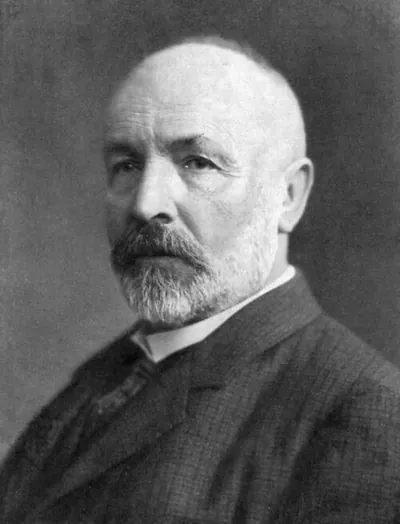 Georg Cantor1845–1918 · Mathematics
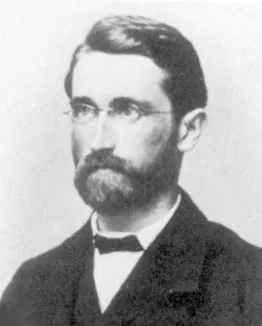 Richard Dedekind1831–1916 · Mathematics
 Felix Klein1849–1925 · Mathematics
 Bernhard Riemann1826–1866 · Mathematics
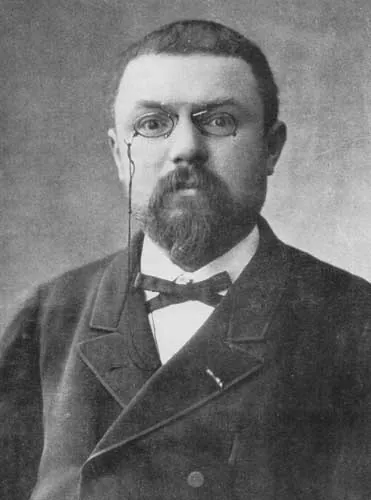 Henri Poincaré1854–1912 · Mathematics
 Giuseppe Peano1858–1932 · Mathematics
