Idelisa Bonnelly
Dominican marine biologist, considered the "mother of marine conservation in the Caribbean" · 1931–2022
- Born
- September 10, 1931
- Died
- July 3, 2022
- Country
- Dominican Republic
- Section
- Biology
Biography
Idelisa Bonnelly de Calventi was a Dominican marine biologist who spent much of her life studying the sea and persuading her country to protect it. Born in 1931 and died in 2022, she is regarded as a pioneer of biology in the Dominican Republic and the best-known figure in marine conservation in the Caribbean. Her work helped create the first protected area for humpback whales in the region.
She was born on 10 September 1931 in Santiago de los Caballeros. At that time there were no schools teaching biology in the Dominican Republic, so she pursued her university education in New York, where she wanted to study marine biology. She enrolled at Columbia University in 1953 and graduated with a degree in marine biology in 1956, then earned a master's degree from New York University in 1961. Her first job was as a research assistant to Ross Nigrelli at the New York Aquarium, where she learned research methods in the marine environment.
In 1962 she returned to the Dominican Republic and began teaching at the Autonomous University of Santo Domingo (UASD), where she founded the country's first institution devoted to the study of biology. In 1966 she set up the Institute of Marine Biology, which later became the Research Center of Marine Biology (CIBIMA). She taught there from 1967 to 1986 and coordinated graduate studies until 1992. In 1974 she founded the Academy of Sciences of the Dominican Republic and began publishing works that became influential for those who manage marine resources and for those who care about their conservation.
Her best-known conservation achievement came in 1986, when she helped create the first protected area for humpback whales, originally named the Humpback Whale Sanctuary on the Silver Bank and now known as the Silver Bank and Navidad Banks sanctuary. In 1991 she founded the Dominican Foundation for Marine Research (FUNDEMAR), which coordinates the marine management plan, studies marine life and coral reefs, and runs the marine mammal sanctuary. Her publications have been used to inform marine and coastal environmental law.
Her work earned many honours: the Medal of Merit of Dominican Women in Science (1986), the National Science Prize (1987), inclusion in the Global 500 Roll of Honour of the United Nations Environment Programme (1987), UNESCO's Marie Curie Medal (2009), and the Order of Merit of Duarte, Sánchez and Mella (2011). In 2013 the BBC named her one of the ten most important women scientists in Latin America. She died in 2022, aged 90, leaving behind a network of institutions and researchers still working to protect the Caribbean sea.
Main contributions
- 1962Founding of the first institution for the study of biology in the Dominican Republic, at the UASD.
- 1966Creation of the Institute of Marine Biology, forerunner of the Research Center of Marine Biology (CIBIMA).
- 1974Founding of the Academy of Sciences of the Dominican Republic.
- 1986Promotion of the first protected area for the humpback whale, on the Silver Bank.
- 1991Creation of the Dominican Foundation for Marine Research (FUNDEMAR), devoted to marine management and reef studies.
- 1994Publication of Mamíferos marinos en la República Dominicana, among her key works.
Trivia and anecdotes
A scientist without a school at home
Because the Dominican Republic offered no biology degrees, she had to train in New York to pursue marine biology.
UNESCO recognition
She received UNESCO's Marie Curie Medal in 2009, one of the most notable international honours of her career.
Their contemporaries
While Idelisa Bonnelly was alive (1931–2022)…
Alive at the same time
Discovered or invented in those years
- 1931Big BangA cosmological model describing how the universe expanded from an early state of extreme density and temperature, about 13.8 billion years ago.
- 1932NeutronA subatomic particle with no net electric charge, found in the nucleus of almost every atom alongside protons.
- 1945ComputerA programmable machine that takes in data, processes it by following stored instructions, and produces results, able to switch tasks simply by running different software.
- 1969InternetA global network of interconnected computer networks that communicate using the TCP/IP protocol suite.
- 1973Mobile phoneA handheld wireless phone that lets people make and receive calls while moving across a cellular network area.
- 1989World Wide WebA system of linked documents and resources, connected by hyperlinks and accessed over the Internet with web browsers.
 Edward O. Wilson1929–2021 · Biology
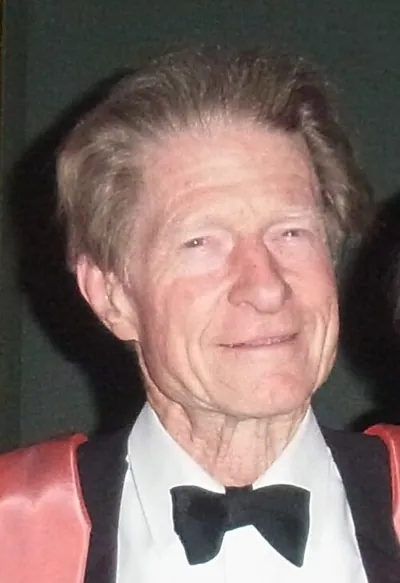 John Gurdon1933–2025 · Biology
 James Watson1928–2025 · Biology
 Carl Woese1928–2012 · Biology
 Sydney Brenner1927–2019 · Biology
 Marshall Warren Nirenberg1927–2010 · Biology