
Ignacy Mościcki
Polish chemist and inventor who served as president of Poland from 1926 to 1939 · 1867–1946
- Born
- December 1, 1867
- Died
- October 2, 1946
- Country
- Poland
- Section
- Chemistry
Biography
Ignacy Mościcki was a Polish chemist and politician who served as president of Poland from 1926 to 1939, the longest tenure in the country's history. His life joins two worlds that rarely meet: applied chemistry in industry and the politics of a state that had only recently regained its independence after more than a century of partition among its neighbours. He was in office when Germany invaded Poland in September 1939 and the Second World War began, which is how he is most often remembered.
He was born on 1 December 1867 in Mierzanowo, a small village near Ciechanów, in the part of Poland then ruled by Russia. After schooling in Warsaw, he studied chemistry at the Riga Polytechnic, where he joined Proletariat, a clandestine socialist group. After graduating he went back to Warsaw to take part in illegal political work, but the tsarist secret police warned him that he could face life imprisonment in Siberia if he kept spreading socialist ideas. In 1892 he left with his family for London.
In 1896 he obtained a post as chemistry assistant at the University of Fribourg in Switzerland, where he patented a method for producing nitric acid cheaply on an industrial scale. Nitric acid is a basic ingredient in fertilisers and explosives, so a low-cost process had real economic weight. In 1912 he moved to Lwów, then part of Austria-Hungary, where he taught physical chemistry and electrochemistry, the study of chemical changes driven by electric current. He remained there through the First World War, with a brief flight to Poland during the Polish-Soviet War. In 1925 he was elected rector of the Lwów Polytechnic, but soon moved to Warsaw to continue his research.
Following Marshal Józef Piłsudski's coup of May 1926, the National Assembly elected Mościcki president on 1 June, on Piłsudski's own recommendation, since Piłsudski had turned the post down for himself. Mościcki was a respected academic with no political experience, though he had once been a close associate of Piłsudski in the early Polish socialist movement. As president he deferred fully to Piłsudski's leadership and never publicly opposed the Sanacja regime.
After Piłsudski died in 1935, his followers split into three camps: those backing Mościcki as successor, those backing General Edward Rydz-Śmigły, and those backing Prime Minister Walery Sławek. To push Sławek aside, Mościcki struck a power-sharing deal with Rydz-Śmigły, who became the de facto leader of the country. Mościcki kept the presidency and presented himself as the moderate voice of the regime, restraining its more nationalist and conservative measures where he could, though not always successfully. The government, dominated by army officers, became known as the "colonels' government".
When Germany invaded Poland on 1 September 1939, Mościcki stayed in office until defeat forced him to flee to Romania. There, under pressure from France, and wishing the Polish forces to keep fighting, he resigned on 30 September and named Władysław Raczkiewicz as his successor to lead the government in exile. Some accounts say the office passed briefly to General Bolesław Wieniawa-Długoszowski first. Romanian authorities held Mościcki until December 1939, when they released him and he went to Switzerland. There he lived in Fribourg and later in Geneva, where he worked in a chemical laboratory and helped fellow Poles in prisoner-of-war and labour camps with money. He died on 2 October 1946 in Versoix, near Geneva.
His legacy is twofold. As a scientist he left patents and a technical training that fed into Polish chemical industry. As a politician his record is debated: he is credited with relative moderation inside an authoritarian system, but also criticised for serving as a figurehead. His remains were moved to Warsaw in 1993 and placed in the crypt of St. John's Archcathedral.
Main contributions
- 1896Patent for a method of producing nitric acid on an industrial scale, a basic ingredient in fertilisers and explosives.
- 1912Chair of physical chemistry and electrochemistry at the Lwów Polytechnic, teaching the study of chemical changes driven by electricity.
- 1926Election as president of Poland, a post he held until 1939.
Trivia and anecdotes
A Swiss citizenship
From 1908 to 1920 he was a Swiss citizen and also held honorary citizenship of Fribourg.
A long journey home
His remains lay in Versoix until 1993, when they were moved to Warsaw after a delay caused by political objections in Geneva.
Their contemporaries
While Ignacy Mościcki was alive (1867–1946)…
Alive at the same time
Discovered or invented in those years
- 1869Periodic tableAn arrangement of the chemical elements into rows (periods) and columns (groups), ordered by atomic number, that reveals recurring chemical behaviour and lets scientists predict properties.
- 1876TelephoneA device that carries the human voice over distance by turning sound into electrical signals and back into sound at the other end of the line.
- 1884CarA road vehicle with four wheels and its own engine, mainly built to carry people.
- 1903AirplaneA fixed-wing aircraft, heavier than air, powered by engines or rockets, that stays aloft because its wings generate lift.
- 1925TelevisionA system that sends moving pictures and sound over distance and shows them on a receiver, the television set.
- 1945ComputerA programmable machine that takes in data, processes it by following stored instructions, and produces results, able to switch tasks simply by running different software.
 Marie Curie1867–1934 · Chemistry
 Fritz Haber1868–1934 · Chemistry
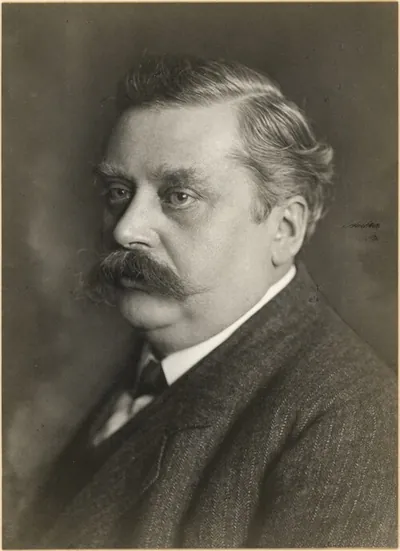 Alfred Werner1866–1919 · Chemistry
 Walther Hermann Nernst1864–1941 · Chemistry
 Svante August Arrhenius1859–1927 · Chemistry
 Otto Hahn1879–1968 · Chemistry
