
Ignazio Porro
Italian engineer and inventor of optical instruments, creator of the Porro prism · 1801–1875
- Born
- November 25, 1801
- Died
- October 8, 1875
- Country
- Kingdom of Italy
- Section
- Technology and communications
Biography
Ignazio Porro was an Italian engineer and inventor of optical and surveying instruments who worked in the nineteenth century, when railways and modern mapping were expanding quickly. His name is linked to a prism system that is still used in binoculars, so his work remains part of everyday experience for anyone who looks through a pair of field glasses.
Born in 1801, Porro trained in practical engineering. In 1836 he joined the Military Engineers corps of the Kingdom of Sardinia, an institution that at the time combined the defence of the territory with major public works. From that post he carried out land surveys, essential work for planning roads, canals and railways with accuracy.
His fieldwork brought him into large projects. Around 1840 he designed the route of the railway between Genoa and Sale di Alessandria, and a branch line connecting to the city of Pavia. Some years later he carried out the topographic survey of the ground between Bardonecchia and Modane for Giuseppe Médail, an early promoter of the Fréjus railway tunnel under the Alps. Precise surveying demanded reliable instruments, and that need drew him into optics.
Around 1850 he invented the prism system that bears his name. A prism is a block of glass that bends light; his arrangement lets the image appear upright inside a compact instrument with short tubes, which made binoculars practical. In the same mapping spirit, in 1853 he devised a strip camera with an elongated negative, one of the earliest attempts to photograph terrain in a systematic way, and he is regarded as a forerunner of photogrammetry.
Porro also worked with other technicians. He took part in founding Tecnomasio and in 1865 established Filotecnica, which was later developed under his pupil Angelo Salmoiraghi and became Filotecnica-Salmoiraghi. After his death in 1875 his memory was honoured in Italy: the state technical institute in Pinerolo was named after him, and the Italian Society of Photogrammetry adopted his name as a tribute.
Porro's legacy is twofold. On one side, the prism that carries his name remains in use in consumer and professional optics. On the other, his contributions to surveying and to photography applied to maps anticipated methods that were fully developed in the twentieth century.
Main contributions
- 1840Design of the railway route between Genoa and Sale di Alessandria, and of the branch line to Pavia.
- 1850Prism system bearing his name, which keeps the image upright in compact instruments such as binoculars.
- 1853Strip camera with an elongated negative, devised for mapping and one of the earliest of its kind.
- 1865Founding of the firm Filotecnica, later Filotecnica-Salmoiraghi.
Trivia and anecdotes
An institute named after him
The state technical institute in Pinerolo was named in his honour.
A photogrammetry tribute
The Italian Society of Photogrammetry also bears his name.
Their contemporaries
While Ignazio Porro was alive (1801–1875)…
Alive at the same time
Discovered or invented in those years
- 1803AtomThe basic unit of a chemical element: a nucleus of protons and usually neutrons surrounded by a cloud of electrons.
- 1839PhotographyA technique for creating lasting images by recording light, either on a light-sensitive material or with an electronic sensor.
- 1846NeptuneThe eighth and most distant planet of the Solar System, an ice giant found through mathematical prediction before any direct sighting.
- 1859EvolutionThe process by which the heritable traits of living populations change over generations, explaining the diversity of life from common ancestors.
- 1869Periodic tableAn arrangement of the chemical elements into rows (periods) and columns (groups), ordered by atomic number, that reveals recurring chemical behaviour and lets scientists predict properties.
- 1869Deoxyribonucleic acidA double-stranded molecule that carries the genetic instructions of nearly all living things and many viruses.
 William Henry Fox Talbot1800–1877 · Technology and communications
 William Fothergill Cooke1806–1879 · Technology and communications
 Louis Braille1809–1852 · Technology and communications
 Samuel Finley Breese Morse1791–1872 · Technology and communications
 Isaac Singer1811–1875 · Technology and communications
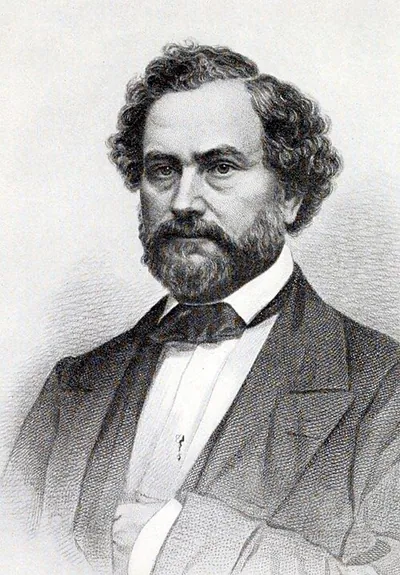 Samuel Colt1814–1862 · Technology and communications
