
Isaac Jacob Schoenberg
Romanian-American mathematician, inventor of splines · 1903–1990
- Born
- April 21, 1903
- Died
- February 21, 1990
- Country
- United States, Romania
- Section
- Mathematics
Biography
Isaac Jacob Schoenberg was a mathematician of Romanian origin who became an American citizen and who, in the 1940s, devised splines, curves built from points they must pass through. The idea is now a basic tool in computer graphics and computer-aided design, so work that began as abstract theory ended up with very wide practical reach.
He was born in Galați, in Romania, into a Jewish family, the youngest of four children. He studied at the University of Iași, where he received his master's degree in 1922. From 1922 to 1925 he worked in Berlin and Göttingen on a problem in analytic number theory suggested by Issai Schur, a highly influential mathematician of the period. He presented his thesis at Iași and earned his doctorate in 1926.
In Göttingen he met Edmund Landau, who arranged a visit for him to the Hebrew University of Jerusalem in 1928. There he began studying totally positive matrices, whose minors are all positive, and variation-diminishing linear transformations, which do not increase the number of sign changes in a sequence. These abstract topics later underpinned much of his work. In 1930 he left Jerusalem and married Charlotte, Landau's daughter, in Berlin.
That same year he received a Rockefeller Fellowship, which took him to the United States. He visited the University of Chicago, Harvard and the Institute for Advanced Study in Princeton. From 1935 he taught at Swarthmore and Colby colleges, and in 1941 he joined the University of Pennsylvania. During the Second World War, from 1943 to 1945, he left the university to work as a mathematician at the Aberdeen Proving Ground, where calculations for artillery and ballistics were carried out. It was during this period that he began the work for which he is best known, the theory of splines.
A spline is, in essence, a smooth curve passing through a set of given points, made of simple polynomial pieces joined so that the curve has no sudden kinks. Its ability to represent shapes from few data points without distortion helped the idea spread far beyond pure mathematics, into engineering, statistics and, with the arrival of computers, digital graphics.
In 1966 he moved to the University of Wisconsin–Madison, joining its Mathematics Research Center, and stayed until his retirement in 1973. In 1974 he received the Lester R. Ford Award.
Schoenberg wrote around 175 papers on many different subjects, about 50 of them on splines. He also worked on approximation theory, the Kakeya problem, Pólya frequency functions and a problem posed by Landau. His coauthors included John von Neumann, Hans Rademacher, George Pólya and Carl de Boor. His legacy is twofold: a theory still used every day in computer graphics and design, and a body of theoretical work linking classical analysis with matrices and functions.
Main contributions
- 1928Totally positive matrices: study of matrices whose minors are all positive, begun during his stay in Jerusalem.
- 1928Variation-diminishing linear transformations: transformations that do not increase the number of sign changes in a sequence, also begun in Jerusalem.
- 1946Splines: curves made of joined polynomial pieces that pass through given points, developed in the 1940s during his work at Aberdeen.
- 1974Lester R. Ford Award, which he received in recognition of his mathematical career.
Teachers and students
Studied under:
Taught:
Their contemporaries
While Isaac Jacob Schoenberg was alive (1903–1990)…
Alive at the same time
Discovered or invented in those years
- 1903AirplaneA fixed-wing aircraft, heavier than air, powered by engines or rockets, that stays aloft because its wings generate lift.
- 1925TelevisionA system that sends moving pictures and sound over distance and shows them on a receiver, the television set.
- 1925Quantum mechanicsPhysical theory describing how matter and light behave at atomic and subatomic scales, where energy is exchanged in minimal packets and results are expressed as probabilities.
- 1931Big BangA cosmological model describing how the universe expanded from an early state of extreme density and temperature, about 13.8 billion years ago.
- 1945ComputerA programmable machine that takes in data, processes it by following stored instructions, and produces results, able to switch tasks simply by running different software.
- 1969InternetA global network of interconnected computer networks that communicate using the TCP/IP protocol suite.
 Andrey Kolmogorov1903–1987 · Mathematics
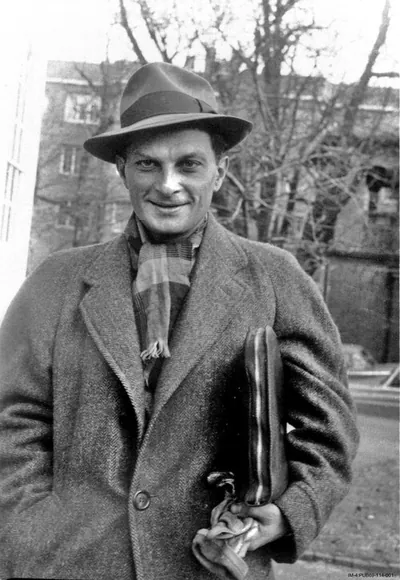 Stanisław Ulam1909–1984 · Mathematics
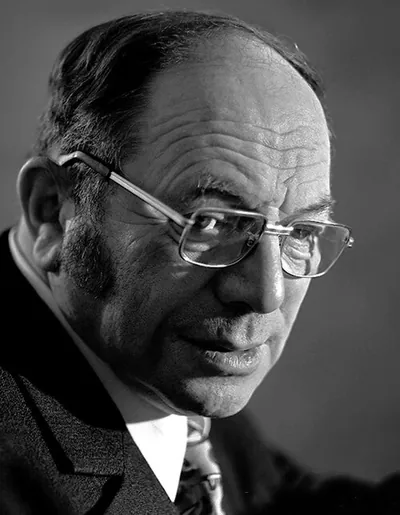 Leonid Kantorovich1912–1986 · Mathematics
 Paul Erdős1913–1996 · Mathematics
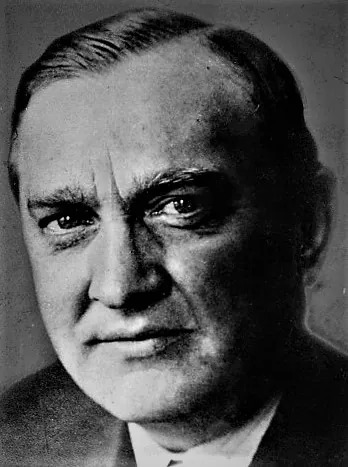 Stefan Banach1892–1945 · Mathematics
 Ronald Fisher1890–1962 · Mathematics
