
Jacques-Henri Bernardin de Saint-Pierre
French writer and botanist, author of the novel Paul et Virginie · 1737–1814
- Born
- January 19, 1737
- Died
- January 21, 1814
- Country
- France
- Section
- Biology
Biography
Jacques-Henri Bernardin de Saint-Pierre (Le Havre, 1737 - Éragny, 1814) was a French writer and botanist whose novel Paul et Virginie remains one of the most widely read works of eighteenth-century French literature. He lived through the last decades of the Enlightenment, when the idea that nature could reveal the existence of God and teach moral lessons was widely held. His significance lies in joining the close observation of plants with a literary sensitivity that shaped several generations of readers.
As a boy he read Robinson Crusoe at the age of twelve, and soon afterwards sailed to the West Indies with an uncle who was a ship's captain. On his return he trained as an engineer at the Ecole des Ponts in Paris. He then joined the French army and took part in the Seven Years' War against Prussia and England, but he was dismissed for insubordination. He travelled widely around Europe in search of work and returned to Paris in 1765. A small inheritance on his father's death gave him some financial breathing space during these uncertain years.
In 1768 he sailed to the Isle de France, today Mauritius, as an engineer for the king, and used the posting to study the local plants. He came back in 1771 and became a friend and pupil of Jean-Jacques Rousseau, with whom he explored the countryside around Paris looking at plants. Rousseau shaped his character and his writing style, particularly his habit of blending careful description of nature with personal feeling. His account of the voyage, Voyage a l'Ile de France, published in 1773, earned him a reputation as a defender of innocence and religion, and through the intervention of the bishop of Aix he received a pension of 1,000 livres a year.
In 1784 he published the three-volume Etudes de la nature, which set out to prove the existence of God from the wonders of the natural world. Against the Encyclopaedists, whose outlook was more materialist, he proposed a philosophy of feeling in which emotion and contemplation led to moral understanding. His novel Paul et Virginie appeared as a supplementary volume to this work. It was received coldly at first, and it survived being destroyed only because the painter Claude Joseph Vernet championed it in public. His second great success, La Chaumiere indienne of 1790, was less sentimental and showed a lighter, more humorous touch.
Saint-Pierre was a committed advocate of vegetarianism. Although he considered himself a devout Christian, he was also shaped by Enlightenment thinkers such as Voltaire and by his mentor Rousseau. In 1792 he married Felicite Didot, a very young woman who brought him a considerable dowry. After her death he married again in 1800, at the age of sixty-three, Desiree Pelleport, also very young. In 1791 he was appointed head of the Jardin des Plantes in Paris, succeeding Buffon, although some biographies date this appointment to 1797. He was elected to the Institut de France in 1795 and to the Academie francaise in 1803. From his seat at the Institut he took issue with Isaac Newton's view that the tides were driven mainly by the Moon, a claim he did not accept.
His legacy sits between literature and popular science. The first Spanish edition of Paul et Virginie appeared in Madrid in 1798, in a translation by Jose Miguel Alea, and the novel was reprinted many times afterwards. Alexander von Humboldt, one of the great naturalists of the nineteenth century, admired the book. The story also inspired operas, among them Gianandrea Gavazzeni's version of 1935 and the one by the Argentine composer Maria Isabel Curubeto Godoy, staged at the Teatro Colon in Buenos Aires in 1946. Today he is remembered as a writer who treated exotic nature with feeling, and as a botanist whose texts brought the plant world to a wide audience.
Main contributions
- 1773Voyage a l'Ile de France: an account of his time as the king's engineer, with observations on the island's plants and society.
- 1784Etudes de la nature: three volumes arguing for the existence of God from the observation of the natural world.
- 1787Paul et Virginie: a sentimental novel set on an island in the Indian Ocean, his best-known work.
- 1790La Chaumiere indienne: a lighter tale with more humour, published as the second great success of his career.
- 1798De la nature de la morale: a philosophical essay on the origin and basis of moral behaviour.
- 1815Harmonies de la nature: published after his death, it argues for a harmonious natural order.
Teachers and students
Trivia and anecdotes
Saved by a painter
Paul et Virginie was poorly received at first, and it is said that it survived only because the painter Claude Joseph Vernet defended it publicly.
A committed vegetarian
Saint-Pierre championed vegetarianism, an unusual stance for his time, and practised it himself.
A dispute with Newton
From the Institut de France he challenged Newton's claim that the tides were caused mainly by the Moon.
Their contemporaries
While Jacques-Henri Bernardin de Saint-Pierre was alive (1737–1814)…
Alive at the same time
Discovered or invented in those years
- 1766HydrogenThe lightest and most abundant chemical element in the universe, atomic number 1, which under normal conditions is a colourless, odourless and highly flammable gas.
- 1772NitrogenChemical element with atomic number 7, a colourless, odourless gas that makes up about 78% of Earth's air and is an essential part of proteins and nucleic acids.
- 1774OxygenA colorless, odorless gas, symbol O and atomic number 8, that forms the dioxygen in air and is essential for respiration in most living things.
- 1781UranusThe seventh planet from the Sun, an ice giant discovered by William Herschel in 1781, the first planet found with a telescope.
- 1803AtomThe basic unit of a chemical element: a nucleus of protons and usually neutrons surrounded by a cloud of electrons.
- 1811MoleculeAn electrically neutral group of at least two atoms held together by chemical bonds in a defined arrangement.
 Jean-Baptiste de Lamarck1744–1829 · Biology
 Edward Jenner1749–1823 · Biology
 Carl Linnaeus1707–1778 · Biology
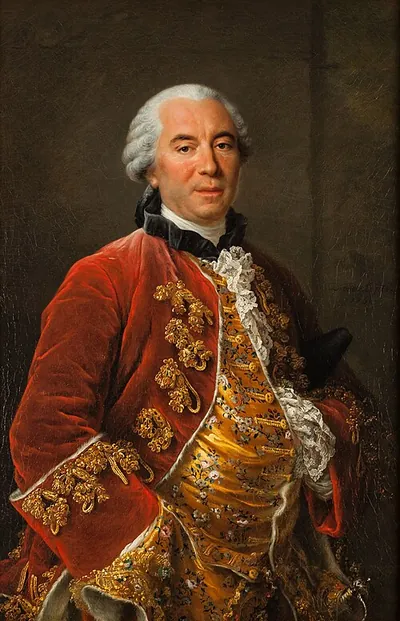 Georges-Louis Leclerc, Comte de Buffon1707–1788 · Biology
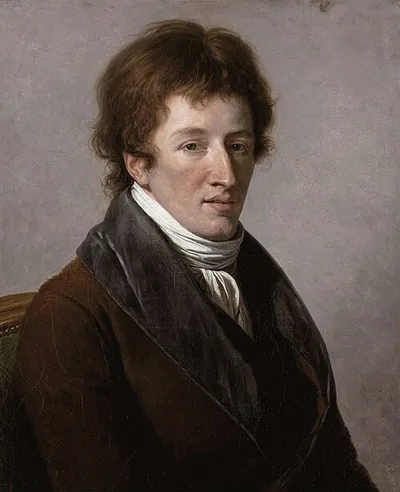 Georges Cuvier1769–1832 · Biology
 Charles Darwin1809–1882 · Biology
