
James Leonard Brierley Smith
South African ichthyologist and organic chemist who identified a living coelacanth · 1897–1968
- Born
- October 26, 1897
- Died
- January 7, 1968
- Country
- South Africa, Union of South Africa, Cape Colony
- Section
- Biology
Biography
James Leonard Brierley Smith was a South African ichthyologist, organic chemist and university professor whose fame arrived in 1939, when he recognised a coelacanth, a fish scientists had believed extinct for more than 65 million years. He moved between the chemistry laboratory and the study of fishes during the first half of the twentieth century, and his story shows how a chance discovery can change what we know about natural history.
He was born in Graaff-Reinet, in the former Cape Province, on 26 October 1897, the elder of two sons. His childhood was spent in several rural schools, in towns such as Noupoort, De Aar and Aliwal North, and he finished school in 1914 at the Diocesan College in Rondebosch. His interest in fish had already started as a boy during a holiday in Knysna, although his formal training was mainly in chemistry. He took a degree at the University of the Cape of Good Hope in 1916 and a master's degree at Stellenbosch in 1918.
He went to Britain and earned his doctorate at Cambridge in 1922. Back in South Africa he taught organic chemistry at Rhodes University in Grahamstown, first as a senior lecturer and later as an associate professor. Between 1922 and 1937 he was married to Henrietta Cecile Pienaar, and they had three children. In Grahamstown he met Margaret Mary Macdonald, born in 1916, who had studied physics and chemistry at the same university. They married in 1938. She had planned to become a doctor, but ended up as his assistant in the ichthyology department.
In 1938 Marjorie Courtenay-Latimer, curator of the East London Museum, told him about an unusual fish she could not identify. Smith arrived in the city in February 1939 and recognised the specimen as a coelacanth, a group of lobe-finned fishes that scientists knew almost only from fossils. The animal had been taxidermied to preserve it, which made it harder to study its insides. He named the new genus Latimeria in her honour. The figure of 65 million years was the accepted idea about its extinction, not a direct measurement.
Smith did not stop there. He launched a search programme that, fourteen years after the first find, produced a second specimen. In 1952 another fish arrived, caught by a fisherman near the Comoros Islands, and the South African government provided a military aircraft to collect it. This specimen allowed scientists to examine the animal's internal organs, which the first had not made possible.
From 1947, when the ichthyology department was officially created, he devoted nearly all his time to fishes, although on paper he remained attached to chemistry. Together with Margaret he wrote Sea Fishes of South Africa, first published in 1949, which became a widely used guide. His output eventually exceeded five hundred papers and books, including Fishes of Seychelles, and he named about 370 new fish species.
In January 1968 he took his own life with cyanide. Accounts of his reasons differ: some describe a long illness that made him fear a decline in his mental faculties, while others speak of a prolonged struggle with cancer.
That same year the J. L. B. Smith Institute of Ichthyology was founded in his memory. Margaret directed it until her retirement in 1982, and in 2001 it was renamed the South African Institute for Aquatic Biodiversity. His legacy lives on in taxonomy, since the abbreviation Smith follows his name when species are described, and several species carry his name.
Main contributions
- 1939Identification of the coelacanth and creation of the genus Latimeria: he recognised a fish believed extinct for millions of years.
- 1949Sea Fishes of South Africa: a guide to marine fishes of South Africa, written with his wife, popular among amateurs and specialists.
- 1952Second coelacanth specimen: caught by a fisherman near the Comoros, it allowed study of the animal's internal anatomy.
- 1968Founding of the ichthyology institute bearing his name, in Grahamstown.
- Description of about 370 new fish species, each given a scientific name.
Trivia and anecdotes
A stuffed fish
The first coelacanth reached Smith taxidermied for preservation, so much of the identification rested on its external appearance.
A military plane for a fish
To collect the second specimen, the South African government lent him a Dakota aircraft from the air force.
A fish named after him
Meiacanthus smithi, known as the disco blenny, carries his name in his honour.
Their contemporaries
While James Leonard Brierley Smith was alive (1897–1968)…
Alive at the same time
Discovered or invented in those years
- 1897ElectronA negatively charged subatomic particle found in every atom, and key to electricity and chemical bonding.
- 1903AirplaneA fixed-wing aircraft, heavier than air, powered by engines or rockets, that stays aloft because its wings generate lift.
- 1925TelevisionA system that sends moving pictures and sound over distance and shows them on a receiver, the television set.
- 1925Quantum mechanicsPhysical theory describing how matter and light behave at atomic and subatomic scales, where energy is exchanged in minimal packets and results are expressed as probabilities.
- 1931Big BangA cosmological model describing how the universe expanded from an early state of extreme density and temperature, about 13.8 billion years ago.
- 1945ComputerA programmable machine that takes in data, processes it by following stored instructions, and produces results, able to switch tasks simply by running different software.
 Gerty Cori1896–1957 · Biology
 Hans Krebs1900–1981 · Biology
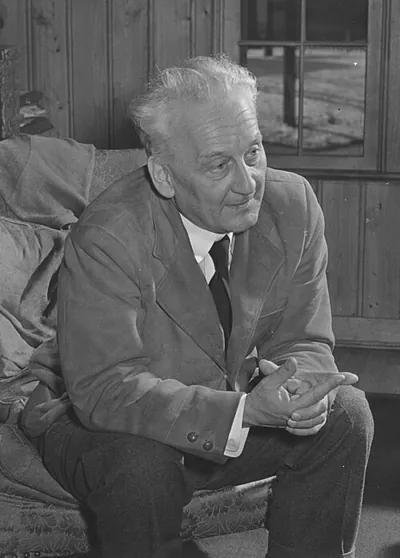 Albert Szent-Györgyi1893–1986 · Biology
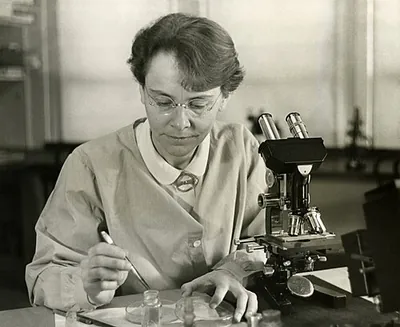 Barbara McClintock1902–1992 · Biology
 J.B.S. Haldane1892–1964 · Biology
 Konrad Lorenz1903–1989 · Biology
