
James Naismith
Physical educator, coach and Christian chaplain, Canadian-American inventor of basketball · 1861–1939
- Born
- November 6, 1861
- Died
- November 28, 1939
- Country
- Canada, United States
- Section
- Technology and communications
Biography
James Naismith (Almonte, Canada, 1861-Lawrence, Kansas, 1939) was a physical educator, coach, Christian chaplain and physician, born in Canada and naturalised as an American citizen in 1925. He is remembered as the inventor of basketball, which he devised in 1891 at a time when organised sport was spreading through universities and youth associations. His work matters because the game is now played worldwide and reached the Olympic Games within his own lifetime.
Naismith was born to a family of Scottish descent settled in Ontario. His parents died of typhoid fever in 1870, and he and his siblings went to live with their grandmother and their uncle Peter Young. He walked about four kilometres to school. Among his childhood games was one called Duck on a Rock, a target game in which one player guarded a stone while the others tried to knock it down by throwing smaller stones. Later writers have suggested that this game, which discouraged violence and rewarded teamwork, shaped his thinking about rules, although that link is an interpretation rather than a documented fact. He left high school to work on the family farm and resumed his studies at nineteen, after a brief attempt to join the North West Mounted Police.
In 1883 he enrolled at McGill University in Montreal, where he excelled in Canadian football, lacrosse, gymnastics and boxing, and twice received the Wickstead medal for the university's best athlete. He graduated in 1887 and worked as a part-time gymnastics instructor before succeeding Frederick Barnjum as director of physical education in 1890. He had trained for the ministry, but he began to doubt that path and chose physical education, believing he could reach more young people through a gymnasium than through a parish.
That same year he joined the YMCA in Springfield, Massachusetts, where the physical education head, Luther Gulick, asked him to devise, within about two weeks, an indoor game that would keep a restless class occupied through the harsh New England winters. Naismith reviewed the popular sports of the day and judged the large, soft football the safest ball. He banned running with it, so players could only pass or dribble it, and he placed the goal high above the players' heads so no one could guard it from below. For scoring, he drew on the gentle lobbing throw of his childhood game. He wrote thirteen basic rules, and the first game took place in December 1891, with two peach baskets fixed to the gallery railings instead of rings with nets.
The game spread quickly around the campus. In March 1892 a public match was held in which the students beat the teachers 5 to 1, and Naismith invited his friend Amos Alonzo Stagg to play; Stagg scored the only basket for the teachers. Around this time Naismith also made a cloth band to protect his ears during football, which is sometimes described as the first American football helmet, though it was really a strip of flannel and the claim should be treated with caution.
He qualified in medicine in Denver in 1898 and that year joined the University of Kansas, where he set up the basketball programme. He became director of the Kansas Jayhawks in 1919. As a chaplain with the Kansas National Guard he taught basketball to soldiers as a way of channelling their energy, which helped to lift morale and reduce disciplinary punishments.
He lived to see basketball shown as a demonstration sport at the 1904 Olympics in St. Louis and become an official event at the Berlin Games in 1936. He died in Lawrence in 1939. His legacy is marked by many honours, including the Naismith Memorial Basketball Hall of Fame in Springfield, which bears his name. His role has also been disputed: the family of Lambert G. Will argued that parts of the game came from Will's ideas, while accepting that Naismith deserved credit for the general concept.
Main contributions
- 1890A cloth band worn to protect the ears in football, often described as the first American football helmet, though the claim is doubtful.
- 1891Invention of basketball, a team game in which players score by throwing the ball into a high basket.
- 1891Writing of the thirteen original basketball rules, which banned running with the ball.
- 1898Founding of the University of Kansas basketball programme, which he helped lead.
- 1936Basketball becomes an official event at the Berlin Olympic Games.
Trivia and anecdotes
Peach baskets
The janitor brought peach baskets instead of the boxes Naismith had asked for, and these were used in the early games.
An invented initial
Naismith had no middle name and never signed with an “A”. That initial was added by someone in the administration at the University of Kansas.
The teachers lose
In the public match of 1892, the faculty lost 5 to 1 to the students, and Stagg scored the faculty's only basket.
Their contemporaries
While James Naismith was alive (1861–1939)…
Alive at the same time
Discovered or invented in those years
- 1869Periodic tableAn arrangement of the chemical elements into rows (periods) and columns (groups), ordered by atomic number, that reveals recurring chemical behaviour and lets scientists predict properties.
- 1869Deoxyribonucleic acidA double-stranded molecule that carries the genetic instructions of nearly all living things and many viruses.
- 1876TelephoneA device that carries the human voice over distance by turning sound into electrical signals and back into sound at the other end of the line.
- 1884CarA road vehicle with four wheels and its own engine, mainly built to carry people.
- 1903AirplaneA fixed-wing aircraft, heavier than air, powered by engines or rockets, that stays aloft because its wings generate lift.
- 1925TelevisionA system that sends moving pictures and sound over distance and shows them on a receiver, the television set.
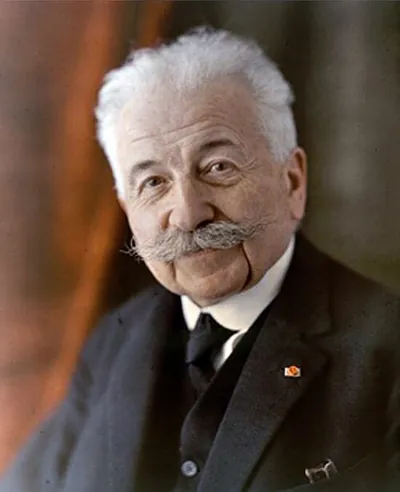 Auguste Lumière1862–1954 · Technology and communications
 Aleksandr Popov1859–1906 · Technology and communications
 Louis Lumière1864–1948 · Technology and communications
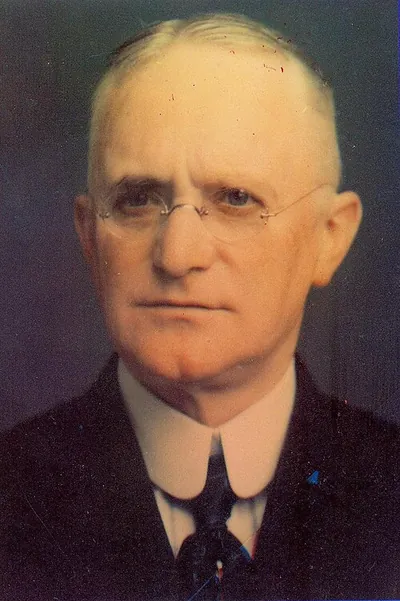 George Eastman1854–1932 · Technology and communications
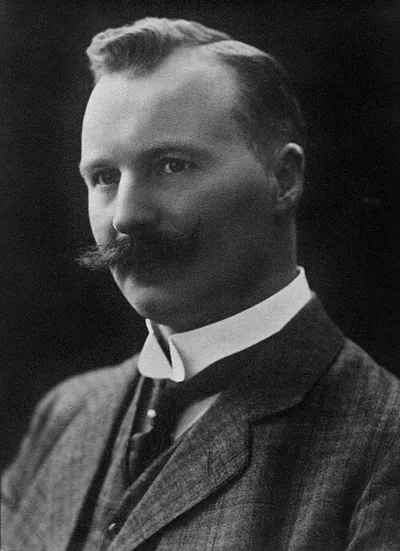 Nils Gustaf Dalén1869–1937 · Technology and communications
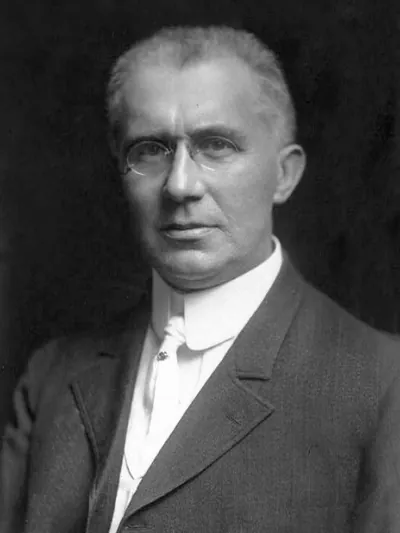 Emile Berliner1851–1929 · Technology and communications
