
Janaki Ammal
Indian botanist specializing in cytogenetics and sugarcane breeding · 1897–1984
- Born
- November 4, 1897
- Died
- February 7, 1984
- Country
- India, British Raj, Dominion of India
- Section
- Biology
Biography
Edavalath Kakkat Janaki Ammal (1897-1984) was an Indian botanist who worked on plant breeding, cytogenetics (the study of chromosomes, the structures inside cells that carry heredity) and phytogeography, the field that studies how plants are distributed across the planet. She moved between colonial India, the United States and Britain at a time when few women could pursue science. She is best known for her work on sugarcane, but her research covered much more.
She was born on 4 November 1897 in Tellichery, now Thalassery, in the state of Kerala in south-western India. Her father was a senior judicial official in the Madras Presidency, which gave the family a comfortable position. She was schooled at a convent in her home town and then in Madras, where she studied at Queen Mary's College and Presidency College. Unlike her sisters, who entered arranged marriages, she chose a life of study.
In 1924 she went to the University of Michigan in the United States on a scholarship, earning a master's degree in botany in 1926. After teaching botany in Madras she returned to Michigan for her doctorate. Her thesis, on the chromosomes of a plant called Nicandra physaloides, was completed around 1931, and she is regarded as one of the first women to earn a doctorate in botany in the United States. She later taught in Trivandrum and in 1934 joined the Sugarcane Breeding Station at Coimbatore.
At Coimbatore the aim was to develop more productive sugarcane suited to Indian conditions, which would reduce the country's reliance on imports from Indonesia. Janaki crossed related plants from different species and genera. She is credited with being the first to cross sugarcane with maize, a result that helped explain the plant's origin and evolution. Her analysis of how sugarcane was distributed geographically led to the conclusion that the wild species Saccharum spontaneum had originated in India. One of her hybrids was used in many commercial varieties, yet she received little recognition for it at the time. She also bred hybrid varieties of brinjal, the eggplant.
In 1940, shortly after the Second World War began, she went to England to work at the John Innes Horticultural Institution in Norwich, alongside the geneticist C. D. Darlington. Together they published the Chromosome Atlas of Cultivated Plants in 1945, a catalogue of chromosome numbers in many crop plants that remains a standard reference. From 1945 to 1951 she worked at the Royal Horticultural Society's garden at Wisley, becoming the society's first female scientist. There she studied magnolias and the effects of colchicine, a substance that doubles a plant's chromosomes. She also collected plant specimens in Nepal between 1948 and 1949.
In 1951 Prime Minister Jawaharlal Nehru invited her to reorganise the Botanical Survey of India. Inspired by Gandhi's ideas, she accepted, but her male colleagues would not accept instructions from a woman, and the reform did not succeed. She turned instead to plant exploration and to the traditional knowledge of tribal communities about plants. After several posts in Indian laboratories, she settled in Madras in 1970 as an emeritus scientist and spent her final years on medicinal plants and ethnobotany.
Her advocacy for nature was decisive in the case of Silent Valley forest in Kerala, which was threatened by a hydroelectric project. She died on 7 February 1984. A few months later, in November of that year, the forest was declared a national park, though she did not live to see it. Her legacy includes taxonomy awards named after her, a magnolia cultivated at Wisley and a herbarium bearing her name. She is remembered as a scientist who opened a path in a field dominated by men.
Main contributions
- 1931Doctoral thesis on the chromosomes of Nicandra physaloides, at the University of Michigan.
- 1945Chromosome Atlas of Cultivated Plants, written with C. D. Darlington, a catalogue of chromosome numbers in crop plants.
- 1948Plant collecting expedition to Nepal, with specimens taken to Wisley.
- 1984Her advocacy helped secure the declaration of Silent Valley forest as a national park.
- Cross between sugarcane and maize, which helped explain the origin and evolution of sugarcane.
- High-yielding sugarcane hybrids adapted to Indian conditions.
- Studies of magnolias and the effect of colchicine on woody plants, at Wisley.
Trivia and anecdotes
A hybrid without recognition
One of her hybrids was used in many commercial sugarcane varieties, but she received no recognition for it at the time.
The woman who sweetened sugarcane
Because of her work on sugarcane she is sometimes given this nickname, which is a popular description rather than an official title.
A magnolia bearing her name
At the Wisley gardens grows a magnolia with small white flowers named after her, Magnolia kobus 'Janaki Ammal'.
Their contemporaries
While Janaki Ammal was alive (1897–1984)…
Alive at the same time
Discovered or invented in those years
- 1903AirplaneA fixed-wing aircraft, heavier than air, powered by engines or rockets, that stays aloft because its wings generate lift.
- 1925TelevisionA system that sends moving pictures and sound over distance and shows them on a receiver, the television set.
- 1925Quantum mechanicsPhysical theory describing how matter and light behave at atomic and subatomic scales, where energy is exchanged in minimal packets and results are expressed as probabilities.
- 1931Big BangA cosmological model describing how the universe expanded from an early state of extreme density and temperature, about 13.8 billion years ago.
- 1945ComputerA programmable machine that takes in data, processes it by following stored instructions, and produces results, able to switch tasks simply by running different software.
- 1969InternetA global network of interconnected computer networks that communicate using the TCP/IP protocol suite.
 Gerty Cori1896–1957 · Biology
 Hans Krebs1900–1981 · Biology
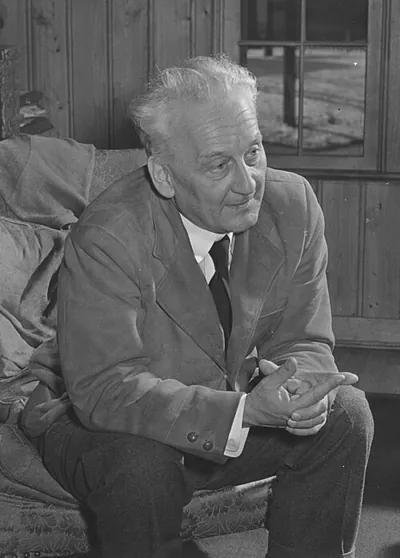 Albert Szent-Györgyi1893–1986 · Biology
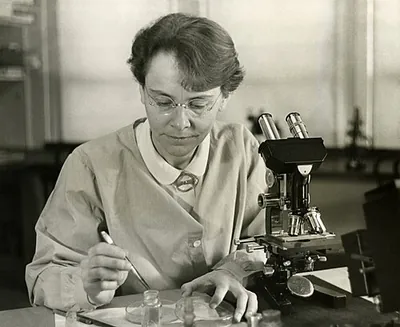 Barbara McClintock1902–1992 · Biology
 J.B.S. Haldane1892–1964 · Biology
 Konrad Lorenz1903–1989 · Biology
