
Jean-Baptiste Dumas
French chemist known for organic analysis and atomic mass measurements, who also held political office and helped found an engineering school · 1800–1884
- Born
- July 14, 1800
- Died
- April 11, 1884
- Country
- France
- Section
- Chemistry
Biography
Jean-Baptiste-André Dumas (Alès, 1800 - Cannes, 1884) was a French chemist who also held political office and played a prominent role in science education in his country for much of the nineteenth century. His name is linked to methods for measuring the mass of atoms and the nitrogen content of organic compounds, as well as to one of the earliest attempts to classify these substances. He matters because his work helped move chemistry from the speculative theories of the early nineteenth century towards one grounded in precise measurement.
He was born in Alès, in the Gard region, and as a young man worked as an apprentice to a pharmacist in his home town. In 1816 he moved to Geneva, where he attended lectures in physics by M. A. Pictet, in chemistry by C. G. de la Rive and in botany by A. P. de Candolle. Before he came of age he was already working with Pierre Prévost on original research into physiological chemistry and embryology. Candolle's botany left a mark on him that would show later, when he applied to chemistry the idea of grouping substances by their resemblances, much as living things are classified.
In 1822 he settled in Paris, following the advice of Alexander von Humboldt. There he became a professor of chemistry, first at the Lycée and from 1835 at the École polytechnique. He joined the French Academy of Sciences in 1832 and from 1868 until his death he served as its permanent secretary for the physical sciences. In 1829 he helped found the École centrale des arts et manufactures in Paris, one of the great engineering schools of France. He succeeded Louis Jacques Thénard in the chemistry chair at the Polytechnique and Jean-Baptiste Biot at the Faculty of Sciences in Paris in 1841; Henri Sainte-Claire Deville took over the latter post in 1868.
His first major disagreement was with the electrochemical theory of Jöns Jakob Berzelius, which was then widely accepted as the correct account of how compounds are built. Berzelius argued for a dualism in which substances formed by joining parts carrying opposite electrical charges. Dumas favoured a unitary view and, in a paper on atomic theory published in 1826, anticipated ideas often credited to a later period. Put simply, he held that atoms combine according to rules of substitution and not only through electrical attraction.
Dumas wanted to measure atomic masses accurately, and to that end he refined the method of measuring vapour densities, which tells you how heavy a given volume of gas is. A known amount of the substance went into a glass bulb that had been weighed beforehand; the bulb was sealed and heated in water until everything had turned to vapour. Measuring the pressure with a barometer and then letting the bulb cool gave the mass of the vapour, and the gas laws then allowed the number of moles inside to be calculated. Using this procedure he revised the atomic weights of carbon and oxygen, and his later work, mostly published between 1858 and 1860, covered around thirty elements. He set new atomic mass values for thirty elements, taking hydrogen as the reference point of 1. He also determined the atomic mass of samarium, one of the rare earth elements.
In 1833 he devised a way of estimating the nitrogen in an organic compound. He burned the sample mixed with copper oxide in a tube, but first filled the tube with carbon dioxide to push out the air, which also contains nitrogen and would have distorted the result. The gases from the burning passed over copper, which took up the oxygen, and then a solution of potassium hydroxide absorbed the carbon dioxide, leaving only nitrogen whose volume could be read off. The technique, known as the Dumas method, largely replaced earlier ones and laid foundations for modern analysis.
Dumas also made an important advance in substitution. According to the best-known story, guests at a party in the Tuileries palace began coughing because of a gas given off by the candles, and his father-in-law, Alexandre Brongniart, asked him to look into it. Dumas found that the chlorine used to whiten the wax was the cause. He then studied how chlorine acted on acetic acid, producing trichloroacetic acid, a similar but stronger acid. He concluded that in an organic compound a hydrogen atom could be replaced by a halogen atom without the overall structure changing much, and he proposed a theory of types in which certain structures remain almost intact even when one atom changes. The idea challenged both Berzelius's dualism and the radical theory, and it helped classify organic compounds into homologous series.
Dumas also worked in physiology and showed that the kidneys remove urea from the blood. After 1848 he traded much of his research for ministerial posts under Napoleon III. He sat in the National Legislative Assembly and served as minister of agriculture and commerce for a few months in 1850-1851. He later became a senator, president of the Paris municipal council and master of the French mint, but his official career ended abruptly with the fall of the Second Empire. He was a devout Catholic and often defended Christian views against his critics. In 1826 he married Herminie Brongniart, daughter of Alexandre Brongniart.
He died in Cannes in 1884 and is buried in the Montparnasse Cemetery in Paris. His legacy is spread across organic chemistry, analytical method and science education: he helped found an engineering school, and his name is one of the 72 inscribed on the Eiffel Tower. The method bearing his name stayed in use in laboratories for decades.
Main contributions
- 1826A paper on atomic theory that argues for a unitary view of chemical combination against Berzelius's dualism.
- 1826A method for measuring vapour densities, which gives the weight of a gas volume and so helps establish atomic masses.
- 1829Co-founding of the École centrale des arts et manufactures in Paris, one of France's major engineering schools.
- 1833A method for determining nitrogen in organic compounds by combustion and gas measurement, known as the Dumas method.
- 1839A theory of substitution and chemical types, holding that certain organic structures persist even when some of their atoms are replaced.
- 1858A series of atomic mass determinations for around thirty elements, mostly published between 1858 and 1860.
- Demonstration that the kidneys remove urea from the blood.
Teachers and students
Taught:
Trivia and anecdotes
The candle gas
According to the most widely told story, guests at an evening in the Tuileries began coughing from a gas given off by the candles, and Dumas traced it to the chlorine used to bleach the wax. The tale is popular, but its historical accuracy is not firmly documented.
Among the 72 names on the Eiffel Tower
His name is carved on the Paris tower, among the 72 scientists honoured on its structure.
A Catholic chemist
Dumas was a practising Catholic who sometimes defended Christian views against critics, which was unusual in the scientific circles of his time.
Their contemporaries
While Jean-Baptiste Dumas was alive (1800–1884)…
Alive at the same time
Discovered or invented in those years
- 1803AtomThe basic unit of a chemical element: a nucleus of protons and usually neutrons surrounded by a cloud of electrons.
- 1846NeptuneThe eighth and most distant planet of the Solar System, an ice giant found through mathematical prediction before any direct sighting.
- 1859EvolutionThe process by which the heritable traits of living populations change over generations, explaining the diversity of life from common ancestors.
- 1869Periodic tableAn arrangement of the chemical elements into rows (periods) and columns (groups), ordered by atomic number, that reveals recurring chemical behaviour and lets scientists predict properties.
- 1876TelephoneA device that carries the human voice over distance by turning sound into electrical signals and back into sound at the other end of the line.
- 1884CarA road vehicle with four wheels and its own engine, mainly built to carry people.
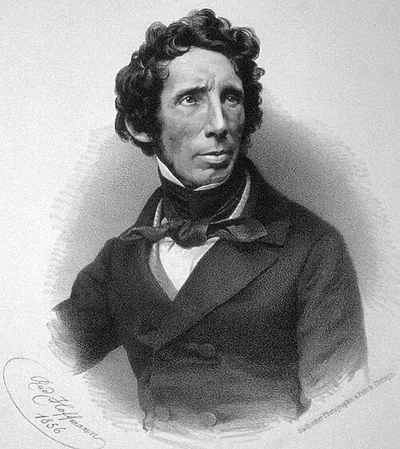 Friedrich Wöhler1800–1882 · Chemistry
 Justus von Liebig1803–1873 · Chemistry
 Thomas Graham1805–1869 · Chemistry
 Robert Bunsen1811–1899 · Chemistry
 Jöns Jacob Berzelius1779–1848 · Chemistry
 Humphry Davy1778–1829 · Chemistry
