
Jean Gaston Darboux
French mathematician known for work in geometry and analysis, and biographer of Henri Poincaré · 1842–1917
- Born
- August 14, 1842
- Died
- February 23, 1917
- Country
- France
- Section
- Mathematics
Biography
Jean Gaston Darboux (Nîmes, 14 August 1842 – Paris, 23 February 1917) was a French mathematician who worked in the second half of the nineteenth century, when geometry and mathematical analysis were undergoing deep renewal in France. His research in both fields, together with his work as an editor and teacher of mathematicians, makes him a key figure of his generation, and his name still appears in many theorems and equations.
According to his birth certificate, he was born at one in the morning on 14 August. Because he came into the world shortly before midnight, he usually gave his birthday as 13 August, as he did on his application for the Légion d'Honneur. He was the son of François Darboux, a haberdashery merchant, and Alix Gourdoux. His father died when Gaston was seven, and his mother ran the family shop with great determination and insisted that her children be well educated. His younger brother, Louis, taught mathematics at the lycée in Nîmes for almost his whole career.
He studied at the lycées of Nîmes and Montpellier and, in 1861, entered the École Normale Supérieure in Paris at the top of the entrance examination. There he completed his doctorate in 1866 under Michel Chasles, with a thesis titled "On Orthogonal Surfaces", a study of families of surfaces that meet at right angles. While still a student he also gave lectures at the Sorbonne and the Collège de France, a sign of the early confidence he inspired.
In 1870 he co-founded the Bulletin des sciences mathématiques et astronomiques, a journal that his contemporaries nicknamed "Darboux's journal" because of his central role in it. Its editorial board included Paul Émile Appell, Émile Borel, Jacques Hadamard and Amedeo Guillet, with Darboux as president. It was published by Gauthier-Villars in Paris.
In 1872 he married Amélie Célina Carbonnier, a milliner from Beauvais, and the couple had two children: Jean-Gaston, born during the Siege of Paris, who later became a marine zoologist at the Faculty of Science in Marseille, and Anaïs Berthe Lucie. In 1880 he helped found the École Normale Supérieure for Young Women, an institution training female teachers that ran alongside the men's school on the rue d'Ulm. Its first director was Julie Favre.
As a researcher, Darboux made important contributions to geometry and analysis, notably to linear partial differential equations, which relate a function to its rates of change. He was elected to the Académie des Sciences in 1884, and in 1900 became the permanent secretary of its mathematics section. He also wrote a biography of Henri Poincaré and edited the selected works of Joseph Fourier. His students included Émile Borel, Élie Cartan, Édouard Goursat, Charles Émile Picard, Gheorghe Țițeica and Stanisław Zaremba, who carried his approach to several countries.
His international recognition grew in the following years. In 1902 he was elected to the Royal Society and to the American Philosophical Society, in 1908 he gave a plenary lecture at the International Congress of Mathematicians in Rome, and in 1916 he received the Sylvester Medal. He went on contributing to the Bulletin even after 1916.
His legacy survives in the names of many concepts: Darboux's equation, the Darboux integral, the Darboux transformation, Darboux's theorem in symplectic geometry and in real analysis, and the Christoffel–Darboux identity, among others. His influence spread through his own papers, the school of students he trained, and the journal he helped lead.
Main contributions
- 1866Doctoral thesis "On Orthogonal Surfaces", supervised by Michel Chasles, on families of surfaces meeting at right angles.
- 1870Co-founding of the Bulletin des sciences mathématiques et astronomiques, a leading journal that he helped direct with other mathematicians.
- 1884Election to the Académie des Sciences of France.
- 1887Lectures on the General Theory of Surfaces and the Geometric Applications of the Infinitesimal Calculus, a four-volume work published up to 1896.
- 1900Appointment as permanent secretary of the mathematics section of the Academy of Sciences.
Teachers and students
Studied under:
Taught:
Trivia and anecdotes
An earlier birthday
Although his birth certificate gives 1 a.m. on 14 August, he usually reported 13 August as his birthday.
Darboux's journal
His contemporaries nicknamed the Bulletin after him because of the great influence he wielded over it.
Their contemporaries
While Jean Gaston Darboux was alive (1842–1917)…
Alive at the same time
Discovered or invented in those years
- 1846NeptuneThe eighth and most distant planet of the Solar System, an ice giant found through mathematical prediction before any direct sighting.
- 1859EvolutionThe process by which the heritable traits of living populations change over generations, explaining the diversity of life from common ancestors.
- 1869Periodic tableAn arrangement of the chemical elements into rows (periods) and columns (groups), ordered by atomic number, that reveals recurring chemical behaviour and lets scientists predict properties.
- 1876TelephoneA device that carries the human voice over distance by turning sound into electrical signals and back into sound at the other end of the line.
- 1884CarA road vehicle with four wheels and its own engine, mainly built to carry people.
- 1903AirplaneA fixed-wing aircraft, heavier than air, powered by engines or rockets, that stays aloft because its wings generate lift.
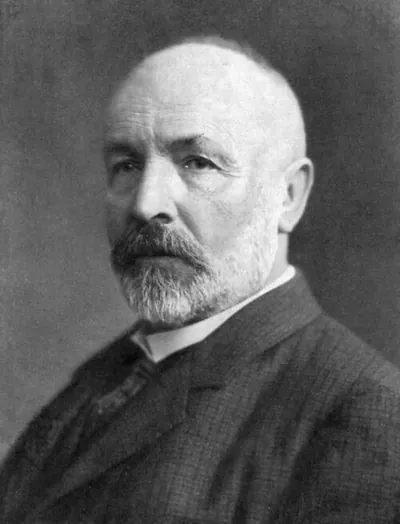 Georg Cantor1845–1918 · Mathematics
 Felix Klein1849–1925 · Mathematics
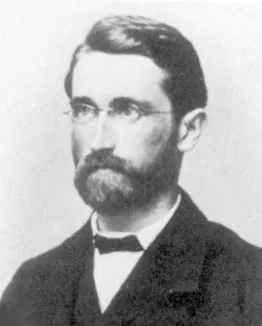 Richard Dedekind1831–1916 · Mathematics
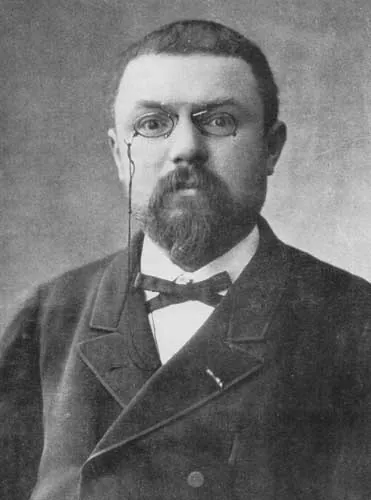 Henri Poincaré1854–1912 · Mathematics
 Bernhard Riemann1826–1866 · Mathematics
 Giuseppe Peano1858–1932 · Mathematics
