
Élie Cartan
French mathematician known for work on Lie groups and differential geometry · 1869–1951
- Born
- April 9, 1869
- Died
- May 6, 1951
- Country
- France
- Section
- Mathematics
Biography
Élie Cartan (Dolomieu, 9 April 1869 – Paris, 6 May 1951) was a French mathematician whose work on Lie groups, differential geometry and systems of differential equations reshaped large parts of modern mathematics. He is widely regarded as one of the greatest mathematicians of the twentieth century, although his originality was only fully recognised late in his life. His ideas later became essential tools in theoretical physics, from general relativity to quantum mechanics.
He was born in a village in the Isère region, the son of a blacksmith, and his mother worked at a spinning wheel while looking after the house and the children. His talent showed early. A local teacher remembered him as a shy pupil with an unusual intellect and an excellent memory, and a regional politician encouraged him to sit for a scholarship to a lycée. He passed the exam at the age of ten and went on to study at schools in Vienne, Grenoble and, finally, the Lycée Janson de Sailly in Paris, where he befriended the future physicist Jean-Baptiste Perrin.
In 1888 he entered the École Normale Supérieure and attended lectures by leading figures such as Hermite, Darboux, Picard and Poincaré. Poincaré's lectures were the ones Cartan admired most, and Poincaré's later recommendation helped him secure a chair at the Sorbonne. After his military service, where he reached the rank of sergeant, he returned to the school and chose a subject that seemed rather old-fashioned: the classification of simple Lie groups. A Lie group is a mathematical structure that describes continuous symmetries, such as the rotations of a sphere. The groundwork had been laid by Wilhelm Killing, whose proofs were often flawed, and Cartan set out to put the theory on a rigorous footing.
In 1892 Sophus Lie visited Paris at the invitation of Darboux and Tannery and met Cartan for the first time. The two corresponded fruitfully during the years that followed. Cartan defended his doctoral thesis in 1894 at the Faculty of Sciences in Paris, on the structure of finite continuous groups of transformations. The thesis gave a complete classification of simple complex Lie algebras, the algebraic objects that encode the local behaviour of these groups: four main families and five exceptional cases. It became the starting point for much of his later work.
His academic career moved steadily through provincial universities, first Montpellier, then Lyon and Nancy, where he became a full professor in 1904. In 1909 he moved to Paris, where he held the chairs of differential and integral calculus, rational mechanics and higher geometry. He also cared about practical teaching and organised numerical exercises for large groups of students. He had two sons: Henri, who became a leading mathematician in algebraic topology, and Jean, a composer. He retired in 1940, and after the war he was elected president of the French Academy of Sciences in 1946.
His deepest work concerns differential systems, that is, equations relating unknown functions to their derivatives. Cartan aimed to state and solve such problems without relying on any particular choice of coordinates, which allowed him for the first time to define precisely what a general solution of an arbitrary system is. To capture singular solutions, those that cannot be obtained from the general one, he devised a method of prolongation that adds new unknowns and equations to the system. He showed that the method worked in every example he studied, but could not prove it in general. That proof came in 1955, from Masatake Kuranishi. His main tool was the calculus of exterior differential forms, which he helped to develop in the decade after his thesis. He applied it to differential geometry, Lie groups, dynamics and relativity, in a style that his colleagues found hard to follow but that rested on an exceptional algebraic and geometric intuition.
In differential geometry he revitalised a field that he felt had become bogged down in lengthy calculations and minor results. He extended Darboux's method of moving frames, which attaches to each point of a surface a reference system that moves with it, and gave it far greater power. Working this way, he implicitly introduced the idea of a fibre bundle, a structure that attaches to each point of a space an auxiliary space, although he never defined it explicitly. The concept later became central to modern mathematics. He also formulated the notion of connection, which describes how a vector can be carried from one point to another on a curved space, and his version is used universally today. It underpinned his proposal of a generalised geometry, now called Riemann-Cartan geometry.
His most striking contribution to geometry was the study of symmetric Riemann spaces. These are spaces where, around each point, there is a symmetry that leaves that point fixed and preserves distances. Cartan showed that they can be completely described through the classification of simple Lie groups, a result that was not obvious and later proved useful in the theory of automorphic functions and analytic number theory. He was one of the rare mathematicians who both opened a theory and brought it to completion.
His links with physics were indirect but important. While studying the linear representations of orthogonal groups in 1913, he discovered spinors, mathematical objects that later proved essential in quantum mechanics. Around 1922 he also helped refine tools of general relativity, in particular Ricci tensors. He corresponded with Einstein about absolute parallelism and tried to build an alternative theory of gravity, now known as the Einstein-Cartan theory. It never displaced general relativity, but it remains an object of study.
Cartan was not a man of public controversies, though his work was often discussed intensely among his contemporaries. Many of his methods seemed too abstract until others applied them. His legacy lies in the concepts that now form part of the everyday toolkit of physicists and mathematicians: Lie groups, exterior differential forms, connections, symmetric spaces and spinors. His name is attached to theorems and objects, and a lunar crater was named after him in 1976. He also trained a generation of researchers in the interwar period, among them his son Henri.
Main contributions
- 1894Classification of simple complex Lie algebras, presented in his thesis: four main families and five exceptional cases.
- 1900The calculus of exterior differential forms, developed in the decade after his thesis and now a central tool of geometric analysis.
- 1913Discovery of spinors while studying linear representations of orthogonal groups, objects later central to quantum mechanics.
- 1922Contributions to the mathematical tools of general relativity, including Ricci tensors, and the proposal of Riemann-Cartan geometry.
- 1926Classification of symmetric Riemann spaces through the classification of simple Lie groups.
- 1935Formulation of the concept of connection, which describes how geometric information is carried between points of a curved space, now used universally.
Teachers and students
Studied under:
Taught:
Trivia and anecdotes
A student's recollection
Shiing-Shen Chern, one of his students, recalled that Cartan often wrote to him the day after their meetings with new answers, and that he knew the papers on simple Lie groups by heart.
A crater with a borrowed name
Before it was renamed for him in 1976, the lunar crater now bearing his name was designated Apollonius D.
Their contemporaries
While Élie Cartan was alive (1869–1951)…
Alive at the same time
Discovered or invented in those years
- 1869Periodic tableAn arrangement of the chemical elements into rows (periods) and columns (groups), ordered by atomic number, that reveals recurring chemical behaviour and lets scientists predict properties.
- 1876TelephoneA device that carries the human voice over distance by turning sound into electrical signals and back into sound at the other end of the line.
- 1884CarA road vehicle with four wheels and its own engine, mainly built to carry people.
- 1903AirplaneA fixed-wing aircraft, heavier than air, powered by engines or rockets, that stays aloft because its wings generate lift.
- 1925TelevisionA system that sends moving pictures and sound over distance and shows them on a receiver, the television set.
- 1945ComputerA programmable machine that takes in data, processes it by following stored instructions, and produces results, able to switch tasks simply by running different software.
 Bertrand Russell1872–1970 · Mathematics
 Hermann Minkowski1864–1909 · Mathematics
 Henri Lebesgue1875–1941 · Mathematics
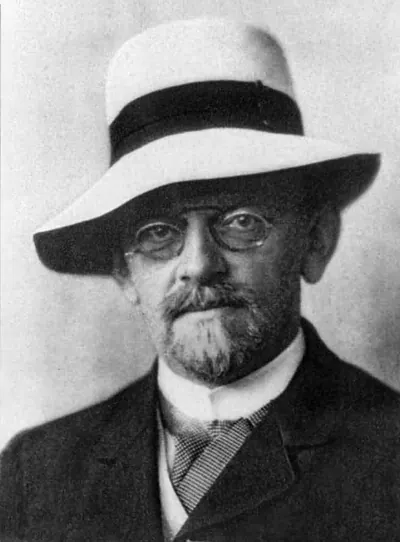 David Hilbert1862–1943 · Mathematics
 G.H. Hardy1877–1947 · Mathematics
 Giuseppe Peano1858–1932 · Mathematics
