
Johan Gunnar Andersson
Swedish archaeologist, geologist and palaeontologist, Antarctic explorer and pioneer of Chinese archaeology · 1874–1960
- Born
- July 3, 1874
- Died
- October 29, 1960
- Country
- Sweden
- Section
- Earth sciences
Biography
Johan Gunnar Andersson (1874-1960) was a Swedish archaeologist, geologist, palaeontologist and polar explorer. After taking part in an Antarctic expedition at the start of the twentieth century, he became a central figure in the beginnings of Chinese archaeology in the 1920s, which places him between polar geology and the prehistory of East Asia.
He studied at Uppsala University, where he trained in geology and palaeontology, the science of ancient fossils. In 1906 he became professor of geography at Uppsala and head of the Swedish Geological Survey. He held the chair of geology at Stockholm University from 1925 to 1926.
Between 1901 and 1904 he served as second in command of the Swedish Antarctic Expedition, led by Otto Nordenskjöld. He explored South Georgia's St Peter's Island and Hope Bay, at the northern tip of the Antarctic Peninsula, where he mapped the area and collected fossils and minerals on Flora Peak. With Samuel A. Duse and Toralf Grunden he spent the austral winter of 1903 at Hope Bay, after an unsuccessful attempt to reach Cerro Nevado island. The three men built a stone hut and survived nine months on penguins and seals until they were rescued by the Argentine corvette ARA Uruguay. The hut is now a protected historic site under the Antarctic Treaty and was declared a National Historic Monument of Argentina in 2010. His work in the Falkland Islands and on Bjørnøya led him to coin the term solifluction, for the slow downhill movement of waterlogged soil in cold regions. The idea influenced the Polish geologist Walery Łoziński, who proposed the concept of periglaciation in 1909.
In 1914 he went to China as a technical adviser on oil and coal for the Chinese government. He worked with the National Geological Survey under Ding Wenjiang, helped train China's first generation of geologists, and located iron ore and other resources. His fascination with fossils drew him toward archaeology. He first visited Zhoukoudian in 1918. In 1921, at Yangshao in Henan province, he found finely painted pottery that showed a Neolithic culture in China. He suggested that these pottery styles might have come from the west, an idea that is still debated. His excavations in Gansu and Qinghai between 1923 and 1924, and his 1923 preliminary report, shaped these early investigations.
In 1921 he judged, from quartz that did not belong to the local rock, that human remains might lie in the cave at Zhoukoudian, and he sent his assistant Otto Zdansky to dig there. In 1926 he announced two human teeth, which were later identified as the first finds of Peking Man, Homo erectus pekinensis.
In 1926 he founded the Museum of Far Eastern Antiquities in Stockholm, which he directed until 1939. He returned the Chinese part of his collections to the Chinese government in seven shipments between 1927 and 1936. Much of this material was lost and has never been found. His book Den gula jordens barn, published in 1932, was translated into several languages and brought his work to a wide readership. He died in Stockholm in 1960.
Main contributions
- 1903Spends the austral winter at Hope Bay, where he maps the northern tip of the Antarctic Peninsula.
- 1906Publishes a study of the geology of Graham Land in Uppsala.
- 1914Travels to China as a technical adviser on oil and coal and helps train China's first geologists.
- 1921Finds painted pottery at Yangshao, the first evidence of a Neolithic culture in China.
- 1923Publishes a preliminary report titled Early Chinese Culture.
- 1926Announces two human teeth, the first finds of Peking Man.
- 1932Publishes Den gula jordens barn, a book about his years in China that was translated into several languages.
- Coins the term solifluction, the slow downhill creep of waterlogged soil in cold regions.
Trivia and anecdotes
A hut still standing
The stone hut where he spent the winter of 1903 has been preserved and is now a protected historic monument in Antarctica.
The hill of chicken bones
Local people called Zhoukoudian the Chicken Bone Hill because they mistook the abundant rodent fossils there for chicken bones.
Lost collections
For decades the objects returned to China were thought to be lost forever, until three crates of ceramics turned up in a Beijing museum in 2002.
Their contemporaries
While Johan Gunnar Andersson was alive (1874–1960)…
Alive at the same time
Discovered or invented in those years
- 1876TelephoneA device that carries the human voice over distance by turning sound into electrical signals and back into sound at the other end of the line.
- 1884CarA road vehicle with four wheels and its own engine, mainly built to carry people.
- 1903AirplaneA fixed-wing aircraft, heavier than air, powered by engines or rockets, that stays aloft because its wings generate lift.
- 1925TelevisionA system that sends moving pictures and sound over distance and shows them on a receiver, the television set.
- 1931Big BangA cosmological model describing how the universe expanded from an early state of extreme density and temperature, about 13.8 billion years ago.
- 1945ComputerA programmable machine that takes in data, processes it by following stored instructions, and produces results, able to switch tasks simply by running different software.
 Lev Berg1876–1950 · Earth sciences
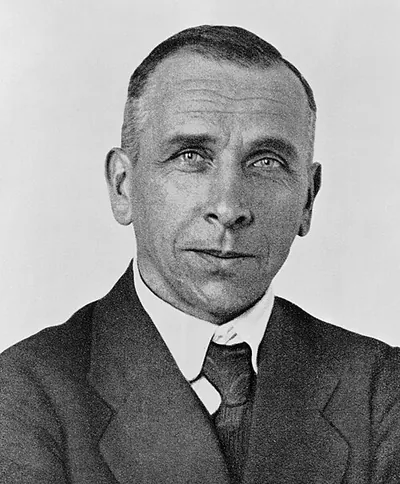 Alfred Wegener1880–1930 · Earth sciences
 Lewis Fry Richardson1881–1953 · Earth sciences
 Vladimir Vernadsky1863–1945 · Earth sciences
 Vladimir A. Obruchev1863–1956 · Earth sciences
 Vilhelm Bjerknes1862–1951 · Earth sciences
