
John Charles Fields
Canadian mathematician and founder of the Fields Medal · 1863–1932
- Born
- May 14, 1863
- Died
- August 9, 1932
- Country
- Canada
- Section
- Mathematics
Biography
John Charles Fields was a Canadian mathematician whose lasting mark on his field lies less in his own research than in the prize that bears his name. He was born on May 14, 1863, in Hamilton, Ontario, then part of Canada West, to a family that ran a leather goods shop.
He graduated from Hamilton Collegiate Institute in 1880 and then from University College at the University of Toronto in 1884. That same year he left for the United States to study at Johns Hopkins University in Baltimore. His doctoral thesis, on solutions of a differential equation, which links a function to its own rates of change, appeared in the American Journal of Mathematics in 1886, and he received his PhD in 1887. He taught at Johns Hopkins for two years before joining the faculty of Allegheny College in Meadville, Pennsylvania.
He soon grew disillusioned with the state of mathematical research in North America. In 1891 he went to Europe, spending most of his time in Berlin, Göttingen and Paris, where he met some of the leading figures of the day, among them Karl Weierstrass, Felix Klein, Ferdinand Georg Frobenius and Max Planck. There he also began a friendship with the Swedish mathematician Gösta Mittag-Leffler that lasted his whole life. It was around this time that he started publishing on algebraic functions, a subject that turned out to be the most productive area of his career. Put simply, an algebraic function is one built from a variable through sums, products, powers and roots.
In 1902 he returned to Canada to lecture at the University of Toronto, and he set about raising the standing of mathematics in both academic and public life. He lobbied the Ontario Legislature until it granted an annual research grant of $75,000, and he helped set up the National Research Council of Canada and the Ontario Research Foundation. From 1919 to 1925 he served as president of the Royal Canadian Institute, hoping to turn it into a leading centre of scientific research, though with mixed results. His efforts were decisive in bringing the 1924 International Congress of Mathematicians to Toronto. He also gave invited lectures at the congresses of 1912 in Cambridge and 1928 in Bologna.
His standing earned him election to the Royal Society of Canada in 1907 and to the Royal Society of London in 1913. The Fields Institute at the University of Toronto was later named in his honour, and it is devoted to mathematical research.
His most enduring idea came in the late 1920s: an international prize for mathematicians under forty. Some regard it as the Nobel Prize of mathematics, although the two awards differ. Every four years, at the International Congress of Mathematicians, it goes to two, three or four mathematicians who have made important contributions to the field. Fields never saw it realised, because his health deteriorated. He died on August 9, 1932, after a three-month illness, at the age of 69, and in his will he left $47,000 for the medal fund. His plan was completed by J. L. Synge, and the first medals were awarded in 1936. Since 1950 the International Mathematical Union has been responsible for the award.
His legacy is the medal and the attention it brings to a discipline that rarely gets much of it. Among the laureates there is one unusual case. The Russian mathematician Grigori Perelman refused the medal, explaining that he cared only about whether his proof was correct. Fields thus left behind a prize that keeps mathematics in the public eye.
Main contributions
- 1886Thesis on solutions of a differential equation, published in the American Journal of Mathematics.
- 1887Received his doctorate from Johns Hopkins University.
- 1907Elected a fellow of the Royal Society of Canada.
- 1913Elected a fellow of the Royal Society of London.
- 1924The International Congress of Mathematicians held in Toronto, largely thanks to his efforts.
- 1936First award of the Fields Medal, the prize he had championed.
- Research on algebraic functions, the most productive field of his career.
Teachers and students
Trivia and anecdotes
A prize refused
The Russian mathematician Grigori Perelman is the only laureate known to have turned the medal down. He said he cared only about whether his proof was correct.
The only physicist to win
Edward Witten is the only physicist to have won the Fields Medal. He works at the Institute for Advanced Study in Princeton.
An idea he never saw realised
Fields conceived the prize in the late 1920s but died before it was launched. His will left $47,000 to fund it.
Their contemporaries
While John Charles Fields was alive (1863–1932)…
Alive at the same time
Discovered or invented in those years
- 1869Periodic tableAn arrangement of the chemical elements into rows (periods) and columns (groups), ordered by atomic number, that reveals recurring chemical behaviour and lets scientists predict properties.
- 1869Deoxyribonucleic acidA double-stranded molecule that carries the genetic instructions of nearly all living things and many viruses.
- 1876TelephoneA device that carries the human voice over distance by turning sound into electrical signals and back into sound at the other end of the line.
- 1884CarA road vehicle with four wheels and its own engine, mainly built to carry people.
- 1903AirplaneA fixed-wing aircraft, heavier than air, powered by engines or rockets, that stays aloft because its wings generate lift.
- 1925TelevisionA system that sends moving pictures and sound over distance and shows them on a receiver, the television set.
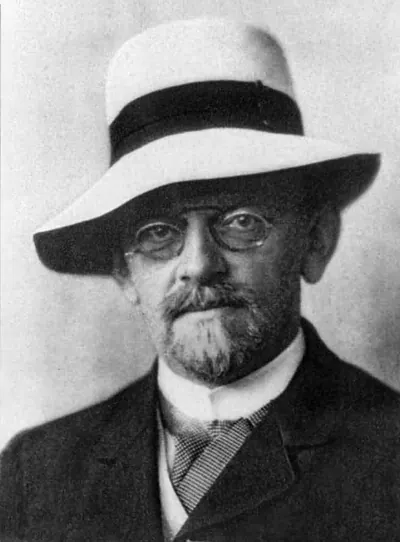 David Hilbert1862–1943 · Mathematics
 Hermann Minkowski1864–1909 · Mathematics
 Giuseppe Peano1858–1932 · Mathematics
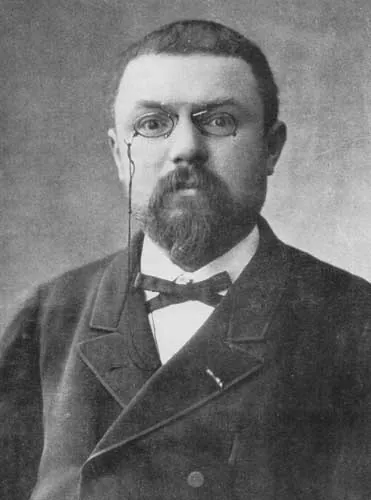 Henri Poincaré1854–1912 · Mathematics
 Bertrand Russell1872–1970 · Mathematics
 Henri Lebesgue1875–1941 · Mathematics
