
John Couch Adams
English mathematician and astronomer who predicted the existence and position of Neptune using mathematics alone · 1819–1892
- Born
- June 5, 1819
- Died
- January 21, 1892
- Country
- United Kingdom of Great Britain and Ireland
- Section
- Astronomy and space
Biography
John Couch Adams (born 5 June 1819 at Laneast, Cornwall; died 21 January 1892 in Cambridge) was a British mathematician and astronomer best known for predicting, on paper, the existence and position of a planet that no one had yet seen: Neptune. He worked in Victorian England, when calculating planetary orbits was the core of positional astronomy, and his case showed that celestial mechanics could reveal a body before a telescope found it.
Adams was born on a farm in Cornwall, the eldest of seven children of a poor tenant farmer and a devout Wesleyan mother. His mother had inherited a small library from her uncle, John Couch, and the boy grew fascinated by astronomy books from an early age. He attended the village school at Laneast, where he picked up some Greek and algebra, and at twelve he moved to Devonport to a private school run by a cousin of his mother. There he studied the classics, but he taught himself most of his mathematics, using the library of the Devonport Mechanics' Institute. At nineteen he watched Halley's Comet and began making his own calculations and observations, paying for his interests with private tutoring.
He entered St John's College, Cambridge, in 1839 as a sizar, a student who held a paid-service place, and graduated in 1843 as senior wrangler, the top mathematics graduate of his year, also winning the Smith's Prize. His real project, though, had begun as an undergraduate. Since 1821, astronomical tables by Alexis Bouvard had failed to predict the orbit of Uranus accurately, and Bouvard suspected an unseen body pulling on it. Adams became convinced that the observed data, together with Newton's law of gravitation alone, could reveal that body's mass, position and orbit. He noted his intention to tackle the problem in July 1841 and, after his exams, spent a summer in Cornwall working through the first of six successive approximations, while tutoring undergraduates and sending money home to educate his brothers.
In September 1845 he passed his results to James Challis, director of the Cambridge Observatory, though how exactly is uncertain. On 21 October 1845 he called twice, without an appointment, on the Astronomer Royal, George Biddell Airy, at Greenwich. Airy was out, and Adams reportedly left a manuscript with the solution but not the detailed working. Airy wrote asking for clarification and Adams never replied. Historians have offered several reasons, from nervousness and procrastination to disorganisation, and the claim that he thought the question trivial is doubtful. Meanwhile Urbain Le Verrier, a Frenchman working independently, presented his own results to the Paris Academy of Sciences between November 1845 and August 1846. Alarmed, Airy launched a systematic search in late July 1846, run by Challis from Cambridge. Challis observed the planet on 8 and 12 August but took it for a star, since his star charts were not up to date.
On 23 September 1846 Johann Gottfried Galle at the Berlin Observatory found Neptune within about one degree of the position Le Verrier had given him. The announcement set off a dispute in France and England over who deserved the credit. Most historians now regard the two men as having reached the result independently and give them equal recognition. Adams himself openly acknowledged Le Verrier's priority in his November 1846 paper to the Royal Astronomical Society, and he bore no lasting grudge against Challis or Airy, although the myth that Britain had stolen Neptune still circulates.
His fame from Neptune did not end his productive work. In 1847 Queen Victoria is said to have offered him a knighthood, which he reportedly declined, out of modesty or a wish to avoid the costs of such a title. The Royal Society gave him the Copley Medal in 1848. In 1852 he published lunar parallax tables more accurate than those of Johann Karl Burckhardt, and in 1853 he showed that tangential gravitational forces, which others had neglected, affected the Moon's secular acceleration. He concluded that Plana had overestimated this acceleration by about 1.66 arcseconds per century. The dispute with other specialists lasted years, until in 1860 Adams repeated his results without power series and they were accepted. That work won him the Royal Astronomical Society's Gold Medal in 1866.
In 1858 he was appointed professor of mathematics at St Andrews but lectured for only one session before returning to Cambridge as Lowndean Professor of Astronomy and Geometry, a post he held from 1859 until his death. In 1860 he succeeded Challis as director of the Cambridge Observatory. His work on the Leonids, the November meteor shower, was especially influential. After the great shower of 1866 he calculated that the meteors followed an elongated ellipse in about 33 years and were disturbed by Jupiter, Saturn and Uranus. His orbit matched that of comet 55P/Tempel-Tuttle, which pointed to a link between comets and meteors that is now widely accepted. In 1884 he represented Britain at the International Meridian Conference in Washington.
Adams had an intense devotion to numerical work, which he pursued for its own sake, and an unbounded admiration for Newton. With G. G. Stokes he arranged the Newton papers donated to Cambridge by the Earl of Portsmouth. He married Eliza Bruce of Dublin in 1863; she survived him. He died at Cambridge on 21 January 1892 after a long illness and was buried near his home. His legacy lives on in the lunar crater Adams, in Neptune's outermost ring, in the asteroid 1996 Adams, in the Cambridge Adams Prize, and in memorials such as his statue in Manchester. His reticence and difficulty with other people are still discussed by historians of science as possible traits of a solitary mind.
Main contributions
- 1845Mathematical prediction of Neptune: from Uranus's irregularities, he deduced the mass, position and orbit of an unknown planet using only Newton's law of gravitation.
- 1852Lunar parallax tables: more precise tables that superseded those of Burckhardt.
- 1853Correction of the Moon's secular acceleration: he showed that tangential gravitational terms matter and estimated Plana's overestimate at about 1.66 arcseconds per century.
- 1867Orbit of the Leonids: he calculated an elliptical orbit of about 33 years for this meteor shower, matching comet Tempel-Tuttle.
- 1888Catalogue of Newton's papers: work with G. G. Stokes to arrange and catalogue the Newton manuscripts donated to Cambridge.
Teachers and students
Trivia and anecdotes
A peculiar calculation
According to his biographers, Adams calculated the Euler-Mascheroni constant to 236 decimal places, an almost playful exercise for him.
The unanswered letter
It is said that Adams never replied to Airy's letter asking for clarification of his work, and the reasons for that silence are still debated.
Their contemporaries
While John Couch Adams was alive (1819–1892)…
Alive at the same time
Discovered or invented in those years
- 1846NeptuneThe eighth and most distant planet of the Solar System, an ice giant found through mathematical prediction before any direct sighting.
- 1859EvolutionThe process by which the heritable traits of living populations change over generations, explaining the diversity of life from common ancestors.
- 1869Periodic tableAn arrangement of the chemical elements into rows (periods) and columns (groups), ordered by atomic number, that reveals recurring chemical behaviour and lets scientists predict properties.
- 1869Deoxyribonucleic acidA double-stranded molecule that carries the genetic instructions of nearly all living things and many viruses.
- 1876TelephoneA device that carries the human voice over distance by turning sound into electrical signals and back into sound at the other end of the line.
- 1884CarA road vehicle with four wheels and its own engine, mainly built to carry people.
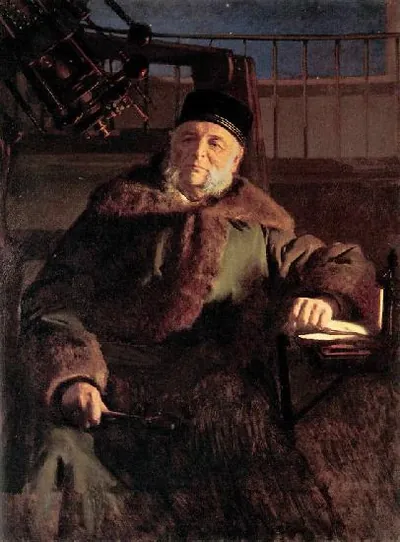 Otto Wilhelm von Struve1819–1905 · Astronomy and space
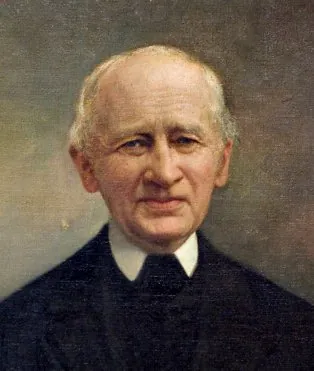 Johann Gottfried Galle1812–1910 · Astronomy and space
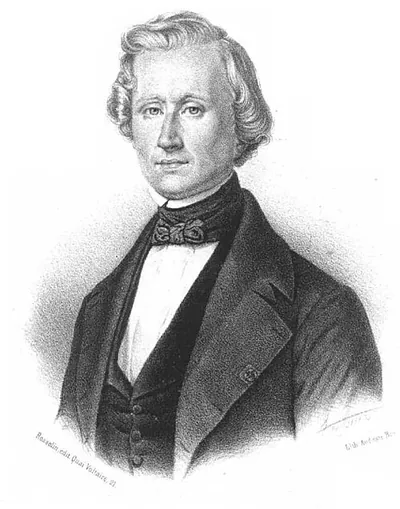 Urbain Le Verrier1811–1877 · Astronomy and space
 John Frederick William Herschel1792–1871 · Astronomy and space
 Annie Jump Cannon1863–1941 · Astronomy and space
 Henrietta Swan Leavitt1868–1921 · Astronomy and space
