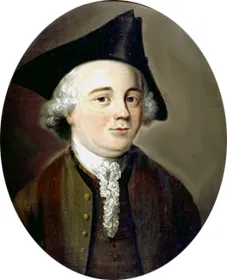
John Kay
English inventor of the flying shuttle · 1704–1779
- Born
- June 17, 1704
- Died
- 1779
- Country
- Kingdom of Great Britain
- Section
- Engineering and construction
Biography
John Kay (born 17 June 1704 in Walmersley, near Bury, Lancashire; died c. 1779 in France) was an English inventor best known for the flying shuttle, a device that sped up weaving and became a key step in the Industrial Revolution. He lived during the shift from hand craft to machine production. He is often confused with a namesake who built the first spinning frame, so the two should be kept apart.
Kay grew up in a yeoman farming family. His father died before he was born, and as the fifth of ten children he received a modest bequest of £40 when he came of age at 21, along with schooling until 14. He was apprenticed to a maker of hand-loom reeds, the comb-like frames that keep warp threads spaced, but tradition says he went home after a month claiming he had mastered the trade. He soon devised a metal substitute for the natural reed, which sold well across England. He married Anne Holte in 1725, and in 1730 he patented a machine for twisting worsted, a long-fibred wool yarn.
In 1733 he patented his most famous device, a 'wheeled shuttle' for the hand loom. The shuttle carries the weft thread back and forth through the warp threads. Before, it was thrown by hand, and a broad cloth needed two weavers, one on each side. Kay mounted the shuttle on wheels running along a track and fired it across with paddles when the weaver pulled a cord. One operator could now weave any width faster than two could by the old method. Kay always called it the wheeled shuttle, but the name 'flying shuttle' caught on because of its continuous speed.
Weavers resisted. In 1733 Kay formed a partnership in Colchester to make the shuttles, but by September local weavers were petitioning the King to stop his inventions. The shuttle doubled weaving output without speeding up spinning, which upset spinners and weavers alike. In 1738 he moved to Leeds to collect royalties of 15 shillings a year per shuttle. Manufacturers responded by forming the Shuttle Club, a fund that paid the legal costs of any member sued. Kay launched many lawsuits, but awards barely covered court costs, and the struggle nearly ruined him. In 1745 he and Joseph Stell patented a ribbon-weaving machine, but lacked the money to develop it.
In 1747 he went to France, a country he had never visited and whose language he did not speak. The French government agreed to buy his patent for 3,000 livres plus a pension of 2,500 livres a year from 1749, far less than he had asked. Traditionally, French textile mechanisation is dated from about 1753, when the flying shuttle spread widely, though most machines were copies he did not make. His attempts to enforce his monopoly brought him into conflict with officials. He visited England briefly in 1756 and was back in France by 1758, where he settled.
In the winter of 1765-1766 he appealed to the Royal Society of Arts for a reward and showed a card-making machine, but no award followed, since nobody there understood the shuttle and correspondence broke down. In 1774, aged 70 and without his pension, he returned to France and earned a living building machines for cotton makers in Sens and Troyes. His last known letter is dated 8 June 1779, and he probably died later that year.
In Bury he is remembered as a local hero: several pubs bear his name, and a 1908 memorial by William Venn Gough, with sculpture by John Cassidy, stands in the town centre. His son Robert developed the drop-box in 1760, which let looms use several shuttles and weave multicolour wefts. Kay's legacy is mainly technical: the flying shuttle increased demand for yarn, which encouraged spinning machines, and it paved the way for the power loom.
Main contributions
- 1730A machine for twisting and spinning worsted wool, patented in 1730.
- 1733The flying shuttle: a wheeled shuttle that let one operator weave broad cloth.
- 1745A ribbon-weaving machine, patented with Joseph Stell, that was never fully developed.
- 1760The drop-box, developed by his son Robert, for weaving multicolour wefts.
Trivia and anecdotes
A confusing name
Kay is often mixed up with his namesake, who built the first spinning frame. They were two different people.
Speed beyond imagining
A contemporary described the shuttle as moving so fast that it could only be seen as a tiny cloud that vanished at once.
A doubtful attack
It is said that a mob wrecked his Bury home in 1753 and that he narrowly escaped with his life, but the story is probably a 19th-century tale based on the Colchester riots.
Related discoveries and inventions
- 1733Flying shuttleA weaving shuttle propelled mechanically along a track, allowing one weaver to produce much wider cloth.
Their contemporaries
While John Kay was alive (1704–1779)…
Alive at the same time
Discovered or invented in those years
- 1712Steam engineAn engine that turns the heat energy of water vapour into mechanical motion, using a piston that moves back and forth inside a cylinder.
- 1755MagnesiumMagnesium is a light, shiny gray-white metal with atomic number 12 and symbol Mg, found in many minerals, seawater and living organisms.
- 1766HydrogenThe lightest and most abundant chemical element in the universe, atomic number 1, which under normal conditions is a colourless, odourless and highly flammable gas.
- 1772NitrogenChemical element with atomic number 7, a colourless, odourless gas that makes up about 78% of Earth's air and is an essential part of proteins and nucleic acids.
- 1774OxygenA colorless, odorless gas, symbol O and atomic number 8, that forms the dioxygen in air and is essential for respiration in most living things.
- 1774ChlorineA yellow-green, poisonous and highly reactive gas, element 17, which is part of common salt and is used to disinfect water and make plastics.
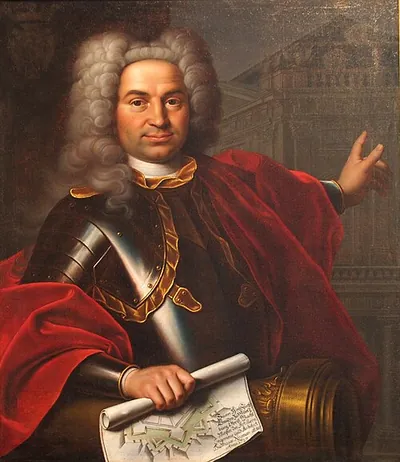 Johann Balthasar Neumann1687–1753 · Engineering and construction
 John Smeaton1724–1792 · Engineering and construction
 René Antoine Ferchault de Réaumur1683–1757 · Engineering and construction
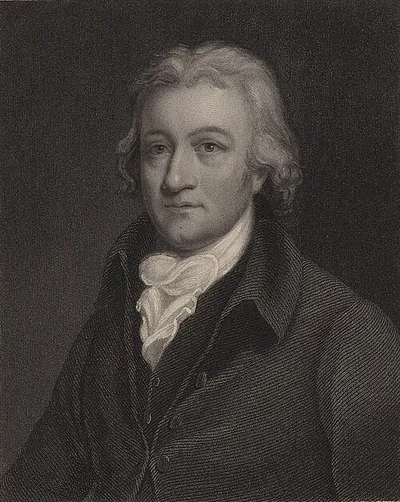 Edmund Cartwright1743–1823 · Engineering and construction
 Lazare Carnot1753–1823 · Engineering and construction
