
John Perdew
American theoretical physicist, a key figure in density functional theory · 1943
- Born
- August 30, 1943
- Country
- United States
- Section
- Physics
Biography
John Perdew is an American theoretical physicist who works on condensed matter, the branch of physics that studies solids and liquids. His work on density functional theory (DFT) has made him one of the world's most cited physicists. His contributions have helped the method become reliable enough for quantum chemistry, materials science and geoscience.
Perdew was born and raised in Cumberland, Maryland. After showing talent for mathematics at school, he won a National Merit Scholarship and went to Gettysburg College, where his interest in physics took root. He graduated summa cum laude in 1965 and earned a PhD in physics from Cornell University in 1971. His doctoral adviser, John W. Wilkins, introduced him to solid-state theory, the study of how electrons behave inside solids such as metals and crystals.
His research career began as a postdoctoral fellow with Sy Vosko at the University of Toronto, from 1971 to 1974, and then with David Langreth at Rutgers University, from 1975 to 1977. It was in those postdoctoral posts that he first learned DFT, years before the method came into wide use. He started teaching in 1977 at Tulane University, where he stayed until 2013 and supervised nine PhD students and eleven postdoctoral researchers. In 2013 he moved to Temple University, where he holds a chair in physics and chemistry and founded the Center for Materials Theory.
DFT describes a system of many electrons through its electron density, meaning how charge is spread through space, rather than tracking each electron separately. The difficulty is that one term in the energy, the exchange-correlation term, cannot be known exactly. Perdew made major advances both in how this term is approximated and in the rules any good approximation should obey. Among his contributions are the generalized gradient approximation (GGA), which takes into account how the density changes from point to point, and the meta-GGA, a more refined version of the same idea. He also worked on the self-interaction correction, which fixes the error that arises when an electron seems to interact with itself.
To organise these versions he proposed Jacob's Ladder, a picture in which each rung is a generation of functionals more accurate than the one below, climbing toward what he called the heaven of chemical accuracy. He presented it at the DFT2000 congress in June 2000, and other researchers have adopted it as a framework. Today his lines of work include building a better meta-GGA and describing strongly correlated electrons and van der Waals forces, the weak attractions between molecules, more accurately.
The reach of his work shows in citation counts. One study ranked him the most-cited physicist for papers published between 1981 and 2010. His 1996 paper "Generalized Gradient Approximation Made Simple", in Physical Review Letters, was the most-cited physics paper of that period, and five of his works appear among the ten most-cited physics papers of the past thirty years. He was elected to the US National Academy of Sciences in 2011, and a year later the Materials Research Society gave him its Materials Theory Award for pioneering contributions that let thousands of researchers run DFT calculations and simulations. In 2015 he was named an Alexander von Humboldt Professor and received an honorary doctorate from the Budapest University of Technology and Economics.
His legacy is twofold. He gave the scientific community tools now used to design materials, study catalysis and explore complex chemistry without carrying out every experiment. His Jacob's Ladder also offers a conceptual map for further improving the theory, and the field's literature continues to build on it.
Main contributions
- 1984Levy-Perdew-Sahni (LPS) equation: the counterpart to the Kohn-Sham equations for orbital-free density functional theory.
- 1996Generalized Gradient Approximation Made Simple: a paper on the generalized gradient approximation (GGA), a way of estimating the exchange-correlation energy that accounts for how electron density changes from point to point.
- 2000Jacob's Ladder: a classification of DFT functionals into five generations of increasing accuracy, presented at the DFT2000 congress.
Teachers and students
Trivia and anecdotes
A highly cited physicist
One study identified him as the most-cited physicist in scientific papers between 1981 and 2010.
The name of the ladder
The Jacob's Ladder metaphor alludes to the biblical dream of a ladder reaching heaven, used here to describe the pursuit of chemical accuracy.
Their contemporaries
While John Perdew was alive (1943–)…
Alive at the same time
Discovered or invented in those years
- 1945ComputerA programmable machine that takes in data, processes it by following stored instructions, and produces results, able to switch tasks simply by running different software.
- 1957Artificial satelliteAn artificial satellite is a human-made object placed in orbit around a celestial body, usually Earth, to collect information, relay signals, or carry out a specific task.
- 1969InternetA global network of interconnected computer networks that communicate using the TCP/IP protocol suite.
- 1971EmailA network service that lets users send and receive digital messages through addressed mailboxes, much like postal mail but electronic.
- 1973Mobile phoneA handheld wireless phone that lets people make and receive calls while moving across a cellular network area.
- 1989World Wide WebA system of linked documents and resources, connected by hyperlinks and accessed over the Internet with web browsers.
 Stephen Hawking1942–2018 · Physics
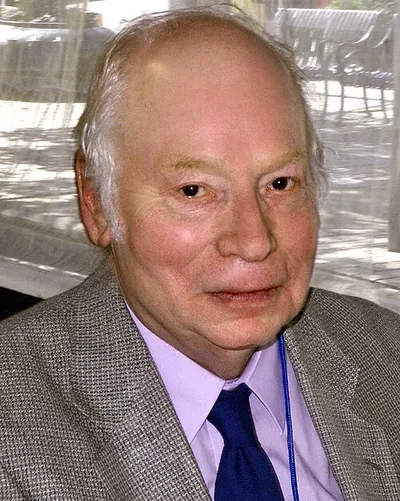 Steven Weinberg1933–2021 · Physics
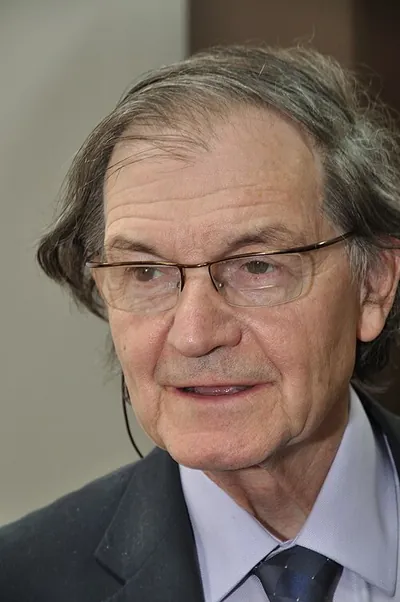 Roger Penrose1931 · Physics
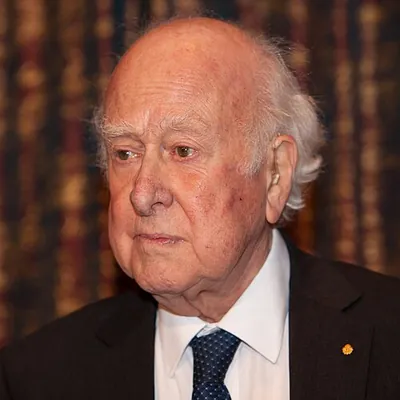 Peter Higgs1929–2024 · Physics
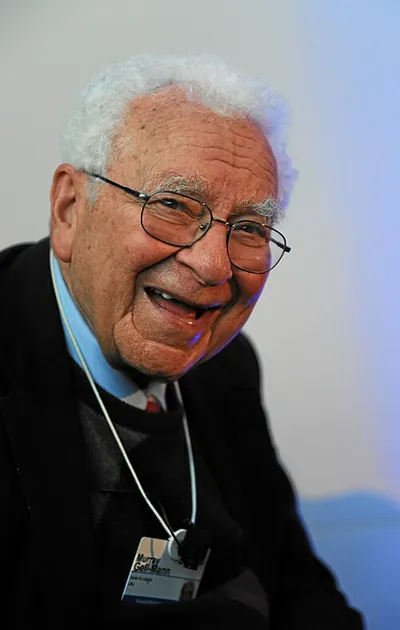 Murray Gell-Mann1929–2019 · Physics
 John Stewart Bell1928–1990 · Physics
