
John Tyndall
Irish physicist, pioneer in the study of infrared radiation and the greenhouse effect, and a founder of experimental microbiology · 1820–1893
- Born
- August 2, 1820
- Died
- December 4, 1893
- Country
- Ireland, United Kingdom of Great Britain and Ireland
- Section
- Physics
Biography
John Tyndall (Leighlinbridge, Ireland, 1820 – Haslemere, England, 1893) was one of the most prominent physicists of Victorian Britain. His name is linked to three major areas: the study of light scattered by particles suspended in the air, the demonstration that certain gases trap heat in the atmosphere, and the proof that microscopic germs cause decay and infection. His era, marked by the growth of experimental science and large engineering projects, gave him the chance to combine laboratory research with public lectures, which makes him a key figure in the history of climate science and public health.
Tyndall was born into a modest family in Ireland. His father worked as a local police constable, and John attended schools in his county until nearly the end of his teens. He learned technical drawing and mathematics, skills that got him a job as a draftsman for the Ordnance Survey of Ireland in 1839 and, from 1842, for the survey of Great Britain. During the 1840s a railway-building boom made surveying skills very valuable, and for several years Tyndall earned good money planning railway lines. In 1847 he chose a different path and accepted a post teaching mathematics and surveying at Queenwood College, a boarding school in Hampshire. He later explained that his wish to grow intellectually had never left him, and that railway work had left him less and less room to pursue it.
At Queenwood he met Edward Frankland, a young chemist with laboratory experience, and the two became close friends. They shared the view that British universities still focused on the classics and mathematics, while some German universities led the world in experimental chemistry and physics. In summer 1848 they moved to Germany and enrolled at the University of Marburg, drawn above all by the reputation of Robert Bunsen as a teacher. Tyndall studied with Bunsen for two years, but perhaps the greater influence on him at Marburg was Professor Hermann Knoblauch, with whom he kept up a correspondence for many years. His doctoral thesis, completed in 1850, was a mathematical analysis of screw surfaces, supervised by Friedrich Ludwig Stegmann. He then spent another year in Germany researching magnetism with Knoblauch, including a few months in the Berlin laboratory of Heinrich Gustav Magnus. Bunsen and Magnus are now regarded as among the finest experimental teachers of their era, so when Tyndall returned to England in 1851 his training was as strong as that of anyone in the country.
His first original work dealt with magnetism and diamagnetism, the tendency of some materials to be weakly repelled by a magnet. Between 1850 and 1856 his experiments brought him fame among scientists of the day, and in 1852 he was elected a Fellow of the Royal Society. In 1853 he won the chair of Natural Philosophy at the Royal Institution in London, largely thanks to the respect he had earned from Michael Faraday, the institution's leading researcher. About a decade later he succeeded Faraday in his posts when Faraday retired.
Tyndall also discovered the mountains. He first visited the Alps in 1856 for scientific reasons and became one of the pioneering mountaineers of his time. He was part of the team that first reached the summit of the Weisshorn in 1861, and he led one of the early expeditions to the top of the Matterhorn in 1868. He studied glaciers, especially how they move, which put him at odds with James David Forbes. The dispute centred on who deserved credit for explaining how ice flows, and supporters of both men continued to argue after their deaths. Tyndall relied on regelation, a process discovered shortly before by Faraday, in which two pieces of ice freeze together when pressed, and this idea was central to his explanation.
His best-known work grew out of a question about climate. After reading the work of Fourier, Pouillet and others, he suspected that the atmosphere could hold back some of the heat the Earth gives off. In 1859 he built an apparatus based on a thermopile, a device that detects very small differences in temperature, and tested which gases absorbed infrared radiation. He found that water vapour was the most effective, with carbon dioxide and methane also contributing. He thus demonstrated a mechanism we now call the greenhouse effect. Earlier, the American scientist Eunice Newton Foote had published similar experiments in 1856, although she did not separate out the effect of infrared radiation.
Tyndall later devoted much of his effort to microbiology. In 1877 and 1878 his sterilisation experiments suggested that microscopic life came from germs already present in the air rather than arising spontaneously from matter. In 1887 he strengthened this idea and described resting bacterial forms that resisted heat well, a result Ferdinand Cohn confirmed shortly afterwards. For this reason he is counted, alongside Pasteur, as one of the fathers of microbiology. The method of repeated heating he used now bears his name, tyndallisation, and his ideas about airborne particles informed the asepsis of operating theatres.
Tyndall was also a gifted popular writer. He published many books, among them Fragments of Science and Heat as a Mode of Motion, which brought experimental physics to a wide readership. His legacy is twofold: his experiments on radiation and gases anticipated modern climate science, and his support for the germ theory helped change medicine and hygiene. Today he is remembered through lunar and Martian craters, an asteroid, and the term Tyndall effect, which describes how particles suspended in a medium scatter light.
Main contributions
- 1850Doctoral thesis on helicoid screw surfaces at Marburg, supervised by Stegmann.
- 1856Research on diamagnetism, which brought him prestige among the physicists of the day.
- 1859Demonstration that water vapour, carbon dioxide and methane absorb infrared radiation, the basis of the greenhouse effect.
- 1863Book Heat as a Mode of Motion, which explains heat as a form of particle motion.
- 1868Led one of the early expeditions to the Matterhorn, during the conquest of the Alpine peaks.
- 1877Sterilisation experiments using repeated heating that undermined spontaneous generation.
- 1887Description of resting bacterial forms resistant to heat, supporting the germ theory.
Teachers and students
Studied under:
Taught:
Trivia and anecdotes
A name on the map
Several geographical features bear his name, including glaciers in Chile, Alaska and Colorado, and mountains in California and Tasmania.
An effect named after him
The Tyndall effect explains why a light beam becomes visible when it passes through a colloid, and also the so-called orbs seen in digital photographs.
Their contemporaries
While John Tyndall was alive (1820–1893)…
Alive at the same time
Discovered or invented in those years
- 1846NeptuneThe eighth and most distant planet of the Solar System, an ice giant found through mathematical prediction before any direct sighting.
- 1859EvolutionThe process by which the heritable traits of living populations change over generations, explaining the diversity of life from common ancestors.
- 1869Periodic tableAn arrangement of the chemical elements into rows (periods) and columns (groups), ordered by atomic number, that reveals recurring chemical behaviour and lets scientists predict properties.
- 1869Deoxyribonucleic acidA double-stranded molecule that carries the genetic instructions of nearly all living things and many viruses.
- 1876TelephoneA device that carries the human voice over distance by turning sound into electrical signals and back into sound at the other end of the line.
- 1884CarA road vehicle with four wheels and its own engine, mainly built to carry people.
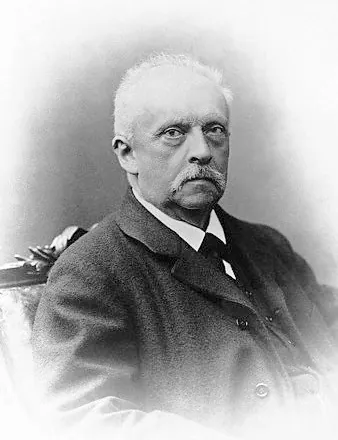 Hermann von Helmholtz1821–1894 · Physics
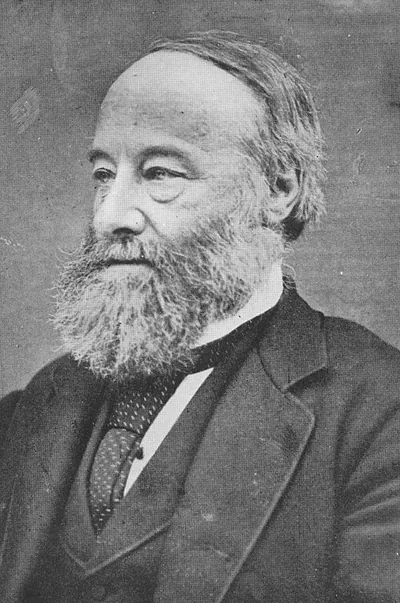 James Prescott Joule1818–1889 · Physics
 Gustav Kirchhoff1824–1887 · Physics
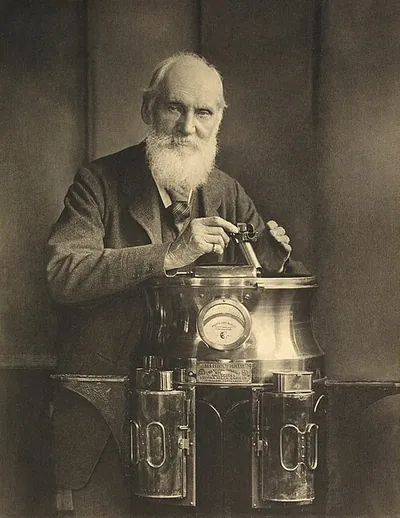 William Thomson, 1st Baron Kelvin1825–1907 · Physics
 James Clerk Maxwell1831–1879 · Physics
 Johannes Diderik van der Waals1837–1923 · Physics
