
Edward Frankland
English chemist, one of the founders of organometallic chemistry and originator of the concept of valence · 1825–1899
- Born
- January 18, 1825
- Died
- August 9, 1899
- Country
- United Kingdom of Great Britain and Ireland
- Section
- Chemistry
Biography
Edward Frankland (Catterall, Lancashire, 1825-Golaa, Norway, 1899) was an English chemist working in the Victorian era, when chemistry was becoming an established academic discipline. He is considered one of the founders of organometallic chemistry, the study of compounds in which a metal is bonded to carbon atoms. He also introduced the idea of valence, meaning the fixed number of other atoms that each element can combine with.
He was born outside marriage, as his baptism record at Churchtown, dated 20 February 1825, shows. His natural father was Edward Chaddock Gorst, the father of the politician John Eldon Gorst. His mother, Margaret «Peggy» Frankland, later married William Helm, a cabinet-maker from Lancaster. The circumstances shadowed his whole life, since he agreed to keep silent about his father's identity. In 1833 the family settled in Lancaster, where he attended James Wallasey's private school and first became interested in chemistry by reading Joseph Priestley, a book he borrowed from the Mechanics Institute library. At twelve he entered Lancaster Free Grammar School, which had also educated William Whewell and Richard Owen.
According to Frankland himself, his interest grew during a trial held in the court at Lancaster Castle, next to his school, in which a Liverpool manufacturer was accused of letting muriatic acid gas escape from his works. Frankland wanted to become a doctor, but training was too expensive, so in 1840 he became an apprentice in a pharmacy, where he pounded and mixed ingredients for medicinal ointments. In the evenings he attended a makeshift home laboratory offered to local young people by the doctor James Johnson. With Johnson's backing, he secured a place in Lyon Playfair's laboratory in Westminster in 1845.
In 1847 he visited Germany and met Robert Bunsen, whose reputation was one of the main reasons he later studied at the University of Marburg. The following year he moved to Justus von Liebig's laboratory at Giessen. In 1850 Playfair offered him his professorship in London, so Frankland cut short his studies and returned to England. Soon afterwards he became professor of chemistry at a newly founded school that is now part of the University of Manchester. In 1857 he moved to St Bartholomew's Hospital, in 1863 to the Royal Institution, and for two decades he also taught at the Royal School of Mines. He had been elected a Fellow of the Royal Society in 1853, received its Copley Medal in 1894 and was knighted in 1897.
In 1849 he became engaged to Sophie Fick, sister of the physiologist Adolf Eugen Fick, whom he had met on his 1847 trip, and they married in 1851. After Sophie died of tuberculosis in 1874, he married Ellen Frances Grenside in 1875. He died while on holiday in Norway and was buried near his home in Reigate, Surrey. His son Percy Frankland also became a distinguished chemist.
His early work involved analysis, but he soon turned to synthesis, the making of new compounds. Bunsen is believed to have steered his students towards cacodyl, an arsenic compound, and this led Frankland to discover organometallic compounds. After returning to England he produced diethylzinc and dimethylzinc by reacting ethyl and methyl iodides with metallic zinc. More important still were his conclusions: he saw these substances as the result of replacing an organic group with oxygen, sulphur or chlorine in known metal compounds. In 1852 he proposed that each element has a definite capacity for combining with other atoms. This theory of valence became the foundation of modern structural chemistry, and in 2015 the American Chemical Society honoured his 1852 publication with an award.
Frankland also made practical contributions to water quality. In 1865 he succeeded August Wilhelm von Hofmann at the School of Mines and began monthly reports on the water supplied to London. At first he was a harsh critic of it, but over the years he became convinced of its general quality. In 1868 he was appointed to the second royal commission on river pollution and, for six years, worked in a fully equipped government laboratory. His analyses combined chemistry and bacteriology, and he is also credited with an early idea for treating sewage biologically with a contact bed, an idea later taken up by others.
In 1859 he spent a night on the summit of Mont Blanc with John Tyndall to test whether a candle burns more slowly in thinner air. It did not, but on the summit the candle gave a very weak light, which led him to study how pressure changes the brightness of flames. He found that higher pressure increases luminosity: hydrogen, which gives no light under normal conditions, burned with a bright flame at ten or twenty atmospheres. He concluded that solid particles alone do not explain a flame's light. Frankland was also one of the discoverers of helium, and his legacy links the chemistry of compounds with the science of the water that cities drank.
Main contributions
- 1852Theory of valence: each element has a definite capacity to combine with a limited number of atoms of other elements.
- 1859Effect of pressure on flames: he showed that increasing pressure makes a flame give off more light.
- 1865London water monitoring: monthly reports on the water supplied to the city, which he kept producing until his death.
- Organometallic compounds: substances in which a metal is bonded to carbon atoms, discovered through his work on cacodyl.
- Diethylzinc and dimethylzinc: the first such compounds he synthesised, made from metallic zinc and organic iodides.
Teachers and students
Trivia and anecdotes
A trial as an early lesson
According to Frankland himself, his interest in chemistry was sparked as a schoolboy when he attended a trial about a gas leak at Lancaster Castle.
Experiments on a mountain
The summit of Mont Blanc served as his natural laboratory, since the candle gave so little light there that it prompted his study of pressure.
Their contemporaries
While Edward Frankland was alive (1825–1899)…
Alive at the same time
Discovered or invented in those years
- 1846NeptuneThe eighth and most distant planet of the Solar System, an ice giant found through mathematical prediction before any direct sighting.
- 1859EvolutionThe process by which the heritable traits of living populations change over generations, explaining the diversity of life from common ancestors.
- 1869Periodic tableAn arrangement of the chemical elements into rows (periods) and columns (groups), ordered by atomic number, that reveals recurring chemical behaviour and lets scientists predict properties.
- 1869Deoxyribonucleic acidA double-stranded molecule that carries the genetic instructions of nearly all living things and many viruses.
- 1876TelephoneA device that carries the human voice over distance by turning sound into electrical signals and back into sound at the other end of the line.
- 1884CarA road vehicle with four wheels and its own engine, mainly built to carry people.
 Stanislao Cannizzaro1826–1910 · Chemistry
 August Kekulé1829–1896 · Chemistry
 Alfred Nobel1833–1896 · Chemistry
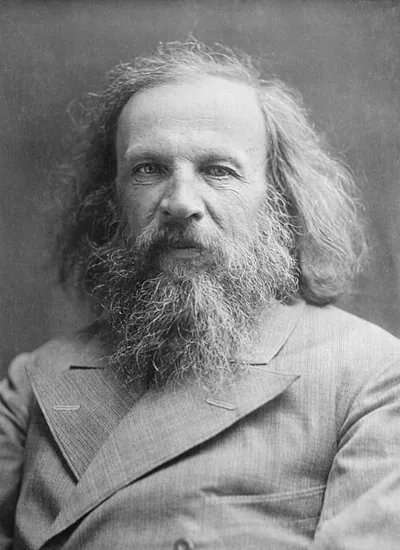 Dmitri Mendeleev1834–1907 · Chemistry
 Adolf von Baeyer1835–1917 · Chemistry
 Robert Bunsen1811–1899 · Chemistry
