
Josefina Castellví
Spanish oceanographer, biologist and writer, a pioneer of marine and Antarctic research in Spain · 1935–2026
- Born
- July 1, 1935
- Died
- February 2, 2026
- Country
- Spain
- Section
- Earth sciences
Biography
Josefina Castellví Piulachs (Barcelona, 1935 - Barcelona, 2026) was one of the first Spanish women to work as an oceanographer and a key figure in Spain's scientific presence in Antarctica. Her career unfolded in the second half of the twentieth century, when Spain had few research ships, and her work helped place Spanish marine and polar science on the international map.
She was born in Barcelona a few months before the Spanish Civil War broke out. She grew up between the Eixample district and Castelldefels, where her family had a house, and studied at the Instituto Montserrat. In 1953 she began a biology degree at the University of Barcelona, in a class so small that only two students finished in 1957: she and a nun. She then spent two years in France and, around 1960, specialised in oceanography at the Sorbonne, where she also taught practical classes. She earned her doctorate in biological sciences in Barcelona in 1969.
From 1960 she worked at the Institute of Marine Sciences in Barcelona and at the Spanish National Research Council (CSIC). Oceanography demands close observation of the sea, so at first she worked in the laboratory, studying organisms and substances under controlled conditions. When Spanish scientists gained their first oceanographic research vessel in 1971, she could study living things in their natural setting and watch how they behaved within the ocean currents. One of the subjects in her work was the marine diatom Skeletonema costatum, a microscopic alga whose pigments depend on the nutrients available in the water.
In 1984 she became the first Spanish woman to take part in an international expedition to Antarctica, and from that year she helped organise research on the continent. Together with Antonio Ballester and other colleagues she set up the Juan Carlos I base on Livingston Island, which she directed between 1989 and 1993. Her work formed part of the process that allowed Spain to join the Antarctic Treaty as a full member in 1988. From 1989 to 1995 she directed the National Antarctic Research Programme in Madrid and in 1995 returned to Barcelona to lead the Institute of Marine Sciences.
Alongside her research she devoted much energy to public outreach. She gave lectures and wrote books, among them I Have Lived in Antarctica (1996), an autobiographical account of her expeditions. She retired in 2000 but kept working with the Advisory Council for the Sustainable Development of Catalonia and giving talks on what ice and sea reveal about the history of the Earth. She received the Gold Medal of the City of Barcelona in 1994 and the Cross of Saint George in 2003, the second of which she valued particularly because it came from her own city and region. She died in Barcelona on 2 February 2026, aged 90. Her legacy includes the Spanish research base in Antarctica, the training of younger scientists, and her long effort to bring the science of the sea closer to the public.
Main contributions
- 1963Study of the pigments of the marine diatom Skeletonema costatum, which vary with the nutrients in the water.
- 1967The book Marine Ecology, on the relationships between living things in the sea and their surroundings.
- 1984First Spanish woman to take part in an international expedition to Antarctica.
- 1989Directed the Spanish Antarctic base Juan Carlos I on Livingston Island until 1993.
- 1996I Have Lived in Antarctica, an autobiographical book about her seasons leading the base.
- 2005The Role of the Oceans in the Balance of Planet Earth, a book in Catalan on climate change and the planet's environmental history.
Teachers and students
Trivia and anecdotes
A peak named after her
Castellvi Peak, on the Hurd Peninsula of Livingston Island, is named in her honour.
A graduating class of two
In 1957 only two people finished the biology degree in Barcelona that year: she and a nun.
On the first prize
Quoting the scientist Ramon Margalef, she said the hard part is winning the first prize, since others follow more easily.
Their contemporaries
While Josefina Castellví was alive (1935–2026)…
Alive at the same time
Discovered or invented in those years
- 1945ComputerA programmable machine that takes in data, processes it by following stored instructions, and produces results, able to switch tasks simply by running different software.
- 1957Artificial satelliteAn artificial satellite is a human-made object placed in orbit around a celestial body, usually Earth, to collect information, relay signals, or carry out a specific task.
- 1969InternetA global network of interconnected computer networks that communicate using the TCP/IP protocol suite.
- 1971EmailA network service that lets users send and receive digital messages through addressed mailboxes, much like postal mail but electronic.
- 1973Mobile phoneA handheld wireless phone that lets people make and receive calls while moving across a cellular network area.
- 1989World Wide WebA system of linked documents and resources, connected by hyperlinks and accessed over the Internet with web browsers.
 W. Jason Morgan1935–2023 · Earth sciences
 Sylvia A. Earle1935 · Earth sciences
 Syukuro Manabe1931 · Earth sciences
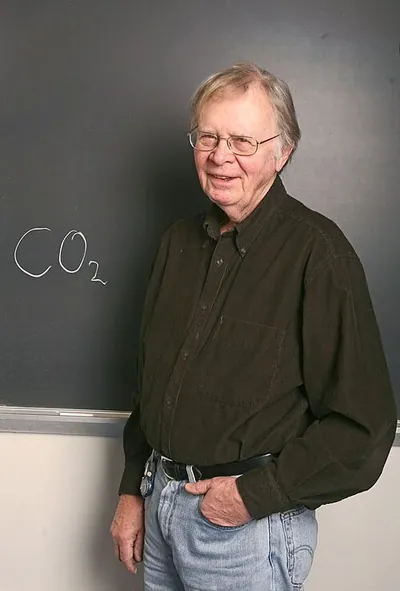 Wallace Broecker1931–2019 · Earth sciences
 Klaus Hasselmann1931 · Earth sciences
