
Joseph Larmor
Irish physicist and mathematician, a pioneer of the electron theory of matter and of the Lorentz transformations · 1857–1942
- Born
- July 11, 1857
- Died
- May 19, 1942
- Country
- United Kingdom, United Kingdom of Great Britain and Ireland
- Section
- Physics
Biography
Joseph Larmor (born in Magheragall, 1857; died in Holywood, 1942) was an Irish mathematician and theoretical physicist who also spent a political career in Westminster. He worked in the decades when James Clerk Maxwell's ideas about electricity and magnetism were becoming the foundation of modern physics. His work on the aether and on the electron places him among the first to describe the Lorentz transformations, and his book Aether and Matter, published in 1900, is his most influential achievement.
He grew up in Belfast, the son of a shopkeeper. He was educated at the Royal Belfast Academical Institution and then at Queen's College, Belfast, where one of his teachers was John Purser. He went on to St John's College, Cambridge, and in 1880 graduated as Senior Wrangler, the top mathematics candidate of his year, ahead of J. J. Thomson. After five years teaching physics at Queen's College, Galway, he returned to Cambridge in 1885 as a lecturer in mathematics. In 1903 he became Lucasian Professor of Mathematics, a post he held until retiring in 1932. He was knighted in 1909. He never married.
His central idea was the aether, a medium that physicists of the period believed filled space and carried light. Larmor pictured it as a uniform fluid, perfectly incompressible and elastic, and separate from ordinary matter. On this basis he saw matter as particles moving through the aether. He also combined his theory with the spinning gyrostat model proposed by Lord Kelvin. For Larmor, electric charge came from a particle, which he was already calling the electron in 1894, and an electric current was the flow of such charged particles, although they were not part of the atom itself.
His best-known contribution concerns the Lorentz transformations, the equations that describe how measurements of space and time change between frames moving at constant speed relative to each other. In 1897 he published an approximation in the Philosophical Transactions of the Royal Society, and in 1900 he reached the full form, at about the same time as Hendrik Lorentz, who was developing his own aether theory. Larmor predicted time dilation: electrons in orbit would complete their paths in shorter times as judged from a system at rest. He also showed that the FitzGerald-Lorentz contraction should apply to bodies whose atoms are held together by electromagnetic forces. In Aether and Matter he treated these effects as dynamical, produced by forces, rather than as mere consequences of how we measure. His priority for these ideas is still debated, and he lacked the correct rules for combining velocities, which Henri Poincaré supplied later.
His work reached well beyond this. He calculated the energy radiated by an accelerating electron, explained how spectral lines split in a magnetic field through the oscillation of electrons, and in 1897 proposed a solar-system-like model of the atom. He also postulated a positive particle he called a positive electron, an early precursor of the proton. In 1919 he suggested that sunspots were self-regenerating dynamos at the surface of the Sun, meaning systems that generate and sustain a magnetic field through the motion of a conducting fluid.
In public life, his opposition to Irish Home Rule led him to stand in February 1911 as a candidate for Cambridge University in the British Parliament, as a unionist. He won the seat and held it until the 1922 general election, by which time the Irish question had been settled. After retiring from Cambridge in 1932, he moved back to County Down in Northern Ireland.
Larmor opposed Einstein's relativity, with a brief exception. He defended an absolute aether and an absolute time, which he considered essential to astronomy, as he argued in Nature in 1924 and 1927. His legacy includes his editing of the collected works of George Stokes, James Thomson and William Thomson, and the lunar crater named after him. He is remembered today as a bridge between the classical theory of the aether and the newer physics of spacetime.
Main contributions
- 1893Dynamical theory of the electric and luminiferous medium: a three-part series describing the universe as an aether with moving charged particles.
- 1894Least action principle: a formulation of dynamics and physics in which systems follow the path that makes a quantity called the action as small as possible.
- 1897Approximation to the Lorentz transformations: an early formulation of how space and time are related between systems in relative motion, including the prediction of time dilation for orbiting electrons.
- 1897Solar-system-style model of the atom, with electrons orbiting a central charged core.
- 1900Aether and Matter: a book presenting the full Lorentz transformation and treating time dilation and length contraction as dynamical effects.
- 1919Solar dynamo for sunspots: the proposal that sunspots are self-regenerating dynamos on the Sun's surface.
Teachers and students
Trivia and anecdotes
A positive electron
Larmor postulated a positive particle he called a positive electron, an idea that anticipated the proton. He described it in his writings on atomic structure.
A Westminster MP
Between 1911 and 1922 he sat in the British Parliament for Cambridge University, where he argued for keeping Ireland united with Great Britain.
A lunar crater
A crater on the Moon bears his name in his memory.
Related discoveries and inventions
- 1897Larmor formulaA formula for calculating the total power radiated by a nonrelativistic point charge when it accelerates or decelerates.
Their contemporaries
While Joseph Larmor was alive (1857–1942)…
Alive at the same time
Discovered or invented in those years
- 1859EvolutionThe process by which the heritable traits of living populations change over generations, explaining the diversity of life from common ancestors.
- 1869Periodic tableAn arrangement of the chemical elements into rows (periods) and columns (groups), ordered by atomic number, that reveals recurring chemical behaviour and lets scientists predict properties.
- 1876TelephoneA device that carries the human voice over distance by turning sound into electrical signals and back into sound at the other end of the line.
- 1884CarA road vehicle with four wheels and its own engine, mainly built to carry people.
- 1903AirplaneA fixed-wing aircraft, heavier than air, powered by engines or rockets, that stays aloft because its wings generate lift.
- 1925TelevisionA system that sends moving pictures and sound over distance and shows them on a receiver, the television set.
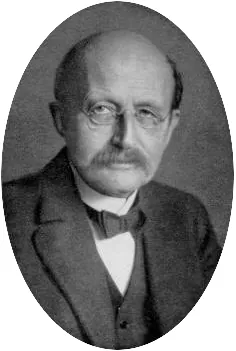 Max Planck1858–1947 · Physics
 Joseph John Thomson1856–1940 · Physics
 Pierre Curie1859–1906 · Physics
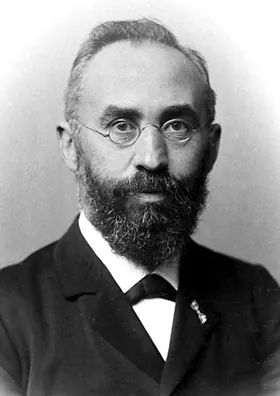 Hendrik Lorentz1853–1928 · Physics
 Heike Kamerlingh Onnes1853–1926 · Physics
 Antoine Henri Becquerel1852–1908 · Physics
