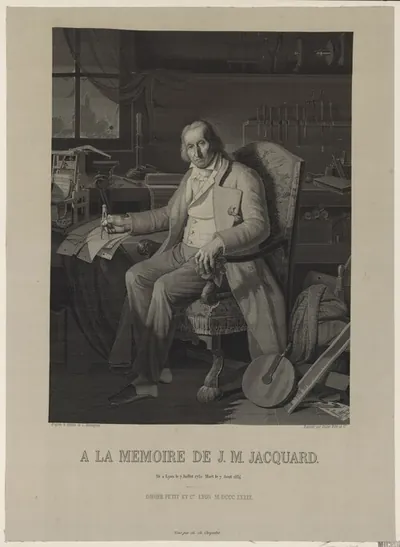
Joseph Marie Jacquard
French weaver and merchant who created the Jacquard loom, controlled by punched cards · 1752–1834
- Born
- July 7, 1752
- Died
- August 7, 1834
- Country
- France
- Section
- Technology and communications
Biography
Joseph Marie Jacquard (Lyon, 1752 - Oullins, 1834) was a French weaver and merchant whose name became linked to a loom that could follow patterns read from punched cards. He lived through the late Ancien Régime, the French Revolution and the Napoleonic Empire, and his invention matters because it anticipated the idea of giving a machine instructions through a physical medium that could be swapped easily, an idea later picked up by the first calculating and data-processing machines.
He was born on 7 July 1752 into a conservative Catholic family in Lyon. His father, Jean Charles, was a master weaver, and his mother was Antoinette Rive. Of nine children, only he and his sister Clémence reached adulthood. Although his father owned property, Joseph received no formal schooling and remained illiterate until he was 13, when his brother-in-law Jean-Marie Barret, who ran a printing and bookselling business, taught him to read and introduced him to learned societies and scholars. The nickname "Jacquard", which the community gave to his branch of the Charles family, eventually became the name by which he is known.
He first helped his father at the loom, but the work proved too arduous. He then worked for a bookbinder and for a maker of printers' type. Accounts of his early career disagree. The British economist John Bowring recorded that he had once made straw hats, another writer listed work as a soldier or a lime burner, and a third, Barlow, mentions cutlery, though without citing sources. In 1772 he inherited his father's house, looms and workshop, along with a vineyard and a quarry.
In 1778 he married Claudine Boichon, a middle-class widow from Lyon who owned property and brought a substantial dowry. According to Barlow, a figure-weaving business failed and Jacquard lost much of his fortune. To pay his debts he had to sell his inheritance and draw on his wife's dowry. The couple lived in a house in Oullins, on the banks of the Rhône, and there their only child, Jean Marie, was born in 1779.
According to Charles Ballot, after the revolt of Lyon was crushed in 1793, father and son joined the revolutionary army and fought together in the Rhine campaign of 1795. The son was killed near Heidelberg. Ballot was a careless historian who repeated rumours, so this account should be treated with caution.
From 1800 Jacquard experimented with several devices: a treadle loom, a loom for weaving fishing nets in 1803 and, from 1804, the loom that wove patterned silk automatically. The first of these did not work well. In 1801 he showed a loom at an industrial exhibition in Paris and was awarded a bronze medal. In 1803 he was called to Paris and attached to the Conservatoire des Arts et Métiers, where he studied a loom built by Jacques de Vaucanson and borrowed ideas to improve his own.
The loom works with stiff cardboard cards, each with holes punched in it, and each card corresponds to one pass of the weft thread. Strung together in order, the cards tell the machine which warp threads to raise on each pass. Weaving elaborate designs by hand was slow and error-prone. His mechanism drew on earlier work: Basile Bouchon's punched paper strip of 1725, Jean Falcon's chain of cards from around 1737, and Vaucanson's system, which removed the tangle of cords and weights.
In 1805 the loom was declared public property, and Jacquard received a pension and a royalty on each machine. Silk weavers fiercely opposed it, fearing the loss of their jobs, but its advantages led to wide adoption, and by 1812 there were 11,000 Jacquard looms in France. Early sales were poor because of problems with the card mechanism, and they rose only after 1815, when Jean Antoine Breton solved those faults.
Jacquard died at Oullins on 7 August 1834. Six years later a statue was raised to him in Lyon, on the spot where his 1801 exhibition loom had been destroyed. His legacy is chiefly technical: the idea of controlling a machine with punched cards passed on to later machines and remains part of the story of computing.
Main contributions
- 1800A treadle loom, one of his first experiments, which did not work well.
- 1801A loom shown at an industrial exhibition in Paris, for which he received a bronze medal.
- 1803A loom for weaving fishing nets.
- 1804The Jacquard loom, which wove patterned silk automatically.
- 1805A loom controlled by punched cards, declared public property that same year.
Trivia and anecdotes
He learned to read late
Jacquard received no formal schooling and did not learn to read until he was 13, thanks to his brother-in-law, who ran a bookshop and printing business.
An unreliable historian
Charles Ballot, who recounted Jacquard's part in the revolutionary army, repeated rumours and made errors, such as confusing his wife's name.
A statue where his loom was destroyed
Six years after his death, a statue was raised in Lyon on the site where his 1801 exhibition loom had been destroyed.
Related discoveries and inventions
- 1804Jacquard loomA mechanism fitted to a loom that automatically controls which warp threads are raised on each pass, so that patterned fabrics are woven by following a chain of punched cards.
Their contemporaries
While Joseph Marie Jacquard was alive (1752–1834)…
Alive at the same time
Discovered or invented in those years
- 1766HydrogenThe lightest and most abundant chemical element in the universe, atomic number 1, which under normal conditions is a colourless, odourless and highly flammable gas.
- 1772NitrogenChemical element with atomic number 7, a colourless, odourless gas that makes up about 78% of Earth's air and is an essential part of proteins and nucleic acids.
- 1774OxygenA colorless, odorless gas, symbol O and atomic number 8, that forms the dioxygen in air and is essential for respiration in most living things.
- 1781UranusThe seventh planet from the Sun, an ice giant discovered by William Herschel in 1781, the first planet found with a telescope.
- 1803AtomThe basic unit of a chemical element: a nucleus of protons and usually neutrons surrounded by a cloud of electrons.
- 1821ElectricityThe set of physical phenomena linked to the presence and movement of electric charge, and one of the most versatile forms of energy in modern life.
 Nicolas Appert1749–1841 · Technology and communications
 Nicéphore Niépce1765–1833 · Technology and communications
 Louis Daguerre1787–1851 · Technology and communications
 Samuel Finley Breese Morse1791–1872 · Technology and communications
 William Henry Fox Talbot1800–1877 · Technology and communications
 William Fothergill Cooke1806–1879 · Technology and communications