
Jacques de Vaucanson
French engineer and inventor known for his automata and early automated textile machines · 1709–1782
- Born
- February 24, 1709
- Died
- November 21, 1782
- Country
- Kingdom of France
- Section
- Technology and communications
Biography
Jacques de Vaucanson (Grenoble, 1709 – Paris, 1782) was a French engineer and inventor of the eighteenth century, remembered above all for his automata and for textile machines that anticipated the automation of production. He worked in a France that was trying to catch up with the English textile industry, and that is why his work matters: he combined mechanical play with practical use.
He was born into a modest family, the son of a glove maker, and grew up with few resources. According to a common account, as a young man he wanted to become a clockmaker. One day in church he studied the chapel clock closely and, some weeks later, built one like it. His mother sent him to study with the Jesuits, and he later joined the Order of the Minims in Lyon, intending to follow a course of religious studies.
His interest in machines was revived after he met the surgeon Le Cat, from whom he learned the details of human anatomy. With that knowledge he built his first devices, which imitated vital functions such as circulation, breathing and digestion. In 1737 he unveiled The Flute Player, a life-size figure that played twelve tunes. So that its fingers could hold the instrument, he covered them with a fabric that imitated skin, and to reach low and high notes he studied the air pressure and the shape of the lips. He presented it to the Académie des Sciences in 1738. At first the public did not believe the flute really sounded and suspected a hidden organ, until the machine was examined and it became clear that the air from its lips produced the sound.
That same year he showed The Tambourine Player and The Digesting Duck, his most celebrated piece. The duck, made of gilded copper with over four hundred moving parts, seemed to eat grain, digest it and excrete it. In reality a hidden compartment held a green paste that imitated digested food. The invention was nonetheless a huge success, although some critics questioned its authenticity. Vaucanson soon tired of entertainment and sold his automata, which scattered, and none of them survive today.
In 1736 Cardinal Fleury appointed him inspector of silk manufacturing in France. The French textile industry lagged behind England and Scotland, so Vaucanson pushed for the automation of the process. In 1745 he built a fully automatic loom that used punched cards to guide the threads. That idea, later refined by Joseph Marie Jacquard, became a basis for programming with cards. Weavers rejected his proposals, and many of his ideas were never put into use. He is also credited with an early metal lathe with a sliding tool rest, although the date of that invention is uncertain and is given variously as 1751 or 1768.
Vaucanson died in Paris in 1782. He left his collection of machines to King Louis XVI, and that collection became the seed of the Conservatoire des Arts et Métiers in Paris. His most lasting legacy is the idea that a machine can repeat a complex task by following fixed instructions, an idea that led to the loom and, centuries later, to the computer.
Main contributions
- 1737The Flute Player, a life-size automaton that played the flute with mechanical lips, tongue and fingers.
- 1738The Digesting Duck, an automaton with over four hundred moving parts that imitated eating and digesting grain.
- 1745A fully automatic loom that used punched cards to control the weaving pattern.
- 1751A metal lathe with a sliding tool rest; the exact date of this invention is uncertain.
Teachers and students
Trivia and anecdotes
A duck with a trick
The duck seemed to digest its grain, but a hidden compartment held the green paste that was actually expelled.
The lost duck
It is said that the duck resurfaced in Germany decades later and that Goethe saw it in 1805, though this story is legendary and unverified.
Their contemporaries
While Jacques de Vaucanson was alive (1709–1782)…
Alive at the same time
Discovered or invented in those years
- 1712Steam engineAn engine that turns the heat energy of water vapour into mechanical motion, using a piston that moves back and forth inside a cylinder.
- 1755MagnesiumMagnesium is a light, shiny gray-white metal with atomic number 12 and symbol Mg, found in many minerals, seawater and living organisms.
- 1766HydrogenThe lightest and most abundant chemical element in the universe, atomic number 1, which under normal conditions is a colourless, odourless and highly flammable gas.
- 1772NitrogenChemical element with atomic number 7, a colourless, odourless gas that makes up about 78% of Earth's air and is an essential part of proteins and nucleic acids.
- 1774OxygenA colorless, odorless gas, symbol O and atomic number 8, that forms the dioxygen in air and is essential for respiration in most living things.
- 1781UranusThe seventh planet from the Sun, an ice giant discovered by William Herschel in 1781, the first planet found with a telescope.
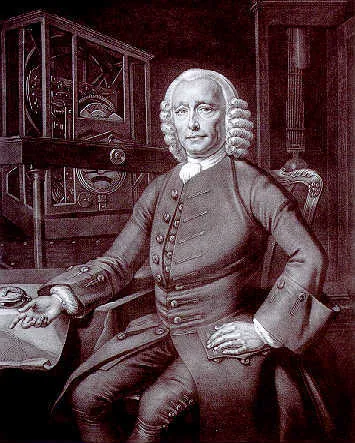 John Harrison1693–1776 · Technology and communications
 Nicolas Appert1749–1841 · Technology and communications
 Nicéphore Niépce1765–1833 · Technology and communications
 Louis Daguerre1787–1851 · Technology and communications
 Samuel Finley Breese Morse1791–1872 · Technology and communications
 William Henry Fox Talbot1800–1877 · Technology and communications
