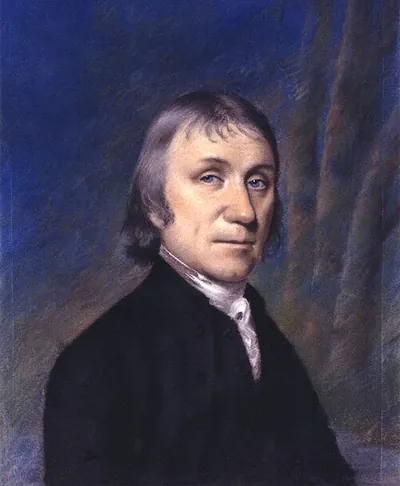
Joseph Priestley
British chemist, theologian and educator, Dissenting minister and defender of religious tolerance, known for isolating oxygen and for devising a method of making carbonated water · 1733–1804
- Born
- March 24, 1733
- Died
- February 6, 1804
- Country
- United Kingdom, United Kingdom of Great Britain and Ireland
- Section
- Chemistry
Extended biography
Early life and formation
Joseph Priestley was born on 24 March 1733 into a family of English Dissenters, Protestants who had separated from the Church of England; his family was Calvinist. He was the eldest of six children. His mother died when he was still a child, and after a period with his grandfather he went to live with an aunt and uncle who were wealthy and had no children. They gave him the best education they could, intending that he become an Anglican minister.
He was a precocious boy. According to the family story recorded by his biographers, at the age of four he could recite without error all 107 questions and answers of the Westminster Shorter Catechism, a widely used religious text of the period. As a youth he attended local schools, where he learned Greek, Latin and Hebrew. Around 1749 he fell seriously ill and feared he would die. The experience made him doubt the Calvinist doctrine he had been taught, especially the idea that salvation was decided in advance for a chosen few. His doubts cost him full membership in his local church, and the illness left him with a lasting stammer.
The crisis turned him away, for the time being, from a church career. He prepared to work in a family trading business in Lisbon, studying modern and oriental languages, and received lessons in mathematics, natural philosophy and logic from a clergyman, drawing on writers such as Isaac Watts, Willem 's Gravesande and John Locke.
Religious and educational formation
In 1752 Priestley returned to theological study and enrolled at Daventry, an academy for Dissenters. He had already read widely, so he was allowed to skip the first two years of the course. There his thinking moved toward what became known as Rational Dissent, a current that valued reasoned analysis of nature and the Bible over dogma and mysticism.
Priestley later said that the book that influenced him most, apart from the Bible, was David Hartley's Observations on Man (1749). Hartley proposed a material theory of the mind, in which ideas formed through association, and he sought a Christian philosophy in which religious and moral truths could be demonstrated scientifically. That ambition would stay with Priestley for the rest of his life.
His first ministry was a failure. In Needham Market, Suffolk, the congregation was unwilling to accept his unorthodox views, and donations fell away. After a briefer spell at Nantwich, where he was happier and founded a school in which he taught natural philosophy using scientific instruments of his own, he published The Rudiments of English Grammar in 1761. The book sought to separate English grammar from Latin, an unusual aim at the time, and it gave him a reputation among students of the language. That same year Warrington Academy hired him.
Warrington: teaching, history and electricity
At Warrington Priestley taught modern languages and rhetoric, although he would have preferred mathematics and natural philosophy. His educational thinking rested on a principle of usefulness: teaching should prepare young people for the practical demands of life. For that reason he recommended modern languages over classical ones, and modern history over ancient. His history lectures combined a providential view of events with the idea that studying the past helped people understand natural laws and advance human progress. He also argued for the education of middle-class women, which was unusual for the time.
To support his lectures he designed two charts that were in effect timelines. They are regarded as among the most influential of the eighteenth century and were used for decades. In 1764 the University of Edinburgh awarded him a doctorate in law, at the urging of the academy's trustees.
The intellectual atmosphere of Warrington drew him toward electricity. After repeating other people's experiments, he began designing his own. His book The History and Present State of Electricity (1767), some 700 pages long, was well received. Its best-known finding was that charcoal and other substances conduct electricity, which contradicted the accepted belief that only water and metals did. He also suggested that electrical force weakened with the square of distance, an idea similar to Newton's law of gravitation, though he did not develop it; the general law was later stated by Coulomb. These achievements earned him election to the Royal Society in 1766.
Leeds and the ministry at Mill Hill
In 1767 Priestley moved to Leeds to become minister of Mill Hill Chapel, one of the oldest Dissenting congregations in England. The congregation was divided over doctrine and was losing members to Methodism. Priestley believed that educating the young would help reunite the community.
In his Institutes of Natural and Revealed Religion (1772-1774), he argued that only revealed religious truths that agreed with experience of the natural world could be accepted. His views came close to Socinianism, which denied the divinity of Christ and the Virgin Birth, and this shocked many readers. He wanted to return Christianity to a 'primitive' form by removing the corruptions that had accumulated over the centuries. The historical section of the work grew so long that it had to be published separately in 1782 as The History of the Corruptions of Christianity, which he regarded as his most valuable work.
Priestley was a tireless controversialist. In 1768 he founded the Theological Repository, a journal meant to support rational inquiry into theology, but since only authors who shared his views sent articles, he had to write much of its content himself. Those texts later became the basis for many of his books. His opponents often felt he was attacking them unfairly, but Priestley rarely changed his opinion after a dispute.
Defence of Dissenters and political thought
Much of Priestley's political writing called for the repeal of the Test and Corporation Acts, which barred Dissenters from public office, from serving in the armed forces, and from studying at Oxford and Cambridge unless they subscribed to the Thirty-nine Articles of the Church of England. His Essay on the First Principles of Government (1768) is one of the early works of modern liberal political theory. In it he clearly separated political rights from civil rights and argued that the state should control only the public sphere, while education and religion belonged to the private realm of conscience.
Priestley also took on the jurist William Blackstone, whose Commentaries on the Laws of England were the standard legal guide. Blackstone had stated that dissent from the Church of England was a crime and that Dissenters could not be loyal subjects. Priestley answered with a harsh rebuttal in 1769. Blackstone corrected the most offensive passages in later editions, but kept the claim that dissent was a crime.
This clash with authority shaped the radicalism that followed, which grew from his conviction that the British government was infringing individual freedoms.
Practical science: optics and carbonated water
Priestley said that natural philosophy was a hobby, but he took it very seriously. His model was Benjamin Franklin, and his science was highly practical. Between 1767 and 1770 he presented five papers to the Royal Society on electrical phenomena, including corona discharges and the conductivity of different kinds of charcoal. For some chemical experiments he used carbon dioxide obtained from a nearby brewery.
In 1772 he published the first part of a history of optics, a work that met with little success. His limited mathematical knowledge led him to dismiss several important theories of his day, and he left out the practical sections that had made his history of electricity useful. The experience persuaded him to abandon the project.
His best-known contribution outside chemistry was carbonated water. He found that gas given off during fermentation could be dissolved in water to produce a fizzy drink. He offered the method to the crew of James Cook's expedition, who he mistakenly believed might cure scurvy with it. Priestley did not exploit the invention commercially; others, such as Schweppes, made fortunes from it. In 1773 the Royal Society awarded him the Copley Medal for his work.
Calne, Shelburne and materialist philosophy
In 1773 Priestley moved to Calne to serve Lord Shelburne, tutoring his children and assisting him in general affairs. He thereby gave up the ministry, though he still preached occasionally. These years were the most scientifically productive of his life, because Shelburne gave him time and resources for research.
During this period he wrote a series of metaphysical works (1774-1780) in which he argued that there is no duality between mind and body: everything that exists is perceptible matter, and the soul, if it exists, is a reality we cannot know. The position caused outrage, because many readers believed such a duality was necessary for the soul to exist. Priestley answered d'Holbach and David Hume, and maintained that materialism and determinism could be reconciled with faith in God. He held that human beings lack free will and that evil is only an imperfect understanding of the world. In his view, nature, including the human mind, follows causal laws set by a benevolent God, and the world will eventually be perfected.
His ideas had older roots. Spinoza had defended absolute determinism, and Leibniz had argued that human will was determined by natural laws, though with a different view of the final outcome. Priestley also rejected Descartes's idea that animals were machines without sensation, and argued for continuity between human and animal minds.
Gases and the discovery of oxygen
The Calne years were the ones most devoted to chemistry. His experiments were almost entirely concerned with 'airs', that is, gases. The six volumes of Experiments and Observations on Different Kinds of Air (1774-1786) record this work. His theoretical framework was phlogiston theory, according to which burning a substance released a material principle called phlogiston. Priestley used it to explain his results and, in part, to undermine the old theory of four elements.
Among the gases he described were nitric oxide, ammonia, hydrogen chloride and nitrous oxide. He also isolated carbon monoxide, though he did not recognise that it was a distinct gas. He observed that plants renewed enclosed air, a finding that later led Jan Ingenhousz to describe photosynthesis. To measure the quality of air he developed a test based on mixing air with nitric oxide and measuring the reduction in volume.
In August 1774 he obtained a gas that seemed new, by heating mercuric oxide with sunlight focused through a lens. He called it 'dephlogisticated air'. He tested it first on mice, which survived quite a while in it, and then on himself, writing that it was far better than ordinary air for breathing. He described it in a paper published in 1775 in the Philosophical Transactions. The gas was renamed oxygen in 1778 by Lavoisier, who explained its role without recourse to phlogiston. Scheele had isolated the gas before Priestley published, so the question of priority remains debated. Priestley was also the first to suggest a link between blood and air in his studies of respiration.
Birmingham, the Lunar Society and the chemical revolution
In 1780 the family moved to Birmingham, where Priestley accepted a post as minister of the New Meeting congregation on the condition that he preach and teach only on Sundays, leaving time for writing and experiments. There he joined the Lunar Society, a group of manufacturers, inventors and natural philosophers who met monthly to discuss their work, among them James Watt and Matthew Boulton.
During these years he published important scientific papers, such as Experiments relating to Phlogiston (1783), in which he tried to rebut Lavoisier's criticisms. His observations on how air passed through certain substances, together with his work on what would later be called gaseous diffusion, helped John Dalton and Thomas Graham develop the kinetic theory of gases.
However, opposition to his defence of phlogiston grew steadily. The scientific community was moving toward Lavoisier's new chemistry, which explained combustion through reaction with oxygen. Priestley became increasingly isolated, and his scientific standing suffered while his political and religious positions made him a target for attacks.
The French Revolution, the Birmingham riots and exile
Priestley openly supported American independence and, more strongly, the French Revolution. His radical political views, joined to his religious ideas, aroused public and official distrust. In 1791 a mob attacked and set fire to his house and church in Birmingham, in what became known as the Priestley Riots. His library and instruments were lost, and he had to flee first to London and then to the United States.
In 1794 he settled in Pennsylvania, in Northumberland County, at the invitation of some of the country's founders. He spent the last ten years of his life there. He kept writing, preaching and defending Unitarianism, and continued his investigations, though without the support of the British scientific community.
Exile ended his active public life but not his intellectual work. He died on 6 February 1804 in Pennsylvania.
Legacy
Priestley's legacy is complex. As a scientist he is remembered for carbonated water, his work on electricity and his isolation of oxygen, although the priority for that discovery is shared with Scheele and Lavoisier. His defence of phlogiston separated him from the new chemistry, which came to prevail. As an educator, his grammars, histories and timelines were used by many institutions, and some historians of education regard him as the most important English writer on the subject between Locke and Spencer.
As a thinker, his philosophical work had great influence. Philosophers such as Jeremy Bentham, John Stuart Mill and Herbert Spencer counted it among the sources of utilitarianism. His defence of religious tolerance and the rights of Dissenters made him a key figure in English political liberalism and in Unitarianism, which he helped to establish in England.
Quotes
“In completing a discovery we never fail to obtain an imperfect knowledge of others”
“The mind of man can never be wholly barren. Through our whole lives we are subject to successive impressions; for, either new ideas are continually flowing in, or traces of the old ones are marked deeper. If, therefore, you be not acquiring good principles be assured that you are acquiring bad ones; if you be not forming virtuous habits you are, how insensibly soever to yourselves, forming vicious ones…”
“The whole business of philosophy, diversified as it is, is but one; it being one and the same great scheme, that all philosophers, of all ages and nations, have been conducting, from the beginning of the world”
“Hitherto philosophy has been chiefly conversant about the more sensible properties of bodies; electricity, together with chymistry, and the doctrine of light and colours, seems to be giving us an inlet into their internal structure, on which all their sensible properties depend.”
“When we say there is a GOD, we mean that there is an intelligent designing cause of what we see in the world around us, and a being who was himself uncaused.”
Main contributions
- 1761The Rudiments of English Grammar: an English grammar that broke away from the Latin model.
- 1767Carbonated water: a method of dissolving carbon dioxide in water, producing fizzy water.
- 1767History of Electricity: a work of about 700 pages that gathered known experiments, proposed new research and showed that charcoal conducts electricity.
- 1768Essay on the First Principles of Government: an early work of liberal political theory that separates political from civil rights.
- 1772Institutes of Natural and Revealed Religion: three volumes arguing that religious truths must agree with our experience of the natural world.
- 1774Isolation of oxygen: by heating mercuric oxide he obtained a gas that intensified burning, which he called dephlogisticated air.
Trivia and anecdotes
A Wedgwood medallion
Josiah Wedgwood met Priestley in 1762 after a fall from his horse, and the two exchanged letters and advice on chemistry. Wedgwood later made a medallion portrait of Priestley in jasperware.
A hymn against Unitarianism
Methodists in Leeds wrote a hymn asking God to expel the Unitarian fiend and send his doctrine back to hell, a sign of the hostility his ideas provoked.
An invention left unpatented
Priestley did not patent or commercially exploit his method of making carbonated water, because he believed in the free exchange of ideas.
Related discoveries and inventions
- 1774AmmoniaA compound of nitrogen and hydrogen (NH3), a colourless gas with a sharp smell, central to the making of fertilisers.
Their contemporaries
While Joseph Priestley was alive (1733–1804)…
Alive at the same time
Discovered or invented in those years
- 1766HydrogenThe lightest and most abundant chemical element in the universe, atomic number 1, which under normal conditions is a colourless, odourless and highly flammable gas.
- 1772NitrogenChemical element with atomic number 7, a colourless, odourless gas that makes up about 78% of Earth's air and is an essential part of proteins and nucleic acids.
- 1774OxygenA colorless, odorless gas, symbol O and atomic number 8, that forms the dioxygen in air and is essential for respiration in most living things.
- 1781UranusThe seventh planet from the Sun, an ice giant discovered by William Herschel in 1781, the first planet found with a telescope.
- 1789UraniumA radioactive metal with atomic number 92, used as fuel in nuclear power plants and in nuclear weapons, and in various military and civilian applications.
- 1803AtomThe basic unit of a chemical element: a nucleus of protons and usually neutrons surrounded by a cloud of electrons.
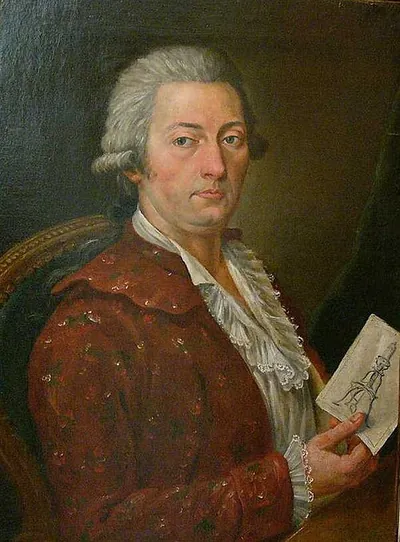 Carl Wilhelm Scheele1742–1786 · Chemistry
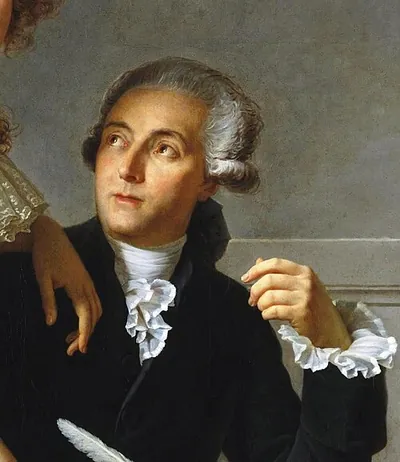 Antoine Lavoisier1743–1794 · Chemistry
 John Dalton1766–1844 · Chemistry
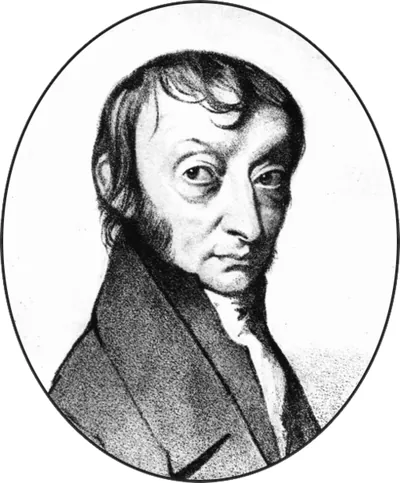 Amedeo Avogadro1776–1856 · Chemistry
 Humphry Davy1778–1829 · Chemistry
 Jöns Jacob Berzelius1779–1848 · Chemistry
