
Konstantin Novoselov
Russian-British physicist, 2010 Nobel laureate in Physics for his work on graphene · 1974
- Born
- August 23, 1974
- Country
- United Kingdom, Russia, Soviet Union
- Section
- Physics
- Awards
- Nobel Prize in Physics
Biography
Konstantin Novoselov is a Russian-British physicist who shared the 2010 Nobel Prize in Physics with Andre Geim for experiments on graphene, a sheet of carbon only one atom thick. His work belongs to condensed matter physics, the field that studies how electrons and atoms behave inside solids. It matters because it showed that a material which for decades existed only as a theoretical model could be isolated and studied in an ordinary laboratory using relatively simple methods.
He was born on 23 August 1974 in Nizhny Tagil, a city in the Urals that was then part of the Soviet Union. Friends and family call him Kostya, the Russian diminutive of Konstantin. He graduated in 1997 from the Moscow Institute of Physics and Technology. Soon afterwards he moved to the Netherlands, to Radboud University in Nijmegen, where he earned his PhD in 2004 with a thesis supervised by Andre Geim, who led a well-regarded research group working on materials only a few atomic layers thick.
Geim was his main mentor and the decisive influence on his early career. The two researchers studied materials made of very thin layers. Graphite, the substance in pencil leads, is built from stacks of carbon sheets. In theory, a single sheet of that stack, called graphene, was known to exist, yet it was widely thought that it could not remain stable on its own. Novoselov and Geim set out to test this by peeling graphite apart, a process known as exfoliation, removing layers again and again until only one remained. They then examined the resulting flakes and measured their electrical properties.
Graphene turned out to have remarkable properties. Its electrons move with exceptional ease, which makes it a very efficient conductor and a material whose behaviour did not fit the rules that apply to ordinary conductors. The scientific community reacted with immediate interest. His output did not stop there. Novoselov has published 475 peer-reviewed research papers on many subjects, including mesoscopic superconductivity, a phenomenon studied at scales between the atom and everyday objects, the subatomic movements of magnetic domain walls, which are the boundaries between regions with different magnetic orientation, and the discovery of gecko tape, an adhesive material inspired by the way a gecko clings to surfaces.
His collaborations were wide-ranging. He took part in the Graphene Flagship, a one-billion-euro initiative of the European Commission aimed at bringing graphene into industrial use. He was also the first director of the National Graphene Institute at the University of Manchester, and he sits on the international scientific advisory committee of an Australian centre of excellence in low-energy electronics. In 2022 he signed an open letter by Russian scientists condemning Russia's invasion of Ukraine, one of the few public political positions he has taken.
In his personal life he holds both Russian and British citizenship. He is married, has two daughters, and describes himself as an agnostic. Since his youth he has practised traditional Chinese painting and calligraphy, which he learned from the artist Zheng Shenglong, and he has taken part in contemporary art projects in which graphene played an unusual role, as described below.
His career has brought many honours. He was elected a Fellow of the Royal Society in 2011, was knighted in 2012, and was appointed Langworthy Professor of Physics at Manchester in 2013. In 2019 he joined the Centre for Advanced 2D Materials at the National University of Singapore, becoming the first Nobel laureate to join a Singaporean university. Two years later, with around 200 million dollars of funding over ten years, he and Antonio H. Castro Neto launched a new centre at the same university devoted to functional intelligent materials.
His legacy is twofold. On one hand, graphene opened a field of research that now covers two-dimensional atomic crystals and their stacked combinations, with applications ranging from electronics to energy. On the other hand, his career shows how a simple experiment, carefully designed and repeated with rigour, can change the understanding of a material that seemed well known. He is remembered today as one of the scientists who has contributed most to materials physics in the twenty-first century.
Main contributions
- 2004Isolation of graphene, a sheet of carbon one atom thick, obtained by peeling apart graphite.
- Study of two-dimensional atomic crystals and their heterostructures, stacks of sheets of different materials with combined properties.
- Discovery of gecko tape, an adhesive material inspired by the way a gecko clings to surfaces.
- Work on mesoscopic superconductivity, measured by Hall magnetometry, a technique that records local magnetic fields.
- Study of the subatomic movements of magnetic domain walls, the boundaries between regions with different magnetic orientation.
Teachers and students
Trivia and anecdotes
Graphene in art
Novoselov has combined science and art in several projects. In 2015 he worked with the artist Cornelia Parker on a firework display in which a graphene gas sensor, whose resistance changes with water vapour, was triggered by his breath. He also reportedly obtained microscopic amounts of graphene from drawings by William Blake, and suggested that similar flakes could be taken from works by other painters.
Hidden jokes in a facade
The veil of the National Graphene Institute shows formulas from his early work with Geim. Novoselov confirms that several scientific jokes are hidden among them, though he has never revealed what they are.
A Soviet radio signal
In 2018, together with Professor Tim O'Brian, he helped transcribe radio transmissions from the Soviet Zond 6 probe, received at the Jodrell Bank Observatory in 1968. They may have been simulated instrument readings.
Related discoveries and inventions
- 2004GrapheneA sheet of carbon one atom thick, with atoms arranged in a hexagonal lattice, the basic building block of graphite.
Their contemporaries
While Konstantin Novoselov was alive (1974–)…
Alive at the same time
Discovered or invented in those years
- 1975Global warmingThe long-term rise in Earth's average surface temperature, driven mainly by greenhouse gases released through human activity.
- 1989World Wide WebA system of linked documents and resources, connected by hyperlinks and accessed over the Internet with web browsers.
- 1990Web browserA program that lets people access the web by fetching a page's files from a server and displaying them on screen as an interactive page.
- 1991HTMLThe markup language used to structure web page content so that a browser can display it.
- 1994SmartphoneA mobile phone that combines the functions of a telephone with those of a small pocket computer, featuring a touchscreen, internet access and installable apps.
- 1998International Space StationA permanently crewed research laboratory in low Earth orbit, about 400 kilometres up, built and operated by five space agencies from different countries.
 Donna Strickland1959 · Physics
 Stephen Hawking1942–2018 · Physics
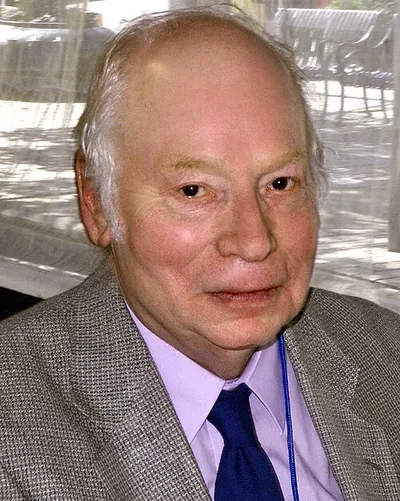 Steven Weinberg1933–2021 · Physics
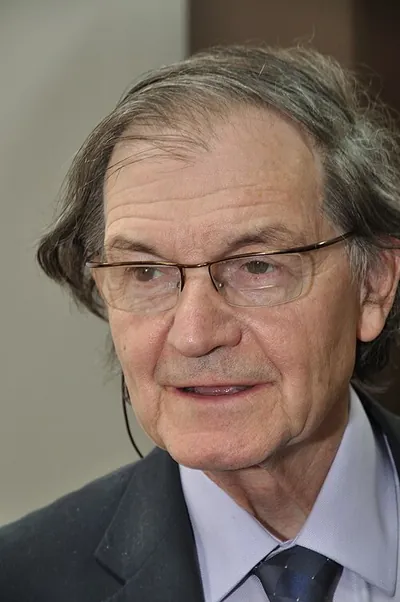 Roger Penrose1931 · Physics
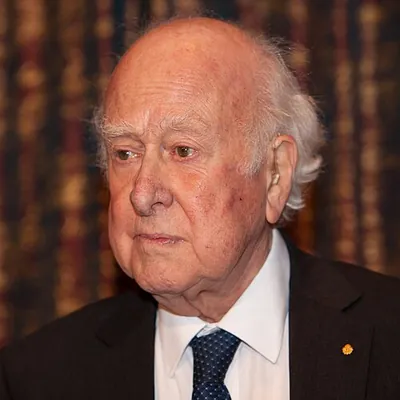 Peter Higgs1929–2024 · Physics
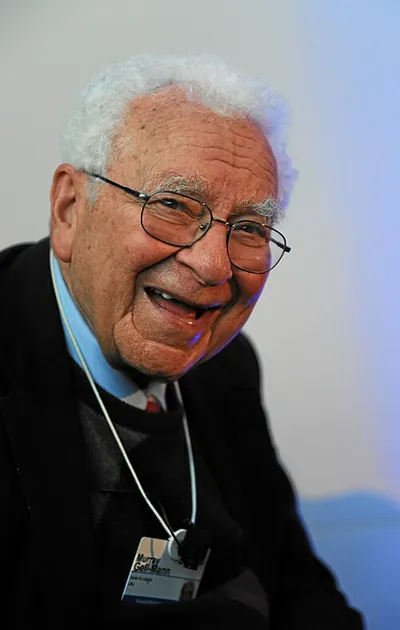 Murray Gell-Mann1929–2019 · Physics
